

 |
|
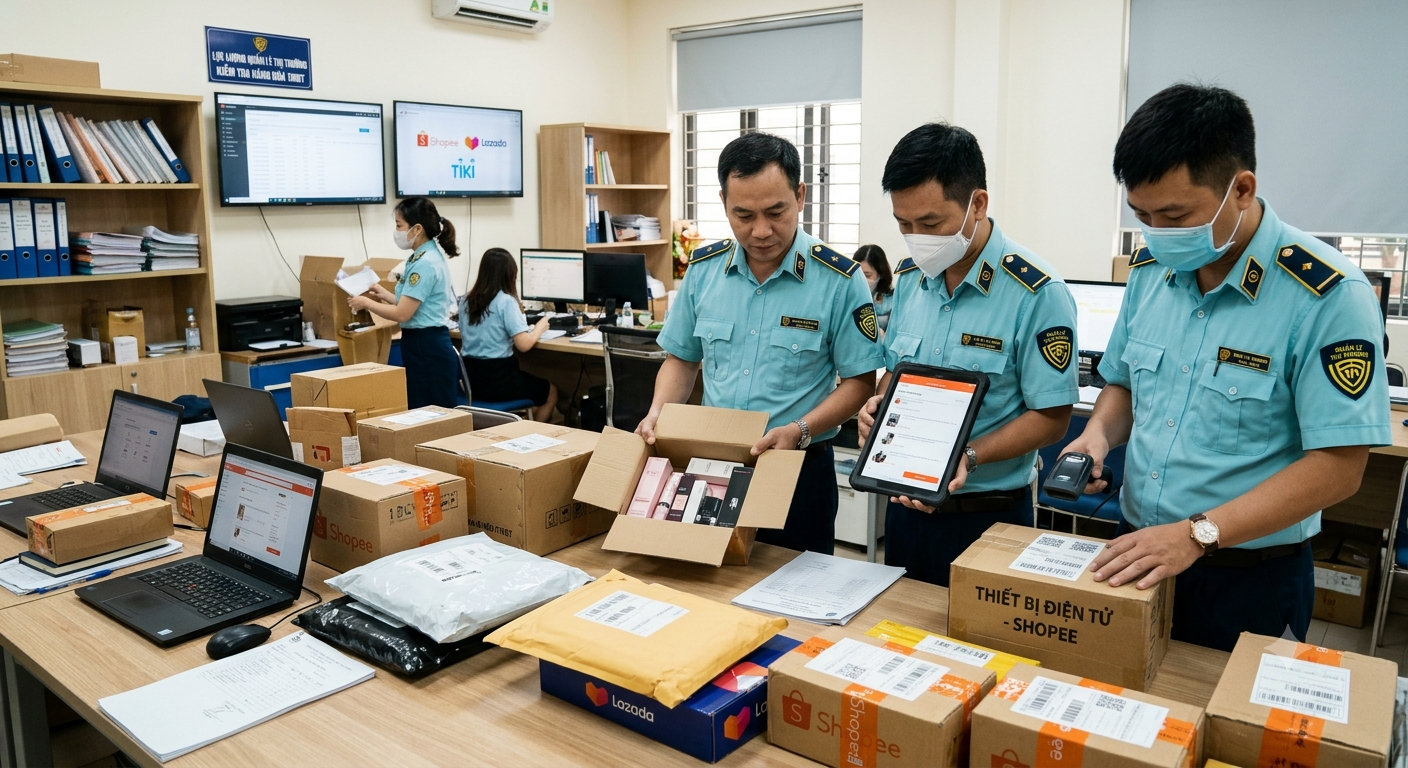
Tightening control over goods distributed on e-commerce platforms – Illustration created by AI |
Cybercrime is becoming increasingly sophisticated.
According to a report by the Hanoi Market Management Force, in the first 10 months of 2026, the unit handled 222 violations in the field of e-commerce, with the amount collected and administrative fines reaching over 4.4 billion VND. Notably, in October alone, the authorities inspected and handled 15 violations related to e-commerce, with a total administrative fine of 497.6 million VND. One case alone was fined 285.1 million VND, with the value of confiscated goods reaching 147.18 million VND. This fine accounted for more than 57% of the total administrative fines for the month, indicating that the nature and scale of some violations in the online business environment are no longer limited to minor offenses.
These figures reflect the efforts of authorities in inspecting, detecting, and handling violations, and also show the increasing pressure on management as buying and selling activities shift strongly to digital platforms. While traditional businesses have relatively clear locations, warehouses, and business entities, in the online environment, an individual or organization can reach a large number of customers without maintaining a physical store.
According to representatives of the National Steering Committee 389, this unique characteristic makes market control more complex. Sellers can use multiple different accounts, change store names, transaction addresses, or switch to other platforms when violations are detected. Meanwhile, goods are advertised, offered for sale, and traded at a rapid pace and with a wide distribution network, making it difficult to determine the origin, responsible party, and gather evidence.
Notably, violations are not limited to the trading of counterfeit goods, smuggled goods, or goods of unknown origin, but can also occur in advertising, product information provision, brand image use, and intellectual property infringement. Consumers often find it difficult to distinguish between genuine and fake products based solely on images, videos , or attractive online advertisements.
Mr. Nguyen Thanh Hung, a member of the Advisory Board of the Vietnam E-commerce Association, shared that when an infringing product is uploaded to an online platform, it can quickly reach thousands, even tens of thousands, of consumers. If not detected in time, the damage is not only to the value of the goods but also affects the rights of buyers, the reputation of legitimate businesses, and the competitive environment in the market.
Management pressure intensifies in the final months of the year, a time when consumer demand typically rises, especially for fashion , cosmetics, food, household goods, and items for the Lunar New Year. E-commerce platforms continuously launch promotional programs, discounts, and shopping events; livestreaming sales also become more active to stimulate purchasing power.
However, the booming market also creates opportunities for unscrupulous businesses to exploit misleading advertising, mixing counterfeit, fake, or products of unknown origin into online sales programs. Offers of deep discounts, products bearing famous brand names but lacking documentation proving their origin, or unclear seller information can put consumers at risk.
Unlike traditional business operations, violations on e-commerce platforms can spread very quickly. A single store can generate many orders in a short period, while post-transaction processing is often more complex. When a seller’s account is locked or deleted, tracing the business entity and determining responsibility can also be challenging.
Therefore, focusing solely on inspection and penalties once goods are in circulation on the market will make prevention efforts less effective. What is needed is control right from the stage of uploading products to the platform, verifying sellers, checking product information, and promptly detecting any unusual signs in transaction activities.
In light of the above situation, the Hanoi Market Management force stated that it will continue to strengthen inspections and handle violations in the field of e-commerce and online business, in conjunction with combating smuggling, commercial fraud, counterfeit goods, and intellectual property infringement.
At the same time, local management will be improved by proactively identifying product groups, subjects, and business methods with a high risk of violations to determine the focus of inspections in the final months of the year. This is a necessary approach to shift from widespread inspections to targeted monitoring, concentrating resources on areas and entities with high potential risks.
Shift from addressing violations to proactive prevention.
According to Dr. Le Xuan Thao, a lawyer and expert in intellectual property, the efforts of market management forces alone are insufficient to effectively manage the online market. The nature of e-commerce is an ecosystem involving many entities, from sellers and trading platforms to shipping companies and payment organizations. Therefore, the responsibility for control also needs to be placed within a coordinated mechanism.
First and foremost, e-commerce platforms need to enhance their responsibility in verifying seller identities, controlling legal documentation, and verifying product origin information. Stores showing signs of selling counterfeit goods, infringing intellectual property rights, or frequently receiving consumer complaints should be closely monitored. Removing infringing products should be accompanied by mechanisms to prevent repeat offenses, avoiding situations where a store that has just been penalized reappears under a different name.
Furthermore, regulatory agencies need to promote the application of technology in monitoring online business activities, analyzing transaction data, and identifying unusual signs. Connecting and sharing information between market management forces, tax authorities, police, and e-commerce platforms will help shorten the time for verifying and tracing the origin of goods and handling violations.
In particular, attention should be paid to inspecting high-risk product groups, stalls with unusual sales or transaction frequencies, livestream sales activities, and large-scale promotional programs during the year-end period. These are areas that need to be monitored regularly, rather than just being inspected periodically or waiting for complaints from consumers.
From the consumer’s perspective, choosing vendors with clear information, checking product origins, invoices, and sales documents are also ways to help limit counterfeit goods. Reports of products not matching advertisements, suspected counterfeit goods, or goods of unknown origin should be promptly provided to the authorities to assist in verification.
During the peak year-end shopping season, the goal is not simply to detect more cases or collect more fines, but more importantly, to prevent infringing goods from entering the market at the source, protect consumer rights, and maintain a healthy competitive environment. The rapid growth of e-commerce cannot be allowed to exceed market control capabilities. To achieve this, management must be one step ahead, preventing violations early and imposing sufficiently deterrent penalties on those who intentionally exploit the digital space for personal gain.
Start Selling Online with ShopOpen24
Are you a small business owner or entrepreneur? Discover seller opportunities and connect with customers through ShopOpen24.
Explore ShopOpen24 →ShopOpen24 | Local Products. Global Reach.














Leave a Reply