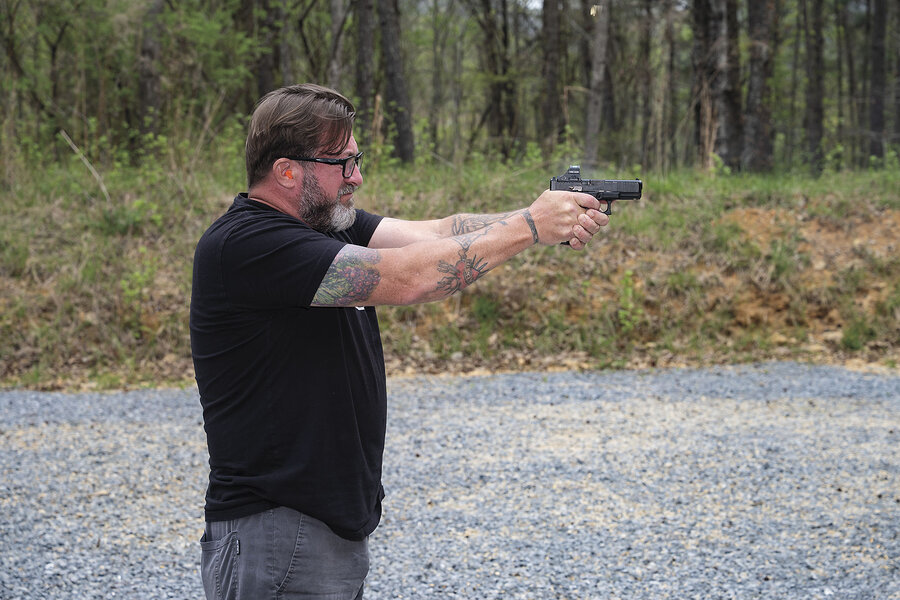
On a hillside outside Rome, Georgia, a sign on a small building announces a firm called Osprey Shooting Solutions, whose Latin motto translates to “In peace, like a wise man, he should make suitable preparation for war.” Next door is a dusty gun range where a man practices quick-draw fire with a trainer behind him. The pop-pop-pop of small-arms fire fills the air.
Rural ranges like this have often been seen as the purview of white conservative men, some of whom style themselves as citizen-protectors.
Yet owner Edgar Mills, a former Green Beret soldier, is a key player in what has become a noticeable shift in who owns firearms in the United States, and why.
Why We Wrote This
Rising gun ownership among Democrats is reshaping U.S. gun culture and recalibrating debates over gun rights, civic safety, and government control – even as Republicans remain 50% more likely to own firearms.
In the last couple of years, a growing number of women and people of color have begun training with Mr. Mills. His clients are conservatives, moderates, liberals, and those who defy simple labels altogether. His star student is Eva, a former infantry soldier who appears at the range in pink stockings and painted nails.
In some ways, Mr. Mills’ expansive view of gun ownership is still unusual in a firearm culture often associated with support for President Donald Trump and his villainization of Democrats and progressive politics. Yet those who see the Second Amendment’s right to bear arms as a bulwark against oppressive government are beginning to include liberals who increasingly find themselves in political – and social – crosshairs.
Laying out the welcome mat to Democrats and others who don’t fit a traditional conservative gun-owner profile has become good business, especially at a time when gun sales, which peaked at about 22 million in 2020, have slowed. Gun owners who lean left politically “are looking for an accepting place where people aren’t stink-eyeing them,” says Mr. Mills, whose solid physique hints at years of war-zone deployments. “Nobody wants to be in an environment where they’re not wanted.”
Across the U.S., gun ownership by people who identify as politically left of center is rising. One NBC News survey showed that the number of Democratic households with guns rose from 33% in 2019 to 41% five years later. Other studies confirm that gun culture is now far more diverse than is often portrayed in the media, and that Second Amendment activism is a key driver for many new gun owners.
Current events and politics, experts and observers say, are playing a role in who carries what and why.
A trend that began with women and Black people outbuying white men at gun shops during the COVID-19 pandemic accelerated with the fatal shooting of Alex Pretti in Minneapolis in January, according to liberal gun-rights groups. A legal gun carrier who never drew his weapon, Mr. Pretti was killed as he tried to help a woman knocked down by federal immigration enforcement agents. His death raised the stakes among some left-leaning Americans worried about armed agents trampling their civil rights.
In the process, some Americans have shifted from opposing guns to embracing them, setting up new political dynamics in a restive America.
“What has changed with Trump’s second term and the Alex Pretti incident is the idea that guns aren’t just for personal self-
defense, but may also be to resist government tyranny,” says David Yamane, author of “Gun Curious: A Liberal Professor’s Surprising Journey Inside America’s Gun Culture.” “This becomes a challenge for a lot of centrist liberals because they place a lot of faith in the state,” he adds. “Then they see what could go wrong if the state falls into the wrong hands.”
Why buy a gun?
Broadly, polls consistently show that Republicans support gun ownership at much higher rates than Democrats. At the Jan. 6, 2021, attack on the U.S. Capitol, one banner showed a Confederate battle flag with an assault-style weapon and the taunt “Come and take it.”
Democrats, by contrast, traditionally favor stricter gun laws. In 2019, when former Texas Rep. Beto O’Rourke declared, “Hell, yes, we’re going to take your AR-15, your AK-47” at a Democratic presidential primary debate to endorse a mandatory buyback program for assault-style weapons, the audience’s cheer drowned out the rest of his answer.

In recent years, gun ownership as a political statement – and for political reasons – has accelerated, with more citing the need for self-defense and liberal gun organizations seeing heightened interest. That sales growth has blunted the “Trump slump” for the firearms industry, which usually sees lower sales when gun owners feel confident that a new president is protecting gun-carry rights.
Professor Yamane, a sociologist at Wake Forest University in North Carolina, began studying gun culture a decade ago to understand its mainstream appeal. To better understand it, he ended up buying a gun himself. The move was unusual – and unpopular – among his peers, he says, and “has been a solitary experience.”
But he is not so lonely anymore.
While gun sales have fallen from a high-water mark in 2021, annual sales still hover around 15 million each year and are still higher than before the pandemic, according to The Trace, a nonprofit publication that reports on U.S. gun violence. Nearly 5 million guns were sold in the first four months of 2025, it says.
L.A. Progressive Shooters, a gun-education group in Los Angeles that welcomes people regardless of their politics, has had to expand its increasingly sold-out training sessions. Another nationwide group based in Newton, Massachusetts, the Liberal Gun Club, saw its membership rise by 66% – from 2,700 members to 4,500 – in the year before Mr. Pretti’s shooting. The organization passed its total 2025 training numbers in the first three months of 2026.
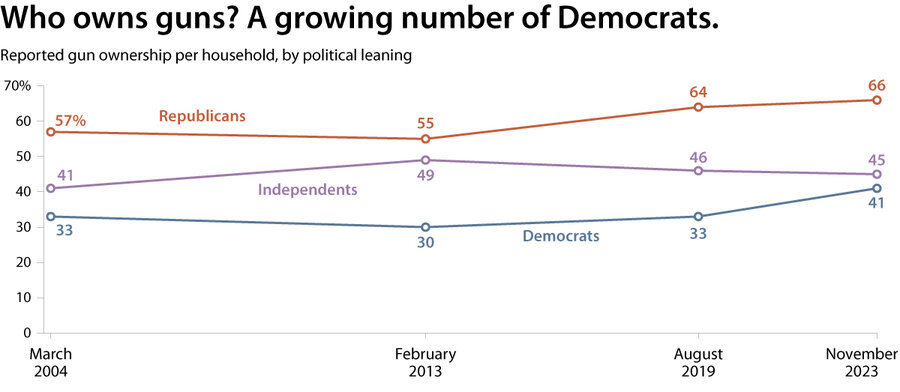
NBC News and Wall Street Journal polls
|
Jacob Turcotte/Staff
Some of the new gun groups eschew political affiliations. Others cater mostly to liberals.
In Shelton, Connecticut, for example, an organization named A Better Way 2A promotes gun rights for progressives and sells a variety of merchandise, including stickers that say, “You can’t vote away fascism. Buy a gun.” The Socialist Rifle Association, founded in Kansas in 2018, claims 10,000 donors and says it seeks to advance “an inclusive, safe and healthy firearms culture in America to combat the toxic, right-wing, and exclusionary firearm culture in place today.”
“Owning a gun now is not an automatic indicator that you’re most likely a conservative,” says Jordan Levine, co-founder of A Better Way 2A. “You have far more people who are politically involved – Gen Z and millennials especially – who see things and feel this dread that your most paranoid conservative gun owners have felt for so long. But now, it’s not liberals coming for your guns, but conservatives coming for our rights.”
Different views among Democrats
For those who see guns as problems, not solutions, the trend is jarring. Most researchers agree that stricter gun laws save lives, though Americans are still split on whether gun rights or gun control is more important.
Now, with the public on high alert about armed federal immigration enforcement, that debate, once confined largely to political circles, is now on Main Street.
“There’s something that has been lost with the aggressiveness of what’s happening,” says Dru Stevenson, a professor at South Texas College of Law in Houston. “We don’t know where the boundaries are anymore, and where do they stop?”
The shootings in January of Mr. Pretti and Renee Good in Minneapolis have crystallized those concerns and turned arguments for stricter gun rights upside down.
Conservatives’ concerns, once fueled in part by the National Rifle Association’s descriptions of federal agents as “jack-booted government thugs,” became visceral for liberals who watched the Trump administration’s immigration crackdown in Minnesota. Mr. Pretti was hailed as a hero among those on the political left for defending his community against federal agents carrying out a deportation agenda in a way many believed clashed with local values.
Videos have since emerged of armed Minnesotans standing guard in neighborhoods, including one in which a gun carrier says, “This is my area. … I protect my people.”
Many liberals identified with those protesting, says Edward Gardner, head of the Liberal Gun Club in Massachusetts. “Renee Good looked like a middle-aged soccer mom. Alex Pretti looked like an average white guy with a beard. [The killings] twinged something in people’s brains: If it can happen to them, it can happen to me.”
Guns as a common cause
But the question of whether calls for gun rights and regulations are evenly applied is a nuance embedded in the legal arc of the Second Amendment in American history.
The amendment has always been messy. The Founding Fathers wrote it in part to discourage tyrannical government. But in practice, it was mostly used to justify repelling Indian attacks on settlements and, in the South, to intimidate abolitionists. The Second Amendment might also be a reminder to respect other people’s spaces, suggesting a broader notion, as Mr. Mills, Osprey’s owner, puts it, that an armed society that is ready to defend itself may, in fact, be a better society.
For Mr. Mills, preserving expanded gun rights helps protect all Americans from government overreach. Not that he doesn’t worry about gun safety for the public at large. But that’s a quandary, he says, he cannot solve. “What we know about the government is, if you give them an inch, they take a mile.”