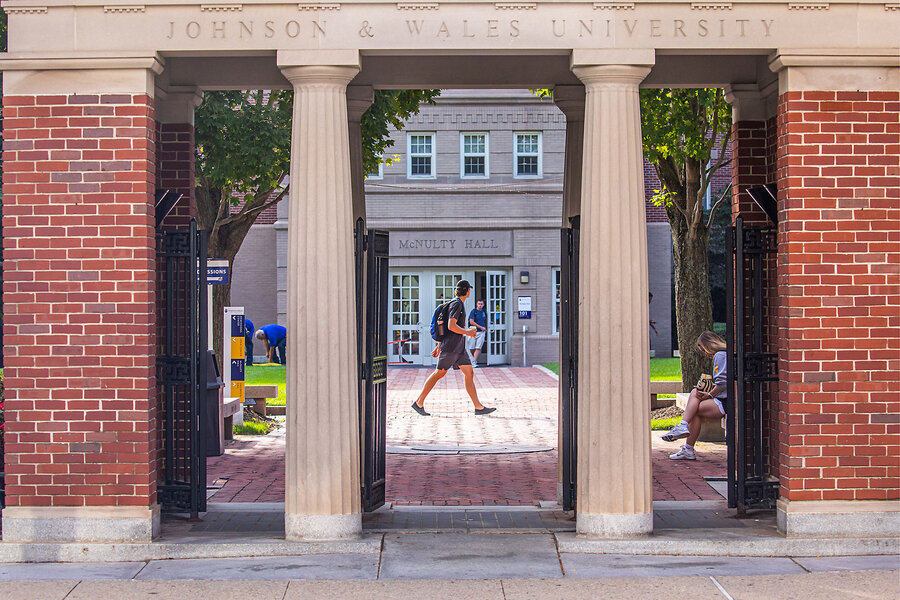
Unlike many first-year college students, Katie McPartlin has her life mapped out.
After she finishes her bachelor’s degree in criminal justice at Johnson & Wales University in Providence, Rhode Island, she plans to work as a corrections officer. Then, she’ll put her minor in psychology to use by training in forensic interviewing, a method of gathering evidence typically used with children and other vulnerable victims of crimes.
Also, unlike many college freshmen, Ms. McPartlin will complete her degree in three years.
Why We Wrote This
Three-year degrees offer students tuition savings and faster career entry. But questions remain over whether accelerated, narrowly focused coursework is preferable to a well-rounded education, and how these programs could affect society.
Students like Ms. McPartlin could soon become more common as more institutions consider offering three-year bachelor’s degrees. The goal of such programs, education watchers say, is to help students enter the workforce faster and with lighter debt amid soaring tuition.
“Since I need to do less credits to graduate, I don’t really have to take random electives like a lot of other people do,” Ms. McPartlin says. “It’s also one less year of tuition, which is very helpful.”
Although Johnson & Wales became the first institution of higher learning in the United States to offer an in-person, three-year bachelor’s degree last year, the trend is catching on. In February, the Massachusetts Board of Higher Education launched a pilot program allowing schools to propose such degrees. Similar initiatives have already made their way through North Dakota, Indiana, and Utah. All in all, some 62 institutions nationwide call themselves members of College-in-3, a nonprofit coalition of colleges and universities offering three-year bachelor’s degrees.
Yet in Massachusetts, a state famed for its high-quality schooling, the movement has revived an age-old debate about the purpose of higher education. Is college meant to prepare students for the workforce? Or to cultivate well-rounded, civic-minded people?
“My goal in my 20-plus years of teaching has been, ‘How do I develop the person?’ – not prepare them,” says James Leone, a professor of health at Bridgewater State University. He’s against three-year degrees. “We definitely need to have a market and have products that come from that market. That drives [the] economy, I understand that. But I work with my students because they are people.”
Schooling for both public and private good
For Noe Ortega, Massachusetts commissioner of higher education, the state’s pilot program is about threading the needle. Higher education, he says, should recognize that it can both create an informed citizenry and position students for successful careers.
“We’ve often seen this back and forth – between whether higher education is a private good for students,” he says, or “something that positions students to be active participants of society.”
“Our board has said both of those things matter,” he adds.
That’s part of what pushed the board to launch the pilot program after kicking the idea around for more than a year. Dr. Ortega also hopes to attract more adult degree-seekers, who may be reluctant to spend four years in college, and to boost affordability.
Over the last 30 years, the average price of in-state tuition at public, four-year universities has risen by more than 100%, and tuition at private, four-year schools has increased by 74%, according to a 2025 report from the College Board. At the same time, 40% of U.S. adults in 2024 told Pew Research Center that having a college degree was “not too or not at all important” for landing a high-paying job, and only 35% of Americans called a degree “very important” in a 2025 Gallup poll.
Amid that landscape, and increasing political rhetoric calling institutions of higher learning too liberal, people have grown leery of universities, says Beth Akers, a senior fellow at the American Enterprise Institute who researches higher education policy.
“The growing dissatisfaction among Americans right now is giving the sector and, I think, lawmakers, the cover to promote experimentation,” Dr. Akers says.
Cultivating well-rounded people
Richard Wiscott, provost at Johnson & Wales, says that for students with clear career goals, taking classes unrelated to their majors – often a requirement of liberal arts programs that aim to produce well-rounded, critical thinkers – can feel like a drag. That’s why the university offers focused, three-year degrees in career-oriented subjects, like criminal justice and hospitality management. About 96 people enrolled when it launched last fall, he says, and all of those students remain enrolled.

Scott Bowers/Courtesy of Johnson and Wales University
Still, Dr. Wiscott says he sees the three-year degree as a supplement to – not a replacement for – the traditional four-year degree. Both, he hopes, cultivate well-rounded people.
“I truly believe in the liberal arts and the foundation of general education. That sets the stage for success, regardless of what a student’s major is,” he says. “We don’t want to give up any of the core tenets or the core foundations of what a college education is about.”
But Dr. Leone, the health professor from Bridgewater State, says he worries that three-year program participants will miss out on experiences that broaden their horizons.
“We need people that are compassionate, empathetic thinkers, that make these connections that truly only happen in either direct experiences, or within courses that provoke that level of thought,” he says. “And those are the very things that we’re trying to rush the student through.”
Irina Seceleanu, a mathematics professor at Bridgewater State University, believes that such degree programs could exacerbate the very inequalities they seek to tackle.
“We’re in essence creating a two-tier track,” she says, because three-year degrees may appeal to low-income students seeking to save money while not opening the same doors as four-year degrees. “In a state like Massachusetts, where we didn’t make it to No. 1 by cutting corners, I really worry that we’re exaggerating inequities.”
Making four years more affordable
Dr. Seceleanu argues that the real affordability solution is not reducing degree length, but making traditional four-year degrees cheaper. She points to initiatives like free tuition at community colleges, a policy Massachusetts adopted two years ago amid a nationwide movement. Many universities here and in other states have also begun offering free tuition to students whose families earn below a certain threshold. Those include both private institutions, such as Harvard University, and public ones like Bridgewater State and the University of Massachusetts.
Ms. McPartlin, though, doesn’t feel like her degree is less than. She sees the three-year degree as a cheaper choice that positions her for the career she wants.
“I personally don’t feel like I’m losing anything,” she says.
McRae Wiederer, who recently completed her first year of veterinary school, says that she would have welcomed a three-year undergraduate degree.
“If it had been offered to me as a three-year option, I probably would have done it,” she says.
A Boston native, Ms. Wiederer saved money by using high school Advanced Placement credits to finish her bachelor’s degree at the Pennsylvania State University in 3½ years.
“Cutting off an extra semester of tuition helped me have more money saved to put toward vet school tuition, which is also really expensive.”
What about jobs?
Much about the future of three-year bachelor’s degrees remains unknown. Questions still swirl about the employability of those who complete three-year degrees and whether they will be competitive graduate school candidates.
Dr. Ortega emphasizes that the Bay State’s pilot program will help the state evaluate the long-term viability of these degrees.

Scott Bowers/Courtesy of Johnson and Wales University
Some, like Dr. Seceleanu, wonder whether universities may ultimately raise their prices to compensate for losing a year of tuition from students, offsetting any savings for the shorter program.
For Dr. Akers, the surge in three-year degrees is a positive sign for higher education. Colleges and universities have resisted change for too long, in her view, and this innovation may encourage more overall experimentation.
Some have criticized “how static higher education is as a sector,” she says.
“I think that’s shifting. And it’ll be interesting to see if that’s going to allow some of these new models like the three-year degree to really catch hold.”