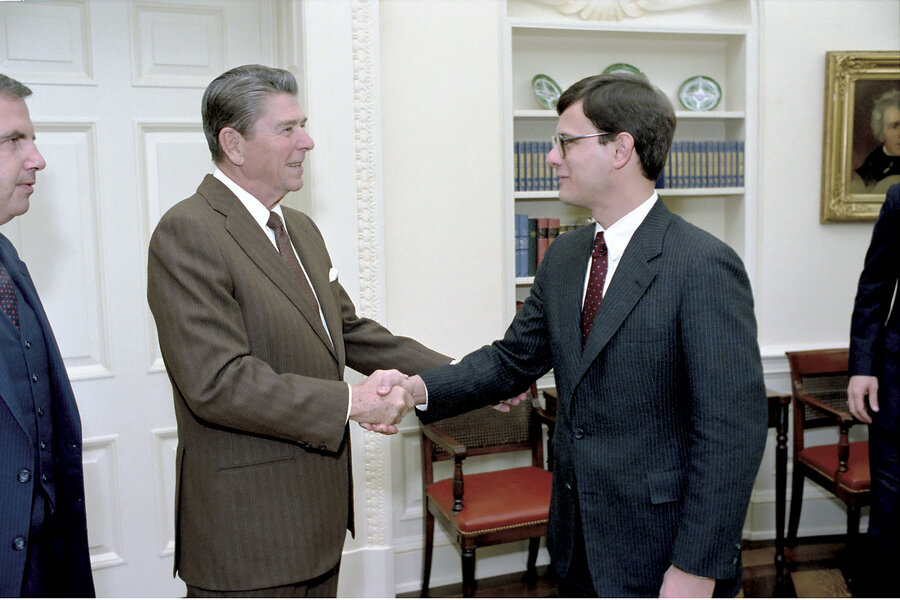
As young lawyers in the Reagan administration, future Supreme Court justices Samuel Alito and John Roberts entered an executive branch convinced that a powerful president could rescue the country after a humbling decade defined by Watergate, defeat in Vietnam, and runaway inflation. What the administration promised most of all was an answer to a generation of Democratic majorities in Congress frustrating Republican priorities.
The early 1970s saw Richard Nixon break new ground in his assertions of presidential power. He refused to spend an estimated $18 billion in funds appropriated by Congress. He authorized secret bombings of Cambodia. During Watergate, he sought to shield executive branch officials from congressional and judicial scrutiny with sweeping claims of executive privilege.
In the face of these moves by the White House, the other branches of government pushed back. Federal lawmakers passed new laws limiting the president’s ability to impound – meaning withhold or delay – funds appropriated by Congress, and to enter military conflicts without approval from Congress. A suite of federal laws strengthening executive branch transparency and oversight also passed in the late 1970s. The Supreme Court rejected the administration’s claims of executive privilege and presidential immunity.
Why We Wrote This
The story of how a constitutional theory grew in prominence reveals the evolving American debate about the presidency.
It was in this context that Ronald Reagan entered the White House as president in 1981, bringing with him a slew of young, conservative lawyers. These included not only the two future Supreme Court justices, but also figures who would go on to found conservative legal organizations such as the Federalist Society.
Reagan’s lawyers, alongside ideologically aligned law professors and think tanks, developed an intellectual framework for establishing the executive branch as above and apart from the other branches of government. The result: an expansive new vision of the separation of powers, underscored by a concept that emerged known as the “unitary executive theory.”
Broadly, the theory holds that the Constitution gives the president of the United States complete power over the executive branch, including personal authority over domestic and foreign policy, such as the ability to unilaterally remove government officials and enter military conflicts. The term soon popped into presidential vocabulary. Reagan used it six times in official statements and President George H.W. Bush 41 times. (Reagan Attorney General Edwin Meese frequently referenced the theory’s ideas. “Leaders in both branches have increasingly recognized that institutionally Congress is ill-suited to lead and that therefore a relatively strong presidency may be necessary,” read a 1986 report that Mr. Meese commissioned.)
Once a theory supported by a minority of jurists and legal minds, the unitary executive theory has shaped a succession of presidencies from both political parties. Over the past 17 months, Donald Trump has sought to push this theory’s view of presidential power further than any president in history.
“A lot of what Trump has done has been done before, but the magnitude is different, and it presages a new normal for presidencies going forward,” says Saikrishna Prakash, a professor at the University of Virginia School of Law and author of the book “The Living Presidency.”
“The direction has been there for 20 or 30 years,” he adds, “with modern presidents showing no hesitation to act unilaterally to implement their agenda in a host of ways that would have been unfathomable 100 or 200 years ago.”
The rise of the unitary executive theory is part of a grander story – the gradual rise of presidential power more broadly. Proponents argue that the trend represents a return to original intent; critics claim it threatens the separation of powers designed by the framers to preserve individual rights and democracy.
This constitutional power struggle has always existed. The Trump era is testing how far Congress, the courts, and the public are willing to empower the president to be the country’s singular problem-solver.
This month, the Supreme Court is expected to rule on several cases that touch on the extent of the president’s hold over the executive branch, and the power the executive holds relative to Congress and the courts. Those include whether Mr. Trump can fire a governor of the Federal Reserve or a commissioner of the Federal Trade Commission (FTC), agencies that Congress established to have semi-autonomy from the presidency.
With Justice Alito and Chief Justice Roberts on the high court – alongside Justices Neil Gorsuch and Brett Kavanaugh, who both served in the George W. Bush administration – some court watchers anticipate that the unitary executive theory will influence some major upcoming opinions.

Manuel Balce Ceneta/AP/File
Yet the Supreme Court in recent months has also set limits on President Trump’s executive power. The court ruled against his signature tariff policy in February and posed sharp questions to the government’s lawyer during oral arguments this spring over whether Mr. Trump’s executive order narrowing the definition of birthright citizenship is constitutional.
All power to the presidency?
How power should be divided among the legislative, judicial, and executive branches of government has defined the American experiment, with power swinging pendulum-like between the branches without ever vacillating too far in one direction.
Is the pendulum now swinging too far toward the executive? The rise of the unitary executive theory – amid other unilateral Trump actions accepted by Congress and the courts – suggests as much, according to critics.
Proponents of the unitary executive counter that it is part of a new equilibrium. The theory counters the growth of what they call the administrative state, the broad array of federal agencies, such as the FTC, created by Congress to operate independently – some say without accountability – within the executive branch. Another argument posits that a powerful, nimble president can protect the national interest faster and more effectively than the other branches.
“We’re definitely in a phase where the unitary executive is the dominant theory,” says John Yoo, who worked in the Justice Department’s Office of Legal Counsel during the George W. Bush administration.
“It’s a natural response to the concern that the administrative state has become too independent and too powerful and governs too much of American life,” adds Professor Yoo, who now teaches at the University of California, Berkeley School of Law.
But the theory also “ignores that the framers were deeply committed to checks and balances,” says Erwin Chemerinsky, who is dean of the School of Law at Berkeley.
“If you’re increasing the power of the president, you’re decreasing the power of Congress,” he adds.
Critics also point to what Article II of the Constitution doesn’t say. The document vests “the executive power” in the president, but does not use the term “all the executive power.” Article I,by contrast, vests “all legislative powers” in Congress.
But, the theory’s supporters note, the Constitution was crafted at a specific moment in U.S. history – after a 10-year experiment with the Articles of Confederation. Those articles created a weak central government with no separate executive branch (a product, at least in part, of the Founding Fathers’ fear of monarchical rule). State constitutions of the time, meanwhile, often put most power in state legislatures, with some states allocating executive power to a council of individuals.
“There’s a shift in thought from 1776 to 1787,” when the U.S. Constitution is beginning to be ratified, says Professor Prakash. “By 1787, the most successful state constitutions are the ones who have a powerful executive check on the legislature.”
Ultimately, the framers of the Constitution decided for a “unitary” executive, meaning an executive branch led by a single person, not a “council” of people.

And the framers still established checks on the president, especially when compared with a monarch, says Professor Yoo. The president is elected, and subject to impeachment and removal, for example. Presidents also don’t have the power to collect tax revenue and spend it how they see fit.
The American Revolution “was not anti-executive [power],” he adds. “It was anti-King George and anti-British empire.”
“That’s why the Constitution … restored a lot of executive power to what it had been. Because the framers thought that all of these experiments that had occurred after the Revolution had failed,” Professor Yoo continues.
Succession of presidents pushes the boundaries
Donald Trump isn’t the first president to experiment with the boundaries of executive power. Strong exertions of such power have waxed and waned throughout American history. A president pushes the envelope, then Congress and the courts rein him in.
Often, these shifts to greater executive power have occurred during times of crisis, such as war and economic collapse.
During the Civil War, Abraham Lincoln, citing war powers, suspended habeas corpus and ordered a naval blockade of Southern ports before Congress had officially declared war. After the war, when President Andrew Johnson vetoed congressional Reconstruction legislation he viewed as too hostile toward the South, the House impeached him.
Facing the successive crises of the Great Depression and World War II, Congress approved many of President Franklin Roosevelt’s sweeping policy goals. In creating new agencies such as the Securities and Exchange Commission and the Federal Deposit Insurance Corporation, for example, the legislative branch gave the executive greater control of domestic economic policy.
In addition to working with Congress, Roosevelt also took unilateral executive power to new heights. He issued more than 3,700 executive orders during his unprecedented four terms – including his infamous order to intern U.S. citizens and noncitizens of Japanese descent after Japan’s attack on Pearl Harbor during World War II.
Mr. Trump has also pointed to crises as he has flexed his powers as commander in chief, including unilaterally authorizing extrajudicial airstrikes against suspected drug boats in international waters, and waging war on Iran. Domestically, the president has cited other emergencies in an effort to exert even broader power, such as justifying mass deportations by proclaiming that the U.S. is being invaded by a drug cartel, and declaring a national emergency to justify a global tariff regime.
The Supreme Court struck down that tariff regime in February. For the most part, however, the high court has been deferential to Mr. Trump’s assertions of executive power and privilege. The personal backgrounds of most of the court’s six conservative justices help explain the rise of this vision of a more powerful, and unitary, executive branch.
A generational clash
When Mr. Roberts and Mr. Alito joined the Reagan administration in the early 1980s, “there was a strong conventional wisdom in the ’70s that the presidency had become too strong, and that Congress had become ineffective in checking its powers,” says Mark Rozell, dean of the Schar School of Policy and Government at George Mason University in Virginia.
On the other side, he adds, “It was common among conservatives of the 1980s [to think] that congressional reforms in the 1970s that constrained executive powers had gone too far.”
When these conservative lawyers began work in the Reagan administration, the balance of power hadn’t felt balanced to them. From the 1950s to 1981, Democrats had complete control of Congress, frustrating the policy goals of several Republican presidents.
During this period “Republicans [began to see] the presidency as the defender of conservative power,” says Mitchel Sollenberger, a political scientist at the University of Michigan, Dearborn.
“By the time you get to the Reagan administration,” he adds, “you get this full-blown focus on executive power.”

What resulted was a clash of generations on the ideological right that paved the way for the unitary executive theory to reach new heights under the Trump administration.
A key case arrived in 1988, in which a Supreme Court justice elevated the unitary executive theory.
The case, Morrison v. Olson, concerned a federal law that empowered the attorney general to appoint an independent counsel to investigate, and potentially prosecute, government officials. The law had been part of Congress’ post-Watergate effort to strengthen oversight of the executive branch. But, the Reagan administration asked, did that law violate the separation of powers? Did it allow Congress to wield executive branch authority?
In a 7-1 decision, the justices said it did not. In a lone dissent, Justice Antonin Scalia delivered what is now thought of as the first articulation of the unitary executive theory in a legal opinion. The independent counsel statute, he famously described, is not a wolf in sheep’s clothing but a wolf that “comes as a wolf.”
The vesting clause of Article II, he wrote with emphasis, “does not mean some of the executive power, but all of the executive power” belongs to the president.
“Since the statute vests some purely executive power in a person who is not the President of the United States it is void,” he concluded.
The majority in Morrison, led by conservative Chief Justice William Rehnquist, disagreed.
To claim that every executive branch official “must serve at the pleasure of the President and be removable by him at will,” wrote Chief Justice Rehnquist, “depends upon an extrapolation from general constitutional language which we think is more than the text [ of Article 11] will bear.”
The outcome in Morrison highlighted a generational divide, wrote Jeffrey Rosen, a law professor and CEO emeritus of the National Constitution Center, in a 2008 law review article:
“Conservatives who came of age during the New Deal era and its immediate aftermath viewed the presidency as a harmful institution, while those who came of age in the 1970s and 1980s viewed it as preferable to an overreaching Congress.”
By 2006, the unitary executive theory had gained a few more votes. In a case that year, the court ruled in a 5-3 decision that military commissions set up by the George W. Bush administration to try detainees held at Guantánamo Bay in Cuba were illegal. Justices Alito and Scalia joined a dissent written by Justice Clarence Thomas that said the majority opinion “openly flouts our well-established duty to respect the Executive’s judgment in matters of military operations and foreign affairs.” (Justice Alito, who joined the Court that year, had been peppered with questions by senators about his views on the unitary executive theory during his confirmation hearing.)
Today, Justice Scalia’s solo dissent in Morrison “would be embraced by a majority of the justices,” says Professor Chemerinsky.
From the Bush White House to the Roberts court
Similar to the Reagan formula, the Bush administration’s assertions of executive power in the war on terror would be advanced by a cadre of young, conservative lawyers who are now shaping the separation of powers.
One of those lawyers was Professor Yoo, who as deputy assistant attorney general from 2001 to 2003 authored a series of legal memos arguing that, under an expansive view of presidential power in wartime, what were often called “enhanced interrogation techniques” were legally permissible.
Justice Gorsuch, Mr. Trump’s first appointment to the Supreme Court, spent a year in the Bush Justice Department defending the torture of terror suspects, as well as their detention without charge at Guantánamo Bay.

Mr. Trump’s second appointment to the court, Justice Brett Kavanaugh, worked as a lawyer in the Bush White House, an experience that he has said gave him a deep appreciation for the daily challenges facing the president.
“The job of the president is extraordinarily difficult,” he said during a 2015 speech. “Every decision seems to be between really bad and worse.”
Between Republican administrations, which cited the unitary executive theory, Democratic presidents also embraced unilateral presidential power, despite those presidents not openly referencing the theory. President Bill Clinton, for instance, continued to have the White House review all proposed agency regulations and allowed an independent counsel statute – the law at issue in the Morrison case – to expire. He also deployed U.S. troops to Bosnia without congressional authorization.
In 2014 – which he dubbed his “Year of Action” – President Barack Obama, frustrated by congressional inaction, leaned into unilateral decisions. In a series of executive orders, he raised the federal minimum wage, shielded the children of unlawful immigrants from deportation, and implemented fuel-efficiency standards for automobiles. “I’ve got a pen, and I’ve got a phone. And I can use that pen to sign executive orders and take executive actions and administrative actions that move the ball forward,” he said that year.
Justice Kavanaugh joined the court in 2018, and a series of decisions expanding presidential power have followed.
That year, the court had upheld Mr. Trump’s travel ban – an executive order issued to restrict entry to the U.S. for nationals of a half-dozen countries in Africa and Asia, as well as Venezuela. The law at issue in the case “exudes deference to the President in every clause,” wrote Chief Justice Roberts in the majority opinion.
In 2020, the court delivered a victory that unitary-executive supporters had been waiting decades for. In Seila Law v. Consumer Financial Protection Bureau, the court broadened the president’s power to fire the directors of independent executive branch agencies without cause.
Chief Justice Roberts penned the majority opinion in that case, too. “The President’s power to remove – and thus supervise – those who wield executive power on his behalf follows from the text of Article II,” he wrote.
The chief justice’s writings on the unitary executive before he became a judge are few and far between – one memo he wrote in 1985 took a dim view of the president’s impoundment authority – but the high court’s recent promotion of broad presidential power has been written by his hand. This includes the court’s biggest separation-of-powers decision so far this decade: the ruling on presidential immunity in Trump v. U.S. in 2024, in which he warned against “enfeebling” the presidency, writing that “the system of separated powers designed by the Framers has always demanded an energetic, independent Executive.”
“If anyone has been driving this train, it’s the Roberts court,” says Professor Yoo. “All Trump is doing in these cases is quoting the Roberts court back to itself.”
Looking ahead
This summer, the court is expected to strike down another precedent interfering with the president’s removal power. The 1935 ruling in Humphrey’s Executor v. U.S. barred the president from firing without cause the leaders of independent agencies with bipartisan boards.
Yet this year could also reveal an outer boundary to presidential power that the Supreme Court will not push beyond.
That boundary has already been marked in one case. In February, the Supreme Court struck down Mr. Trump’s emergency tariffs regime as an unlawful misinterpretation of a Nixon-era statute. The justices also sounded skeptical of Mr. Trump’s claim that he can reinterpret the birthright citizenship clause of the 14th Amendment to exclude the children of unlawful migrants. The court also questioned Mr. Trump’s attempted firing of a member of the Federal Reserve’s board of governors.
And while the unitary executive theory has gained traction amid a polarized Congress and a friendly judiciary, Professor Prakash of the University of Virginia thinks that voters have also had a hand in making the president seem like the singular representative for the U.S. government.
“We vote for [presidents] who’ve promised things they have no authority to implement,” he says. “If we have an inflated expectation of what the president can do it’s not surprising that the president then acts on those inflated expectations.”