Fifty years ago, Don DeCosta and his family came from California to Washington, D.C., to celebrate the country’s 200th Independence Day in style. A teenager at the time, Mr. DeCosta was impressed by the historic sites, reenactments, museums, and fireworks. He thought he’d like to come back again someday.
Now retired, Mr. DeCosta is in Washington once again for the “America 250” celebrations, and he decided earlier this week to take a look at the Great American State Fair on the National Mall. The fairgrounds were better attended than he expected, he says. The only other thing that makes this Independence Day different from the one in 1976? How polarized America has become, he says with some sadness in his voice.
“We are fairly divided these days, and the division comes from the top, I have to say,” Mr. DeCosta adds. “That has to end. Until we can solve that, we’re going to be torn apart.”
Why We Wrote This
America’s 250th birthday is an invitation to celebrate ideas of freedom and independence that changed the world. But today, many Americans believe the country’s foundational values are under threat, prompting a national feeling of concern as much as revelry.
Every Fourth of July, the nation’s capital fills with tourists from across America and the world. More than 27.2 million people came to Washington in 2025, and, in part because of the America 250 festivities, this year is expected to see similar, if not better, numbers. Official attendance numbers have not been released.
Yet, though many Americans will spend the holiday weekend in traditional ways – such as at family barbecues, in city parks watching fireworks, or traveling to historical sites of the American Revolution – many say they feel uneasy about their country. Why? Growing political polarization, lingering concerns about the war in Iran, and the effects of rising costs of living and uncertain job opportunities.
A new Marist poll for NPR and PBS found that Americans remain proud of their country. But one-third are worried about its direction, and 83% feel that the U.S. has drifted away from its founding principles.
In June 2026, the Pew Research Center found that 69% of Americans were dissatisfied with how things are going in America, and a December 2025 Pew poll found that 59% felt that the nation’s best days are behind it.
Though people like Mr. DeCosta are making a point of celebrating the nation’s 250th anniversary, a Marquette Law School poll in June found that many Americans seem tuned out about the celebrations: Only about one-quarter had read or heard a lot about the semiquincentennial, while 57% had heard only “some” information about it.
“The public’s mood is pretty sour,” says Gregory A. Smith, a senior associate director of research at Pew. Hyperpartisanship appears to be a big driver, Mr. Smith says. “Lots of people think the nation’s political divisions will get worse.”
“But it’s not all sour,” Dr. Smith says. “There are also signs of some enduring optimism.”
In fact, more than two-thirds – 68% – of respondents said they felt hopeful about their country’s future, he says.
On a recent weekday morning, the National Mall thrummed with activity. Many families scurried with their children to see dinosaurs at the Museum of Natural History or space capsules at the National Air and Space Museum. Others, often clad in red, white, and blue, made their way to the Great American State Fair.
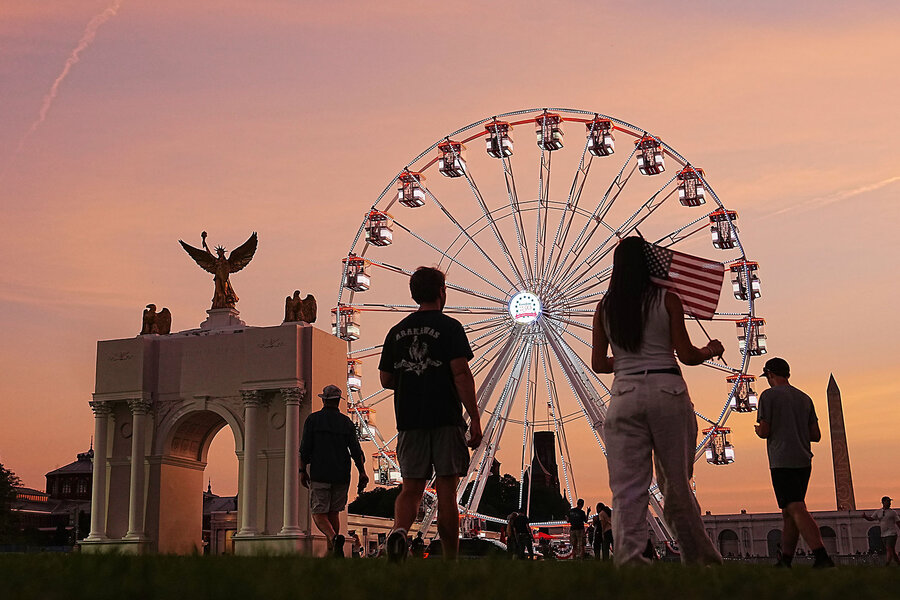
The lawn of the Mall from the Washington Monument to just in front of the Capitol building is surrounded by a chain-link fence. Inside, pavilions for U.S. states and territories showcase their heritage, landscapes, and cultures through interactive displays. (Some states opted out.) Also on offer are food and water stations, a temporary arch, a concert stage, and a Ferris wheel that, on this day, was having technical issues.
On a sidewalk in front of the Agriculture Department building, which faces the Mall, Diana, a retired federal employee from Springfield, Virginia, was making her way to the fair. She also planned to visit the Lincoln Memorial and the Jefferson Memorial, and then “get out of town before the heat hits.”
She says she grew up on U.S. military bases around the world and feels “strongly celebratory” as she heads into the July Fourth weekend.
Diana declined to share her full name. But she did share some of her hopes and concerns.
“We need more people to love our country,” she says.
“I’m sad for all the hatred. I’m sad for our country. We are so blessed, and there is so much opportunity for good in this country. We just need to work on the division. I don’t know how to fix it, and I don’t know if a member of Congress can do anything about it.”
Mr. DeCosta, the retiree, says he has now been to the nation’s capital enough times to have seen everything he wanted to see. So, it just made sense this time to check out the fair and see what everyone was talking about.
The heat of a Washington summer largely kept attendees moving from air-conditioned pavilion to air-conditioned pavilion, which might explain why the mall’s green grass expanse looks empty in news photos.
“If you come to Freedom 250, you can be assumed to be on one (political) side,” Mr. DeCosta says, referring to the fact that the fair is a Trump administration production. He says that when he told friends he was coming to Washington to see the fair, they worried about him. “My red-hat friends said, ‘Aren’t you afraid you’ll get caught up in protests?’ My blue friends said, ‘Aren’t you afraid you’ll be surrounded by red hats?’”
Even his wife refused to join him, but mostly because she doesn’t like crowds. Mr. DeCosta smiled and looked around. “But guess what? No crowds.”
As much as he worries about America’s current mood of division, Mr. DeCosta says that the Fourth of July is a time for celebration.
“I’m from California, so there might be some assumptions about where I stand. But I’m still a proud American.”