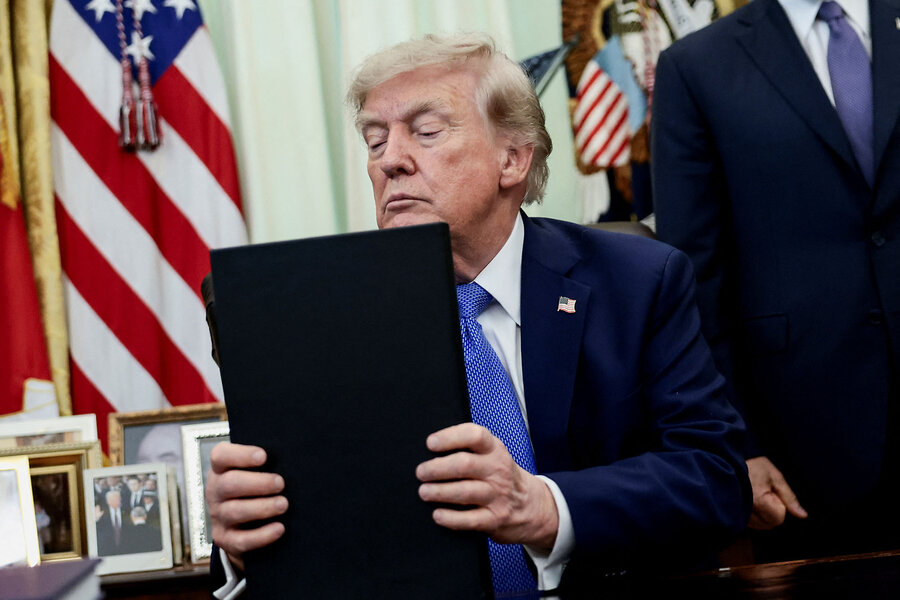
President Donald Trump is making a fresh attempt to limit birthright citizenship after losing on the issue at the U.S. Supreme Court in June.
A pair of executive orders signed Thursday take aim at specific groups of foreign parents. One tries to narrow automatic citizenship for children of parents with certain ties to foreign governments. The other directs a crackdown on what the administration defines as “birth tourism,” the practice of coming to the United States for the purpose of giving birth.
Legal experts question the legality of the president’s latest action in light of the Supreme Court’s rebuke, on constitutional grounds, of one of his past orders. They also expect more litigation against the White House, with a possible return to the nation’s top court.
Why We Wrote This
Weeks after the Supreme Court foiled one attempt, President Donald Trump is again trying to limit birthright citizenship. He has issued two executive orders targeting people who come to the U.S. for the express purpose of giving birth, as well as others, including the children of “alien enemies.”
The order trying to narrow birthright citizenship “is very unlikely to succeed,” says Nicole Hallett, director of the Immigrants’ Rights Clinic at the University of Chicago Law School. “The Supreme Court made it very clear that [Mr. Trump] did not have that power.”
Still, his executive action appears to signal that “the right is not going to give up this issue,” she says. “They view this as a generational fight.”
Others see more of an opening for the White House to get its way.
The latest actions by Mr. Trump “probe for weaknesses or open questions that remain” after the Supreme Court ruling in Trump v. Barbara earlier this summer, says Andrew Arthur, resident fellow in law and policy at the Center for Immigration Studies. For one, he says, it’s “long been accepted” that children of “alien enemies” aren’t entitled to birthright citizenship.
“There will be some very interesting cases that will come out of this,” Mr. Arthur says.
A Day 1 priority
Virtually everyone born in the United States is a U.S. citizen. Children of foreign diplomats are an exception.
On his first day back in office in January 2025, Mr. Trump signed an order that claimed automatic American citizenship didn’t extend to children born to parents in the U.S. unlawfully or temporarily, such as on a visa. He directed federal agencies to withhold documents recognizing U.S. citizenship from people born under those circumstances.
In June, the Supreme Court struck down that order, holding that the Constitution grants birthright citizenship to people born in the U.S. regardless of immigration status.
“We had a very unfortunate decision in the Supreme Court concerning birthright. … So, we’re making adjustments,” Mr. Trump said at the White House on Thursday.
His latest order repackages his first, but this time targets children of immigrants deemed alien enemies, foreign government employees, and those who try to buy citizenship for their child, as well as children of noncitizens born in U.S. territories. The order claims to affect children not covered under the Supreme Court’s June decision.
Among other concerns, some legal experts point to the government’s broad discretion over who counts as an alien enemy. Those include “members” of foreign terror groups, Mr. Trump’s latest order notes. Last year, the White House used contested claims of terrorism ties to send Venezuelan men to a Salvadoran prison with little due process.
“Courts have shown incredible deference to the secretary of state’s authority to designate foreign terrorist organizations,” says Wadie Said, a professor at the University of Colorado Law School. Though he doubts there are many members of those groups in the U.S., he says, Democratic and Republican administrations alike “have employed that trope for political purposes.”
While Mr. Trump has bashed birthright citizenship for more than a decade, most Americans support it, polling shows.
“If you really want to rewrite the birthright citizenship clause of the 14th Amendment, the best way is to rewrite” it, says Sandra Rierson, professor at Western State College of Law, though she doesn’t endorse the change. That would require a constitutional amendment.
Increasingly, some Republicans have argued that guaranteed citizenship at birth encourages not just illegal immigration, but “birth tourism” – a practice that is real but rare.
Birth tourism
Another order signed Thursday directs the Departments of State and Homeland Security to crack down on people or organizations suspected of enabling birth tourism. Mr. Trump defines that term as visa-holders entering the U.S. for the purpose of giving birth, or noncitizens assisting their entry.
While the birthright citizenship order appears to go “beyond what would be allowed by Trump v. Barbara,” the birth tourism executive order “doesn’t seem like a wrong-headed or novel approach,” says Denise Gilman, director of the Immigration Clinic at the University of Texas School of Law. Birth tourism can – and should – be tackled through “regular visa issuance and enforcement,” she says.
It’s not illegal for foreigners to give birth in the United States. But lying in the visa application process about intentions for travel – such as if the goal is to give birth in the U.S. – is considered fraud.
Estimates of its prevalence vary.
As of 2024, the U.S. government reports around 3.6 million births a year, including some 9,600 births (less than 1%) to foreign residents in the U.S. and its territories. The Center for Immigration Studies, a think tank that favors restricted immigration, has estimated some 20,000 or more annual “birth tourists.”
The president’s order says birth tourism diverts consular resources away from “legitimate visa applicants,” and erodes public trust in the “faithful enforcement of the immigration laws.”
When challenging birthright citizenship before the Supreme Court, the government argument “focused quite a lot on birth tourism,” says Colleen Putzel-Kavanaugh, an associate policy analyst at the Migration Policy Institute.
Both directives signed by the president Thursday are broad, she says, with more changes likely to come as they are implemented.
“The devil is always in the details.”