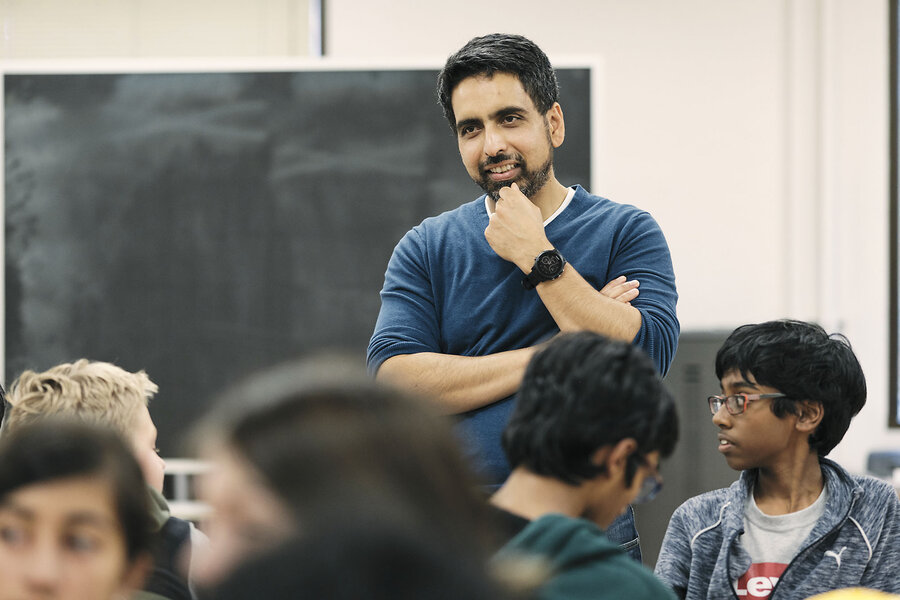
Sal Khan, the founder of Khan Academy, is arguably the most visible figure in U.S. education. He’s drawn praise from figures such as Microsoft co-founder Bill Gates and former first lady Michelle Obama, his 2011 TED Talk on reinventing education garnered some 6 million views, and his free online tutorials have racked up billions of views on YouTube.
So observers took notice, when, in May 2023, Mr. Khan declared in another TED Talk that artificial intelligence represented “probably the biggest positive transformation that education has ever seen.” He understood that AI could help students cheat, but he also argued it was capable of personalizing lessons for every student, essentially providing every child with a customized, digital tutor.
Mr. Khan developed a chatbot called Khanmigo after being given early access to ChatGPT. He touted the tool in a “60 Minutes” television segment with Anderson Cooper, was featured in the book “AI for Good” by Atlantic staff writer Josh Tyrangiel, and penned his own book, “Brave New Words: How AI Will Revolutionize Education (and Why That’s a Good Thing).”
Why We Wrote This
Sal Khan, the founder of Khan Academy, touted the transformative potential of artificial intelligence in tutoring students back in 2023. It has proved more challenging than he expected, but he retains his optimism.
But the revolution has not yet materialized the way Mr. Kahn predicted.
In an April interview with the news site Chalkbeat, the YouTube star acknowledged that “for a lot of students,” Khanmigo “was a non-event.” Many “just don’t use it much,” he said. Still, he remains bullish on AI’s future in education.
He sat down with Monitor AI Bureau Chief Aaron Glantz in July. Here are excerpts of their conversation, lightly edited for clarity and brevity.
Aaron Glantz: When I started reporting on AI and education, everyone pointed me to you because you were working with ChatGPT before it was known to most people. So I’m curious, what have you learned over the past few years?
Sal Khan: From the beginning, we were very careful that the AI wouldn’t give answers, that it would be Socratic; it would nudge you forward; it would provide teachers and parents with transparency as to what was going on. But what we realized is that for a lot of students, just having that extra layer of support wasn’t enough. Imagine I walk into a classroom and I say, “Hey kids, my name is Sal. I think I’m a pretty good tutor. I’m just going to sit in the back of the room here, and if any of you have any questions, I’m happy to help you.” Well, you can imagine what would happen. Some of the kids maybe would leverage it, but a lot of kids might be too embarrassed. They wouldn’t know how to do it.
The easiest thing for the student to do is cut and paste the Google search’s AI summary and they’ll have the answer. You’re offering a different path, but the students didn’t necessarily engage in the way that you had hoped, right?
Yeah. When we launched Khanmigo in 2023, we were already acutely aware ChatGPT was going to be a cheating nightmare. We have observed kids in classrooms doing Khan Academy. Then they’d go to another ed tech tool that the district is paying for, throw the Khan Academy question into that, and get the answer.
But I was thinking, “OK, if we had resources, what would a human do?” At some point, I should go walk up to the students and observe what they’re doing. When they get a question wrong, they might be embarrassed to ask me. But what if I went proactively to that student and said “Look, Billy, I saw that you just got that question wrong. Why don’t you and I work on that a little bit?” That’s essentially what we have evolved into. We piloted a new version last year, and now we’re rolling it out to millions of students around the country. When you get a question wrong, the AI says, “Hey, why don’t you work with me a little bit on this question?” And [the teacher can then say:] If you can show me that you really understand it, I’ll give you credit for it.
But you have to get the student to actually engage with the bot and want to learn.
Exactly. What you’re describing is not unique to AI. I hate to say it. Even putting all technology aside, there’s a lot of classrooms where kids are pretending to pay attention.
This is why we have been partnering with teachers and districts so closely – because we see that when teachers make it part of the assignments, that drives engagement for most students. The first version of Khanmigo was completely optional. Now, it’s actually in the student’s incentive to work with the AI because if the AI deems that you know it, now you’ll get credit for it.
Imagine a class of 30 students, all working on their different things. We highlight to teachers that these five kids are really struggling with negative exponents. And we can now tell the teacher, “You don’t have to slow down all the other 25 kids, but you take these five kids aside and assign a tutoring session with Khanmigo on negative exponents.”
AI has problems with judgment and bias. How do you think about what AI is good for now?
Humans also have a lot of bias. There actually have been studies about how human beings grade students differently based on their perceptions of them. I don’t say that to dismiss the fears of AI. I just also want to say the bar shouldn’t be perfection. The goal is: Could you have a system that’s more consistent and less biased than the status quo? Even if you had an amazing English teacher, who gives very consistent and good feedback, if that teacher has to grade 100 papers on “The Great Gatsby,” it’s going to take them a week or two, and in many cases, the limiting factor on how much feedback you can get depends on how much bandwidth the teacher has, and the teacher … is spending so much time.
We do not do AI grading of full papers yet, but we do have a system that gives AI feedback on papers, and I do think in the next year it will be possible to do pretty solid rubrics-based grading. The benefit of a technical system is that you can benchmark it. You can test it for bias – checking whether details like a family’s cultural background in any way change the feedback that is given.
We don’t really have a centralized education system, and local school officials and teachers often lack information they need to make a smart decision about AI.
What you’re describing is very real. I’ve been telling every university and every school district, regardless of whether they’re using Khan Academy or if they want to go completely nontech or not, I’m like: Assume kids are using AI for any take-home assignment. Even in the classroom, like when kids are on a computer screen, you need to very carefully monitor what they’re doing – even things as basic as Google are AI now.
If you leave a laptop on kids’ desks all day, nothing good’s going to happen. What we should say is: OK, we want these kids to learn math, get a lot of reading comprehension practice, write a lot and get a lot of feedback, and let the teacher spend energy on the human work of teaching – things no technology can do. You can use technology like Khan Academy to drive personalized practice.
Don’t just believe. Look at things that have a base of evidence. For example, we worked closely with Newark Public Schools. They’ve been deep with Khan Academy for about four years, and Khan Academy is a major part of why Newark is now seeing three times the growth in math compared to the state of New Jersey, despite being one of the state’s poorer districts. It’s because of the way they have integrated the tech with human teachers.