
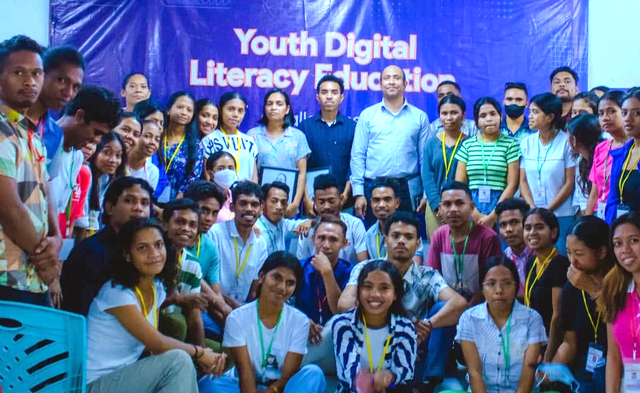

Ask how ready Timor-Leste’s young people are for artificial intelligence and the honest answer splits in two. They use it more than almost any peer group in Southeast Asia. They can do less with it than almost any peer group in Southeast Asia.
Both things are true, and the distance between them is the whole story.
UNESCO’s 2025 AI Readiness Assessment for Timor-Leste, produced with Catalpa International, reports that 98% of survey respondents had heard of AI and 55% used it daily. Timor-Leste is also the youngest country in Southeast Asia, with a median age around 21.
Put those together and you get the story everyone wants to tell: a digitally native generation, already fluent, ready to leap. I want to take that story apart, because it mistakes the one thing these young people can do for the many things the country has never built.
Headline Numbers Measure a Survey
Start with what the 98% and 55% actually describe. They come from an online survey of 120 respondents that the report says targeted public service staff, private-sector professionals, students, educators, researchers, and development-agency officials.
That is a sample of the connected, literate, mostly urban slice of the country. It is not a representative sample of Timorese youth, and the report never claims it is. The youth-specific work was a separate human-centered design session with 25 youth representatives, rich in texture and thin in numbers.
Sign Up Now for more digital development insights
This matters because the report’s own findings describe who gets left out: rural populations, women constrained by cultural norms, people with disabilities, and anyone who speaks only Tetun or a local dialect.
Timor-Leste has the largest gender gap in mobile phone use in Southeast Asia. A survey of the already-connected cannot tell you the readiness of a generation, most of whom live outside the sample frame. Read the 55% as what it is: evidence that the wired minority uses AI heavily, not proof that the median 19-year-old in Ermera does.
Adoption Requires Nothing of the State
Even taking the enthusiasm at face value, high adoption is the least demanding signal of readiness available. Using ChatGPT needs a phone, a data bundle, and a foreign model that someone else trained and pays to run. It asks nothing of the country the user lives in.
The global evidence makes this concrete.
A study of generative-AI diffusion in World Development found that within sixteen months of launch, ChatGPT reached 209 of 218 economies, with middle-income countries supplying over half its traffic. The strongest predictors of national uptake were income, digital infrastructure, human capital, English fluency, and a young population.
Timor-Leste scores low on every one of those except youth, and still reports heavy use. None of that signals readiness. It shows a young population reaching a free product over borrowed pipes.
I have made this argument about the continent I usually cover. AI Preparedness Index shows the Global South is not ready and it makes the same uncomfortable point: coverage and usage stats hide the absence of everything underneath. Being a fluent downstream user, the term the report itself uses for Timor-Leste again and again, describes dependence rather than capability.
Indonesia Built the Floor. Timor-Leste Youth Have the Phone.
The comparison the question invites is instructive, as long as we are honest about what is and is not comparable.
On raw adoption, Timorese and Indonesian youth look alike.
Deloitte’s 2024 survey of nearly 3,000 university students across Asia-Pacific found 90% of Southeast Asian students had used generative AI, Indonesia included, and Indonesia ranks among the top five economies worldwide for ChatGPT traffic.
Timor-Leste’s 55%-daily figure, drawn from a different and far smaller survey, sits in the same enthusiastic range. A clean head-to-head on usage does not exist.
The divergence is underneath the apps.
Indonesia has run a National AI Strategy since 2020, Stranas KA, now paired with an implementation plan for 2025 to 2029 that puts compute and data infrastructure at its core, a median age of 29, and a rank of 42nd on the Oxford Insights Government AI Readiness Index.
Timor-Leste has no national AI strategy. AI is not mentioned in Timor Digital 2032, the strategy it is only now revising. It has no GPUs or TPUs, aging 3G and 4G with no 5G and about a third of the population online, and it ranks well below Indonesia among the ASEAN states that same index flags as least prepared.
So when an Indonesian and a Timorese teenager both close ChatGPT, they return to different countries.
One returns to a state building compute, curricula, and a labor market that might one day hire her to build models. The other returns to a submarine cable whose bandwidth has not yet reached his community, a data center with no capacity to train anything, and a government that uses less AI than he does.
The gap between the two youth populations has nothing to do with the app and everything to do with what waits for them after they close it.
Models Barely Speak Their Language
There is a lingustic capability gap. Tetun is a low-resource language for the models these young people prompt all day. The dedicated service Tetun dot org reports 70,000 monthly active users translating over a million documents a month, most of them pulling English into Tetun.
Google added Tetun to Translate only in 2024. The report warns that competing large language models, each trained differently, could deepen the fragmentation of a language that was never fully standardized to begin with.
A generation that uses AI fluently in its second or third language, on tools that render its own language poorly, is not a portrait of readiness. It is a population bending itself to the tool because no one has resourced the tool to bend toward them.
What Youth Readiness Requires
Calling these young people AI-ready because most of the connected ones use ChatGPT sets the bar where it costs the state nothing. Real readiness is a set of things only institutions build, and the report names most of the actors who would have to build them.
- The Ministry of Transport and Communications is revising Timor Digital 2032 right now. If that revision fails to put AI, compute, and Tetun-language data at its center, the best chance to move youth from consumption to capability is gone before it starts.
- The Ministry of Higher Education, Science and Culture should fund AI literacy that teaches building and auditing, not only prompting, or it will graduate skilled users into an economy with nothing for them to build.
- The National Institute of Linguistics should resource Tetun datasets as public infrastructure, because no foreign lab will do it for them.
- The Ministry of Justice should pass the data protection law that has sat in draft since 2021, so the daily users have legal cover before their data trains someone else’s product.
- And having joined ASEAN in October 2025, Timor-Leste should spend that membership buying regional compute now instead of pretending a domestic Tier-3 data center is close.
Timor-Leste’s young people did the easy part on their own. They adopted the technology faster than their government, their schools, and their laws. The readiness their fluency actually tests is not theirs. It is whether anyone will build the country in which that fluency becomes more than a faster way to finish homework.
Right now, no one is.











Leave a Reply