
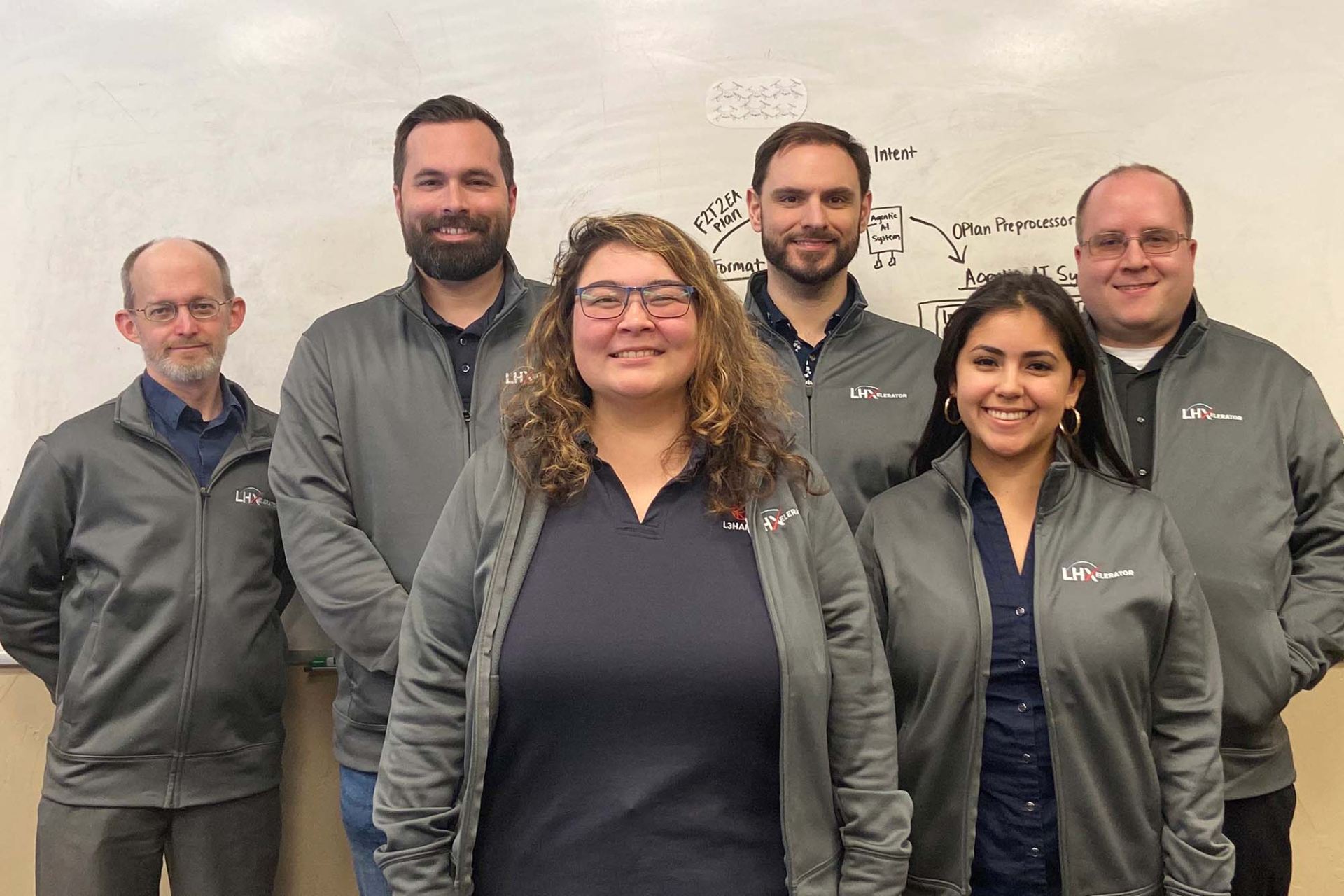

Alexis Tudor PhD’26 (third from left) led the L3Harris project team recognized for its award-winning concept. Team members were, from left, Brandon Parker PhD’14, Harley Heath, Tudor, Christopher Taylor, Fatima Parada-Taboada BS’21 and Donald May.
Software engineer Alexis Tudor PhD’26 uses her insights and knowledge to develop artificial intelligence systems for defense contractor L3Harris Technologies Inc. Much of her research focuses on making AI technologies more reliable and trustworthy, an interest that sparked her computer science doctoral studies at The University of Texas at Dallas.
“War isn’t fair, and our adversaries aren’t playing fair,” she said. “The idea of the unfair advantage is that we want to have the advantage over our adversaries so that we can accomplish our military goals on a world stage.”
Now, Tudor is earning recognition for AI work that began as part of her dissertation at UT Dallas.
Tudor and a team of fellow software engineers at L3 Harris’ Rockwall, Texas, location won a company challenge for a technology that could be integrated into the military’s Find, Fix, Track, Target, Engage and Assess (F2T2EA) model. The model involves the steps military planners use to progress through the necessary stages of a military operation.
Currently, the process proceeds through a variety of military personnel working with existing computerized defense systems. But Tudor and her teammates — Harley Heath, Donald May, Fatima Parada-Taboada BS’21, Brandon Parker PhD’14 and Christopher Taylor — devised a way to use AI technology that mimics human decision-making to automate the actions of the F2T2EA model, potentially making it more trustworthy, faster and less prone to human error.

Alexis Tudor PhD’26 and Dr. Gopal Gupta, her PhD advisor.
“The AI has to be correct every time. That’s the goal,” Tudor said. “We’re talking about taking a high-level commander’s intent or taking a mission plan and executing it. The system has to be as close to perfect every time as is physically possible. That’s not possible with large language models like ChatGPT or Claude, which are known for hallucinating.”
The team incorporated VECSR (Virtually Embodied Common Sense Reasoner), an AI system Tudor developed at UT Dallas, in combination with cutting-edge neural AI to parse human-readable battlefield management plans and translate them into actionable, machine-readable plans. For winning the challenge, the team earned $40,000 in prize money and an additional $50,000 to be used to fine-tune the system, known as Fulcrum.
Dr. Gopal Gupta, Tudor’s PhD advisor, said what makes VECSR so novel is that it uses automated AI common-sense reasoning that can draw conclusions and take action. It also is as powerful as neural AI systems and many times more trustworthy and transparent.
“With automated common-sense reasoning, AI follows premises instead of relying on patterns and statistics like machine learning systems,” said Gupta, professor of computer science and director of the Center for Applied AI and Machine Learning in the Erik Jonsson School of Engineering and Computer Science. “What Alexis did with VECSR for her dissertation in a simulated environment was build a technology capable of automatically figuring out how to do tasks in real time using very sophisticated reasoning. This has always been a very hard problem for AI research.”
“What Alexis did with VECSR for her dissertation in a simulated environment was build a technology capable of automatically figuring out how to do tasks in real time using very sophisticated reasoning. This has always been a very hard problem for AI research.”
Dr. Gopal Gupta, professor of computer science and director of the Center for Applied AI and Machine Learning in the Erik Jonsson School of Engineering and Computer Science
Gupta said Tudor has been successful in her research because of her perseverance and determination. He said it typically takes students four to six years to complete a PhD, but Tudor finished hers in 3 ½ years.
“Her ability to work as hard as she did and not be daunted by anything is really quite amazing,” Gupta said. “When she told me she wanted to complete her doctorate as quickly as she did while working full time, I told her it was possible but would be difficult.”
At L3Harris, Tudor recently was awarded the company’s Golden Quill Award for her productivity in writing and publishing technical articles. She has moved into a product owner position at the company and hopes to continue climbing the leadership ladder, with a goal of becoming an L3Harris fellow.
“Fellows are highly technical but skilled in areas of business development, sales and leadership,” Tudor said. “As a fellow you have to have the technical expertise as well and excel at soft skills.”
Tudor said she plans to continue to work with Gupta and his graduate students at UT Dallas on further uses of VECSR in applications, including operating autonomous drones.
“The challenge is high-level mission planning to understand what is needed to accomplish an objective involving drones,” Tudor said. “How do I navigate a drone autonomously including the orchestration of vision models and the different sensors on board? We will be putting together a paper soon on the project.”












Leave a Reply