
In 2026, cricket is being overrun by armies of spreadsheet merchants who take pride in quantifying information that had previously been the preserve of received wisdom, gut feeling, and guesswork. Every major cricket team now carries outright data scientists or science-adjacent professionals in the backroom whose job it is to attach numbers to physical cricketing acts.
There are no fast bowlers who happen to “bowl a heavy ball” any more, there are only quicks who have a release point X% later than the average bowler, and whose deliveries lose pace at Y% less than the mean loss of pace for balls that pitch on that length. Spinners don’t just “give the ball a rip”, they impart X revolutions-per-second as measured by high-speed cameras, and get Y degrees of turn off the deck.
More than any force acting upon cricket, hard science has shaped the last 15 years of the game’s evolution. Cricket, largely, is better for the granular – almost molecular – understanding of its own physics. It makes teams better at picking players that will sustain their performance, and better at identifying and correcting technical issues, better at devising strategy, better at reading conditions, better at phase-wise breakdowns of expected wickets given bowling lengths delivered on surfaces of a specific profile. If you’re still making cricketing decisions based on a “hunch”, put on this loincloth and rub a pair of sticks together, my friend. Have fun in the Stone Age.
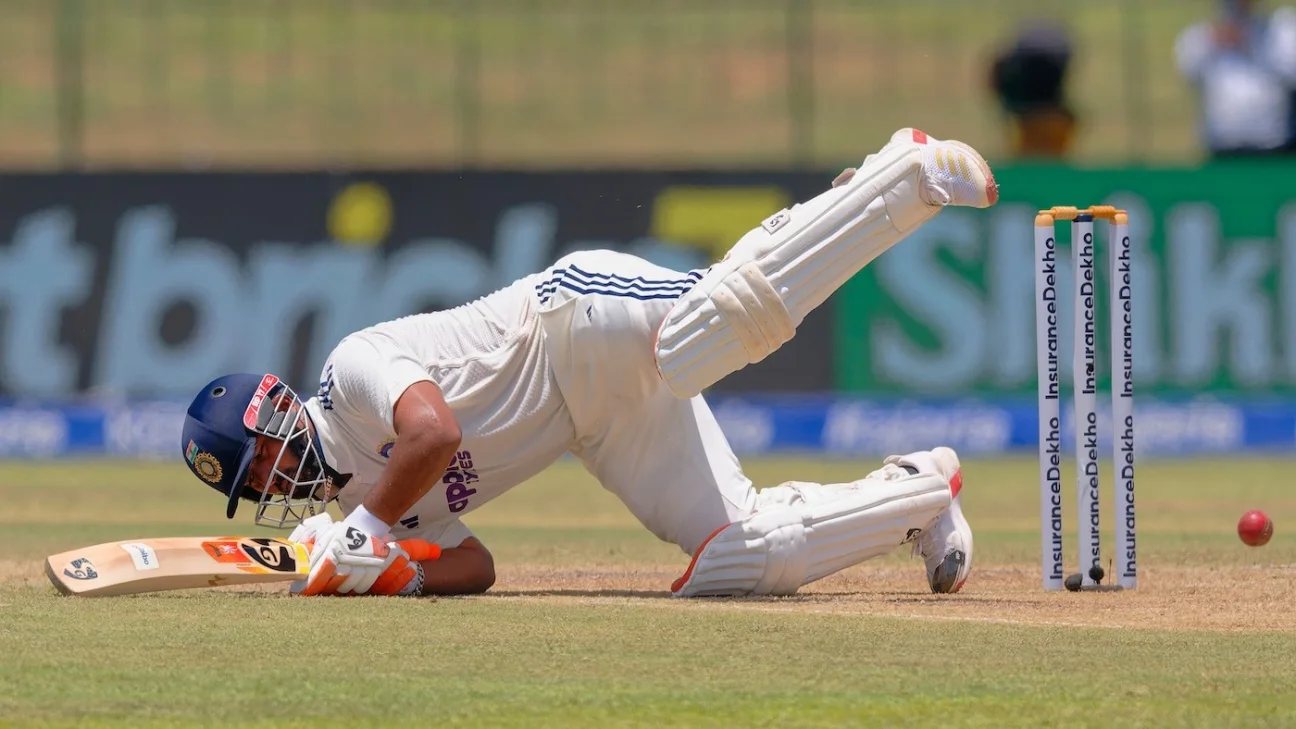
All the data ever mined from all cricket games ever played, pushed through the greatest processors known to man, drawing from acres-big water-guzzling data centres would struggle to quantify Pant. Our man has no love for predictability, no preclusions towards convention, and does not do reverence.
Which algorithm would spit out this sequence of events for example?
On the first evening of a Test, Pant tries to hook a 133kph short ball from Lahiru Kumara with one of his falling-over pull shots. He misses completely and is struck on the wrist, forcing him to retire hurt, although the way he left the field it felt like he was retiring hurt against his own will. Before long he was down at the dugout, looking ruefully at the runs his teammates were making and he was not. Before the end of the day he was padded up again, at the edge of the field, available at a moment’s notice.
He had to wait till the following morning and until after Sri Lanka had taken the second new ball to get out there, and having taken a couple of singles against Asitha Fernando, he faced a series of bouncers from the bowler who had hit him the day before. The first one, he ducked. The second one, he attempted to play a controlled pull shot to deep fine leg to, and missed. To the third one, at 137kph (4kph faster than the one he was hit by), Pant falls over to the off side and plays his favourite hook shot again, connecting so sweetly, so utterly spectacularly, that it lands on the gabled roof of the highest stand in the stadium, and leaps for good out of the camera’s view, possibly into one of the other cricket grounds on Maitland Place.
Imagine finding that ball on another outfield, or on the road, a four-piece Test-match Kookaburra, only 9.5 overs old. It may as well have fallen from outer space. Like Pant.
He didn’t crow about this mega-six either. Didn’t stare Kumara down. Didn’t gesture at the bowler who had struck him the previous day. He doesn’t look to dominate bowlers exactly. He just happens to dominate them. He doesn’t need them to fear him. He is content to be the tornado that occasionally blows through their lives, uprooting foundations laid in previous spells, upending plans devised by information parsed in spreadsheets.
“Pant doesn’t look to dominate bowlers exactly. He just happens to dominate them. He doesn’t need them to fear him. He is content to be the tornado that occasionally blows through their lives, uprooting foundations laid in previous spells”
You can predict where balls bowled at X pitch, released from Y height, on a Z-type pitch will end up in relation to the average left-handed batter. But what the synapses in Pant’s brain will do in response is a subject as-yet undemistyfied by science. Wheeling freely in the gaps of human knowledge is this India wicketkeeper batter.
We might not know how he will play to which ball when, but we do remember the grins we broke into when he struck another tumbling slog sweep for six, the gasps that left our mouths when he made a sweet connection with the ball he had no business making, and jaws we chase around the living room after he made us drop them. Long may his chaos reign.
Andrew Fidel Fernando is a senior writer at Cricinfo. @afidelf










Leave a Reply