Chris “Dough” Fryison dropped off a load of supplies on Monday at a café that he and his wife plan to open next week on 61st Street on Chicago’s South Side. The café, called Doughboy’s CHGO Enterprises, will serve “basic comfort food,” Mr. Fryison said, and they hope it will attract not only locals but visitors from the soon-to-open Obama Presidential Center a mile-and-a-half down the street.
“This is a main artery of Chicago, definitely a main artery to the Obama Center,” Mr. Fryison says as he wheels a cart packed with plastic jugs and other cooking materials into the empty café, gestures to the menu posted on a wooden stand, and fields calls on his cellphone. “It’s going to be a great opportunity to be part of.” He makes clear that the center means more to him, and to the community, than just an economic opportunity. “It’s a beacon of hope,” he says.
After nearly a decade of planning and fundraising, the Obama Presidential Center opens to the public Friday following an official dedication on Thursday. Thousands are expected to participate in the celebrations, including a star-studded concert with headliners like Bruce Springsteen and Stevie Wonder.
Why We Wrote This
As the Obama Presidential Center opens its doors to the public this week with a basketball court, barbecue grills, and a public library branch, its vision of transforming a traditional presidential library into a modern community center will be put to the test.
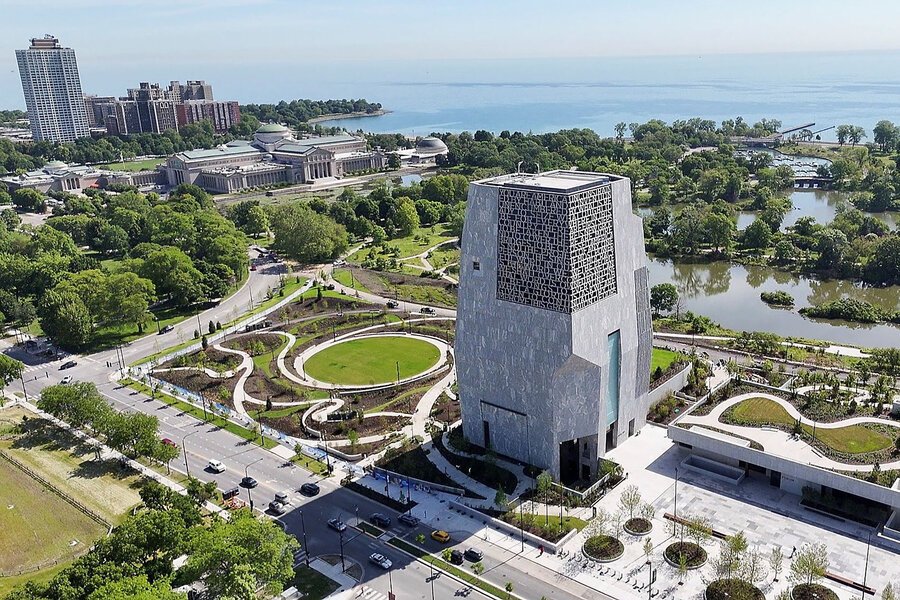
Local residents have watched for years as a 225-foot tall granite building rose nearby, designed to look like four hands coming together, symbolizing community. Many are eager to take a closer look at the building and its surrounding campus, which the Obama Foundation and city leaders say will bring an economic boost to the South Side of Chicago, where former President Barack Obama worked as a community organizer and former first lady Michelle Obama grew up.
The Obama Presidential Center presents a contrast to other presidential centers. Most are libraries that hold a president’s vast collection of documents, plus a museum. The Obama Center is not a library at all. The National Archives and Records Administration, the government agency that typically handles archives at presidential libraries, retains no on-site presence. The records of the Obama administration will be available digitally.
But the difference runs deeper. The Obama Center is not just a museum, either, but a community center. It consists of five separate buildings spread over 19.3 acres shaped and planted to blend into Jackson Park. It includes an NBA-sized basketball court, a branch of the Chicago Public Library, a café, and a restaurant. It also has a vegetable garden, barbecue grills, a playground, and a sledding hill.
All presidential libraries “try to some degree to lean into and cater to local communities and organizations,” says Shannon Honl, a historian writing a doctoral dissertation on presidential libraries at Loyola University Chicago. “But nothing like this. What the Obama Center seems to be setting us up for is a very different model for presidential centers.”
Ahead of its opening, the Obama Center has become for South Side residents a subject of pride, curiosity, nostalgia, and affection for the country’s first Black president. It is raising hopes for jobs and increased economic opportunity, as well as worries that its presence will speed gentrification, forcing out the poorest of its neighbors.
“It’s a good thing for the community,” says Tisa Henderson, a retired patient care worker at a Chicago hospital, as she makes her way from a car she’s still paying off to the three-story brick apartment building where she lives with rental assistance a few blocks west of the Obama Center. She hopes to visit soon. “I’d like to see what all the hoopla is about,” she says.

At the same time, Ms. Henderson says, longtime residents are worried about rising property taxes and rents. “The issue is being pushed out,” she says. “It’s to the point now where you’re probably going to save every cent you can, because you’re not going to be able to afford it.”
Still, those concerns don’t dampen her pride. “I just get flabbergasted how close I live to it,” she says. She said the center’s presence on the South Side shows a “sense of giving back to the community, or what people say is not forgetting where you came from.”
Optimism and doubts on the South Side
Debate over the Obama Center’s effect on the mostly Black neighborhoods nearby began long before the first shovelful of dirt was turned. It has not gone away.
This week, community groups held a press conference in Woodlawn, the neighborhood just west of the center, to call for increased protections for low-income residents and stronger enforcement of housing standards.
Recent analyses, including one by the Illinois Answers Project, have drawn attention to rising rents around the center and what it describes as the city’s failure to build affordable housing on the scores of vacant lots it owns in the Woodlawn neighborhood.
“Most people think the Obama Center will push people out,” says Vanessa White, a professional caregiver watching her own niece and daughter as they frolic in a small playground just a few blocks away. And yet, she adds, “I’m having a positive outlook.”
Ms. White is especially enthused about the center’s sledding hill. In past winters, she’s driven her daughter several miles to find a place with enough slope to accommodate a sled.

Adrienne Upchurch of the Sunshine Gospel Ministries works out of an office a mile and a half down 61st Street. She helps young people who are taking a gap year after high school to do volunteer work and prepare for their lives ahead.
One of the young people she works with already found a job at the center during its construction, and others are hoping for employment.
“They’re excited about potential opportunities,” she says, including ferrying visitors to and fro through Uber and Lyft. Recently, there has been a surge of new listings on short-term lodging platforms like Airbnb. Researchers say that’s both an example of the center’s economic draw and a sign of investors moving in and buying up property.
Laquinda and Tyrone Hendry are two of those visitors using a short-term rental nearby to attend the center’s opening.
Weary but excited, they unload their black SUV at a newly-built brick apartment building. They had driven from Fayetteville, North Carolina, and paid $1,000 to spend four nights.
They came to “show support” for Mr. Obama, Ms. Hendry says. “We felt he was one of the bravest and greatest presidents, who had a huge impact he doesn’t get credit for,” she says. “We also wanted to see the area that influenced him – and, of course, the center.”