It began with a button – and a loophole to the past.
Henry Cooke was a college student searching for his next adventure. In 1975, newly enlisted as a minuteman reenactor, he learned to fire a musket and spent weekends helping to “drive” the occupying British out of Boston during bicentennial commemorations.
These were the early days of the living-history movement in the United States. Enthusiasts devoted their weekends to depicting the people and events that had established the nation.
Why We Wrote This
As celebrations for America’s 250th gear up, reenactors seek out artisans with mastery of historic garments. In Massachusetts, that includes turning to a tailor who got his start during the U.S. bicentennial and an immigrant tailor from Nepal.
The bicentennial in 1976, celebrating 200 years of U.S. independence, offered an opportunity to revisit the valor of the nation’s military history in the devastating wake of the Vietnam War and anti-war activism. President Gerald Ford kicked off celebrations at Boston’s Old North Church on April 18, 1975. At the same time, social history – the study of the lives of ordinary people during extraordinary times – was a burgeoning field. As a result, the bicentennial spawned an army of self-taught reenactors, many too old or too young to have fought in Vietnam, who brought the earliest days of the nation off the pages of history books.
Mr. Cooke, then a budding scholar of social history with an eye for detail and a knack for needlework, embraced the challenge. Alongside a ragtag group of equally passionate friends, he pored over historical documents looking for clues to help them re-create Revolutionary-era clothing as authentically as possible.
Then the commemorative battles ended. What next?
Inspiration came in the form of a replica button, sold in gift shops as a bicentennial souvenir, believed to have been worn by a Massachusetts regiment in 1776. To most, it was a trinket. But to Mr. Cooke, it was the flint that ignited his passion. From the button, he re-created the regiment’s coat. From the coat emerged a purpose. And from that purpose, a call to arms. In 1977, the 10th Regiment of Massachusetts marched again.
Now, a half-century later, the unit that emerged from a souvenir button is still going strong. And, as celebrations for America’s 250th birthday build momentum across the country, a new generation of tailors and history enthusiasts is discovering the creative challenges of reenacting as a serious pursuit.
“The kind of person who becomes a reenactor, that thrives under this demand for historical accuracy, is [someone] who really loves history,” says Chloe Chapin, a designer and scholar of early American men’s fashion and author of the newly published book “Suitable: The Sartorial Revolution and the Fashioning of Modern Men.” “There’s also a hands-on element, too. The goal is not just going into the archive, finding the letter that explains the thing, but also, ‘How do I make that thing?’”
A craft of the “highest standards”
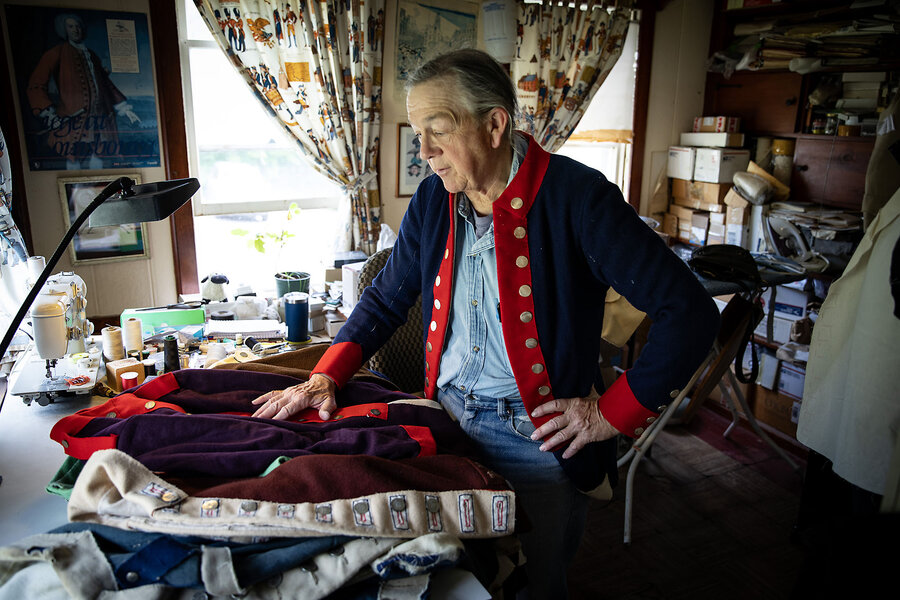
Today, Mr. Cooke is a full-time historian and tailor, drawing on skills he learned from his mother, a dressmaker. He is, in every sense, a man of many hats – and shoes, and boxes of buckskin breeches and meticulously crafted American Revolutionary War coats. They fill a small room hung with bicentennial curtains in his 1853 house in Randolph, Massachusetts, waiting for repair or their next deployment.

Melanie Stetson Freeman/Staff
He has used his talents to preserve, reconstruct, and authenticate historic clothing, such as an old suit found in an attic trunk on Long Island that turned out to be one worn by John Adams.
“We think of these figures as larger than life, as iconic. And yet, in their lifetimes, they were somebody’s dad, they were somebody’s grandpa,” says Mr. Cooke. “They were ordinary human beings who were caught up in extraordinary circumstances.”
By his estimates, he works on 50 to 60 pieces a year, mostly men’s clothing, and participates in a couple of historic events or talks a month. He also serves as the vice president of the Brigade of the American Revolution, an international living history organization with more than 1,000 members.
“We want to make sure that we are presenting history to the highest standards,” says Mr. Cooke.
With every passing year, as historical mysteries are solved, and documents and artifacts emerge from attics and museum archives, those representations become more accurate. The button that started it all? It turns out it was a replica of a souvenir button from the 1876 centennial and not historically accurate.
“For the 250th celebration, we are the benefactors of another 50 years of research,” says Mr. Cooke, who likes to reminisce with friends he has known since the bicentennial about their fledgling efforts in outfits that cost $25.
Authenticity is the fuel that drives historical reenactors. For example, members of the Lexington Minute Men, a volunteer reenacting group, must appear historically accurate at a close distance. Their clothing must be cut and hand sewn to fit proper 18th-century styles. If there is any hint of another era than the one being portrayed – period inappropriate eyeglasses, a wristwatch, a cellphone – that person will not be allowed to participate.
Reenactors have a “different goal than someone who comes up with a Halloween costume at the last minute because they want to go to a party,” says Dr. Chapin.
Today, a typical historic men’s costume, consisting of a coat, vest, breeches, neckwear, and gaiters, can cost a reenactor around $3,000. Thanks to the internet, YouTube, and The History Channel, reenactors, along with the spectators who come to watch, are much more sophisticated and informed.
“When we wanted to learn what uniforms looked like, we had to write letters to people. Now, with a few keystrokes, you can sum up all kinds of information, and pictures, and 3D images that rotate,” says Mr. Cooke.

Melanie Stetson Freeman/Staff
“We have to make it here”
A one-minute march from the Lexington Battle Green, where the opening shots of the American Revolution were fired April 19, 1775, toils a tailor who once outfitted the greatest New England Patriot of all time: Tom Brady.
Provin Pariyar is the owner of Craft Cleaners & Tailor, a long-standing business in Lexington that he and his wife purchased in 2017, where a photo of Mr. Pariyar with the former NFL quarterback hangs behind the counter. At the back of the store, on a large cutting table, gold scissors rest next to a bolt of navy blue wool and a container of pewter buttons. A pair of white breeches is neatly folded on a bench. Nearby, a row of white wool vests hangs on a rack.
Mr. Pariyar is one of the official tailors for the Lexington Minute Men. Next to the photo of Mr. Brady is a framed certificate stamped with a gold medallion honoring the tailor’s work on the redesigned ceremonial dress uniforms for the entire reenacting company.
“It’s very, very, very rare within the whole hobby that we allow a modern tailor to make our clothes because it’s so different,” says Steve Cole, who portrays the captain in the Lexington Minute Men.
Mr. Pariyar never intended to become a historical tailor. He came to the United States in 2004 to pursue a career in fashion after graduating from college in Nepal. He took a job at Newbury Tailoring in Boston, where he dressed Mr. Brady. But after the pandemic, he moved his tailoring business to Lexington.

Melanie Stetson Freeman/Staff
“In Nepal, usually everything is custom-made,” says Mr. Pariyar, who was first taught to make clothing by his mother, also a tailor. Through his work in Boston, he learned how to work on period clothing for theater productions. In Lexington, he met local Lexington Minute Men reenactors who brought in their uniforms for cleaning and alterations during the gamut of annual parades on Patriots’ Day, Memorial Day, and Veterans Day.
“They would only wear their costume once a year, and bodies would change and [the uniforms] would need tailoring,” says Mr. Pariyar.
Mr. Pariyar says he enjoys history, and the reenactment parades remind him of an annual military parade in Nepal held during the Hindu festival Dashain.
“In Nepal, we never [had] a revolution. We are a self-dependent country,” says Mr. Pariyar, who became a U.S. citizen in 2019. When he hears the American national anthem, “it really touches my heart,” he says.
He started outfitting the entire company with new uniforms for the 250th celebrations a year ago, replacing aging outfits and borrowed items with pieces made especially for each reenactor.
“When they fit it more, they look smart” and more powerful, he says. “And they feel like that.”
As the 250th festivities get underway, the Lexington Minute Men make appearances at a variety of activities – including the ceremonial first pitch at a Red Sox game at Fenway Park – wearing their new 18th-century period clothing made by Mr. Pariyar.
“That makes me really proud,” he says.
Each uniform takes three to four days to create. “The jacket takes almost two days, just working nonstop,” he says. Using historic techniques to sew on buttons in just the right way can be a slow process. He’s already made 28 uniforms, but he’s not even close to being done. The 250th has attracted a new generation of young reenactors, and the company has swelled to 81 people, including women. He won’t have all the uniforms completed for this year’s celebration, but he now feels he is officially part of the fabric of Lexington.
“You can buy modern clothes anywhere,” made in countries where labor is cheap, he says. “But this one, this uniform, we have to make it here.”