
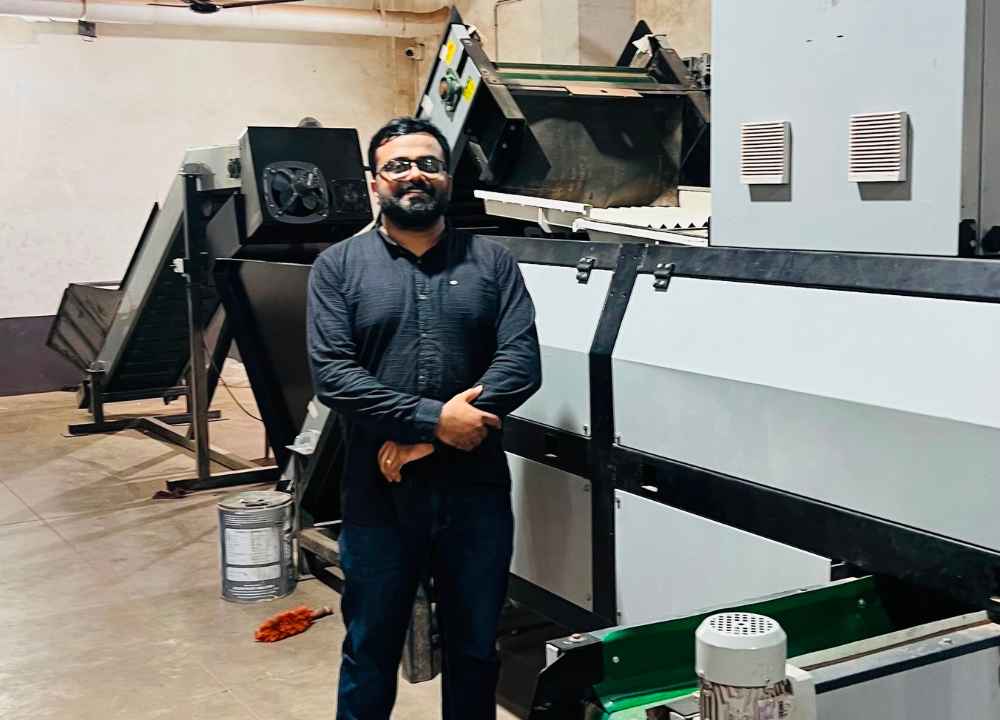
Agrograde, an Indian startup developing artificial intelligence (AI) and automation technologies for agricultural packhouses, has introduced an AI-powered optical sorting system designed specifically for arecanut. The first commercial installation has been completed at Vikas Traders in Mangalore, Karnataka.
The system can process approximately one tonne of arecanut per hour, enabling the facility to handle close to eight tonnes a day. It uses computer vision and AI to inspect individual nuts, identify visible defects and automatically separate rejected material from accepted produce.
Unlike conventional colour-sorting machines that primarily distinguish products based on colour differences, Agrograde’s system examines individual arecanuts for external defects that may not be identified through colour alone. The technology aims to improve sorting consistency, reduce dependence on manual inspection and provide more predictable processing capacity.
Rakeshkumar Barai, Co-founder of Agrograde, said the company studied the physical characteristics of arecanut, variations between varieties and existing quality assessment practices before developing the machine. The development process took nearly five months and involved three product iterations. He also acknowledged Vikas Traders for working with the company to adapt the system to the requirements of the arecanut supply chain.
The machine uses Agrograde’s patent-pending Vector architecture, designed to improve surface coverage during image capture and handle variations in the size and shape of agricultural produce. According to Aniket Ghadage, Head of Product Engineering at Agrograde, the design also focuses on ease of operation and maintenance under conditions involving heat, dust and humidity.
Developed in collaboration with Vikas Traders, the system was tested under actual operating conditions, including exposure to dust, foreign matter and high humidity. When first commissioned, it achieved sorting accuracy of approximately 75%. Following updates to its AI models using operational data, accuracy increased to around 89%, with further improvements expected as more data becomes available.
Before automation, Vikas Traders relied heavily on manual sorting. The company reported that one worker could inspect and sort approximately two bags a day, while a team of around 15 workers processed 40–45 bags daily. The automated system now provides a more consistent processing rate and generates a quality report for each lot, covering size distribution, identified defects, defect intensity and the number of nuts packed.
Raj Padaliya of Vikas Traders said the company worked closely with Agrograde through several versions of the technology before achieving a largely automated sorting process. The system captures 10–12 images of each nut, which are analysed by proprietary AI models within milliseconds. The models have been trained on hundreds of thousands of crop images and run on computing infrastructure powered by NVIDIA.
Agrograde develops computer vision, AI and robotics solutions for post-harvest operations involving crops such as onions, potatoes and apples. The company recently deployed its 150th machine across 15 Indian states. The arecanut installation extends its technology into another agricultural supply chain where quality assessment has traditionally depended on manual inspection.














Leave a Reply