
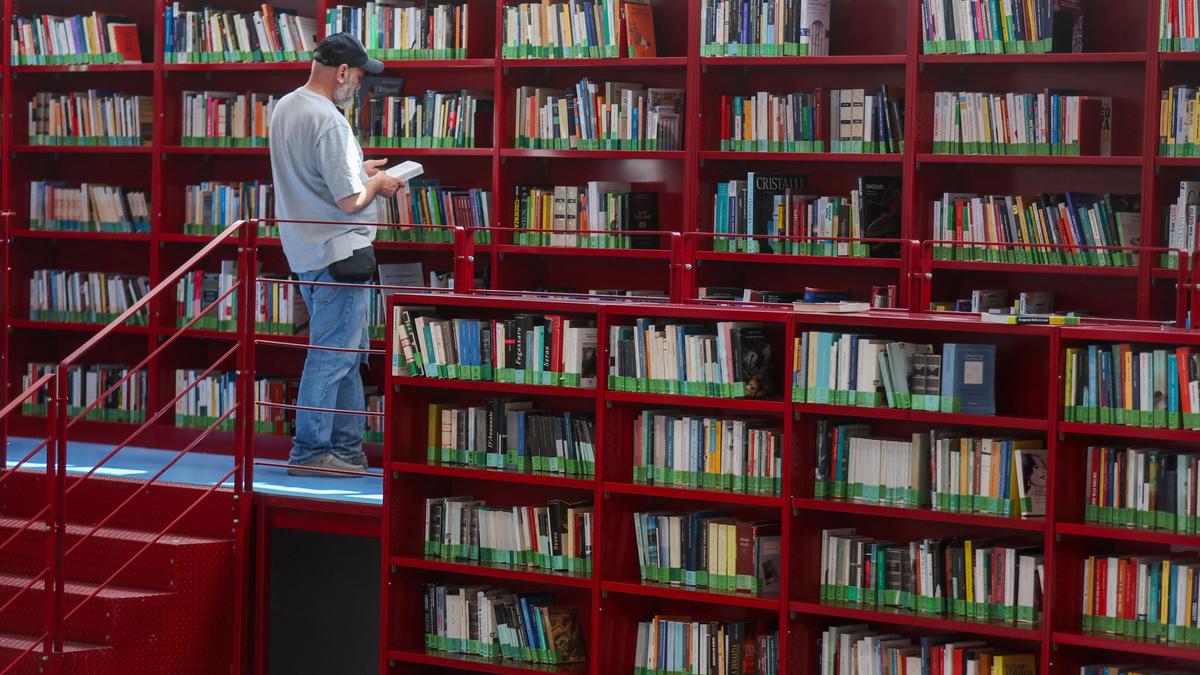
The story so far: An investigation published this week by the tech outlet 404 Media tracked a shipment of rare books to an Amazon facility in Las Vegas. Instead of packing and mailing them out to eager readers, Amazon employees destroyed the books by cutting off their bindings to scan them. Numerous other books have met the same fate, according to the report that ignited global outrage and criticism.
Why are AI companies sourcing physical books?
AI companies are trying to access more works of writing in order to further develop their AI models and train them on high-quality datasets rich with original material. As more of the internet grows saturated with AI-generated patterns of language, rare and/or out-of-print books are becoming an attractive option for tech companies looking to scrape data.
According to 404 Media, Amazon did not directly address its destructive scanning practices but confirmed that it bought books to improve its “products and services”.
But the e-commerce giant is not the only company accused of destroying books.

Anthropic, the Google and Amazon-backed maker of the Claude family of models, had its own secret ‘Project Panama,’ which it described as “our effort to destructively scan all the books in the world.”
What’s more, a focus on rare books also means that the company that sources the content first can destroy the original and ensure that an AI rival cannot easily train its models on the same text.
Is it necessary for AI companies to destroy books?
If you have ever tried to photocopy a thick or old book, you know that getting a high-quality print is often complicated by the book’s spine. You can press down hard to flatten the book, but this is not safe for rare or delicate volumes.
Archivists, librarians, and researchers use a range of advanced scanners that are designed to digitise physical books without damaging them. Some robotic devices can even lift or flip the pages without human help. Naturally, these solutions are expensive and can be hard to scale.

In destructive scanning, however, the book’s binding is cut off and the pages are rapidly scanned. These books cannot be easily rebound and are usually sent for disposal.
Destroying the print book can also work in a company’s favour. This way, it is harder for authors to accuse the company of promoting piracy. After all, a buyer is legally allowed to destroy the rare book they have bought, even if others would consider this a cultural crime.
By contrast, an AI company can be sued if authors find evidence of it downloading pirated e-books without paying for them; this July, Anthropic received approval to pay $1.5 billion to settle a class action lawsuit where authors claimed that the Claude-maker illegally used their copyrighted works for its AI products.
In a court order from last June, U.S. district judge William Alsup had noted that Anthropic bought millions of print copies, and “destroyed” each print copy while replacing it with a digital one that it did not share outside the company.
This print-to-digital format change was ruled as fair use.
What has been the reaction to destructive scanning?
Numerous booksellers, authors, creatives, collectors, readers, and academics have naturally reacted with anger and disgust to news reports of AI companies destroying books.
At the same time, there are some who are not overly concerned by destructive scanning, but oppose companies being allowed to destroy rare books to create a digital copy that the public cannot access.

For context, consider that media preservation platforms (such as the Internet Archive) as well as shadow libraries/piracy platforms (like Anna’s Archive) have been sued for doing the exact opposite: making digital versions of rare print books available to the public at no cost.
Meanwhile, global booksellers face a dilemma. They stand to profit (at least temporarily) by supplying rare or out-of-print books for destruction. The Guardian reported that sellers in Australia, for example, are more carefully scrutinising bulk orders from buyers or reviewing unusual requests for rarer books, in case they are being bought for destructive scanning.
Elon Musk, whose AI company is developing the Grok family of models and tools, was quick to refute potential accusations of his company destroying rare books.
“I’ve asked the SpaceXAI team to preserve any rare books in a library and scan them the hard way vs just cutting off the spine and scanning,” he posted in July on his social media platform X, in response to a user expressing distress over the destructive scanning process.
Even so, the process of building AI models lacks transparency — by design. As AI firms transition from downloading popular books to shredding rare ones, readers and booksellers now fear the world is rapidly losing undiscovered works of literature.
Published – August 20, 2026 07:24 am IST









Leave a Reply