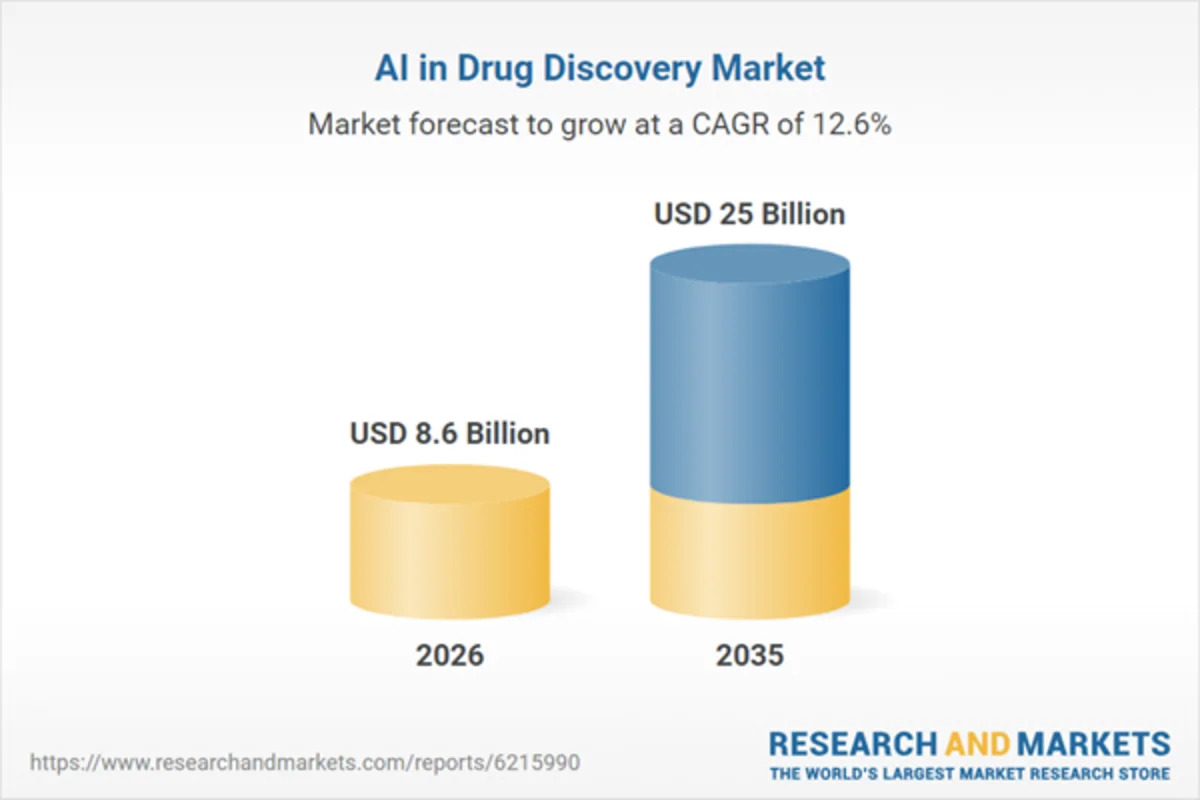
The global AI in drug discovery market is projected to increase from USD 8.6 billion in 2026 to approximately USD 25.0 billion by 2035, expanding at a compound annual growth rate (CAGR) of 12.6%. Market growth is being supported by rising pharmaceutical research and development investment, expanding biomedical datasets, increasing demand for novel therapies, and broader adoption of artificial intelligence across drug discovery workflows.
Pharmaceutical and biotechnology companies are increasingly integrating AI-powered drug discovery platforms into target identification, hit generation, lead identification, and lead optimization. These technologies support faster candidate selection, improve research efficiency, and help address prolonged development timelines and high attrition rates associated with conventional discovery programs.
The growing prevalence of cancer, cardiovascular diseases, neurological disorders, respiratory conditions, infectious diseases, and other chronic illnesses is strengthening demand for more efficient therapeutic development. Aging populations and persistent unmet medical needs are also encouraging companies to expand investments in virtual screening, predictive toxicology, molecular modeling, multi-omics analysis, and generative AI.
AI platforms can process large genomics, proteomics, clinical, and real-world datasets to support drug candidate identification and optimization. Generative models, deep learning, and reinforcement learning are also advancing de novo molecule design and drug repurposing. Industry progress is illustrated by Insilico Medicine’s AI-designed candidate ISM001-055, which advanced into Phase II clinical trials for idiopathic pulmonary fibrosis.
Key Market Findings
More than 260 companies currently provide AI-based drug discovery platforms.
Approximately 76% of market participants use AI platforms to discover candidates for internal development pipelines.
North America is home to about 58% of identified platform providers and accounts for more than 50% of the global market.
More than 35% of disclosed funding has been raised through venture capital rounds, particularly Series A financings.
Grants and awards represent approximately 15% of recorded funding instances.
Patent activity has expanded at a CAGR of 67% in recent years, reflecting demand for efficient drug discovery technologies.
Lead optimization accounts for approximately 50% of the market and remains the leading drug discovery segment.
Growth Drivers and Market Challenges
Strong venture capital activity, strategic pharmaceutical partnerships, cloud-enabled research workflows, and growth in multi-omics and real-world evidence are major drivers of the AI in drug discovery market. Multimodal large language models and precision analytics are further expanding data extraction, patient stratification, molecular interaction prediction, and lead optimization capabilities.
Market adoption nevertheless faces barriers related to fragmented datasets, limited interoperability, data security, privacy, intellectual property protection, and evolving regulatory requirements. Data generated through genomics, proteomics, preclinical studies, compound libraries, and clinical programs is frequently stored in incompatible formats. Standardized data architectures and clearer regulatory frameworks will be important to support secure collaboration and scalable AI deployment.
Segment and Regional Analysis
Lead optimization is the largest drug discovery step, representing approximately half of the market. Its leadership reflects substantial preclinical expenditure on chemical synthesis refinement, ADMET profiling, efficacy assessment, and potency optimization. Predictive modeling and high-throughput screening are enabling companies to improve decision-making throughout this resource-intensive stage.
By technology, the market covers machine learning, molecular modeling and simulation, deep learning, omics integration, generative models, and structure-based drug design. Applications span oncology, cardiovascular disease, neurological disorders, respiratory diseases, immunological conditions, gastrointestinal disorders, endocrine diseases, blood disorders, ophthalmology, dermatology, infectious diseases, and urinary disorders.
Pharmaceutical and biotechnology companies represent the leading end-user segment, supported by substantial R&D budgets, established development pipelines, and infrastructure for enterprise-scale AI integration. Other users include contract research organizations, academic institutions, and research centers.
North America leads the global AI in drug discovery market, driven by significant R&D investment, advanced healthcare IT infrastructure, a concentrated ecosystem of technology providers, and regulatory initiatives supporting AI and machine learning adoption. Europe and Asia-Pacific also present expanding opportunities, while Latin America and the Middle East and North Africa are expected to benefit from increasing digital health and life sciences investment.
Report Coverage
The market report provides revenue forecasts and opportunity analysis by drug discovery step, AI technology, therapeutic area, end user, and geography. It also examines the competitive landscape, company profiles, partnerships, funding activity, patent trends, company valuations, technology-sector healthcare initiatives, cost-saving potential, and market forces influencing adoption.
Primary research includes discussions with senior executives, founders, commercial leaders, product officers, and researchers from companies in the United States, United Kingdom, Israel, and South Korea. These insights support the report’s assessment of market trends, commercial opportunities, competitive positioning, adoption barriers, and future growth prospects.
Market Outlook
Continued investment, expanding data availability, accelerating patent activity, and growing demand for cost-efficient therapeutic innovation are expected to sustain the AI in drug discovery market through 2035. As platforms mature and regulatory guidance evolves, AI is positioned to become increasingly central to pharmaceutical research, candidate optimization, and pipeline development worldwide.
Key Attributes
Report Attribute
Details
No. of Pages
365
Forecast Period
2026-2035
Estimated Market Value (USD) in 2026
$8.6 Billion
Forecasted Market Value (USD) by 2035
$25 Billion
Compound Annual Growth Rate
12.6%
Regions Covered
Global
A selection of companies mentioned in this report includes, but is not limited to:
About ResearchAndMarkets.com ResearchAndMarkets.com is the world’s leading source for international market research reports and market data. We provide you with the latest data on international and regional markets, key industries, the top companies, new products and the latest trends.










Leave a Reply