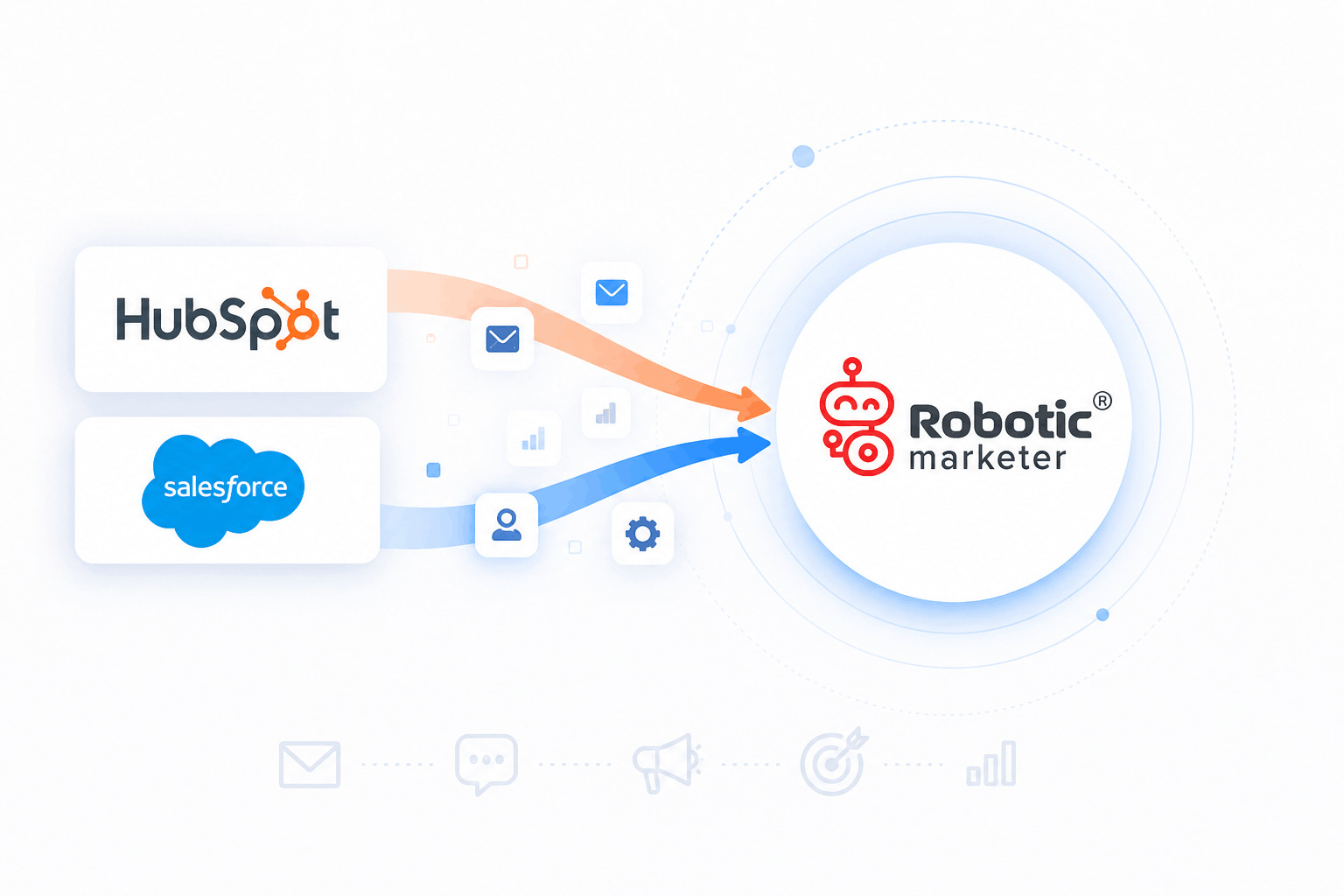
Businesses have long depended on leading customer relationship management (CRM) solutions, frequently choosing between HubSpot and Salesforce to anchor their marketing and sales operations. These platforms have shaped how companies manage leads, segment audiences and execute campaigns. However, a growing number of organisations now expect more than baseline automation. They seek smarter functionality, faster results, and seamless connections between strategy, execution and reporting. Enter the all-in-one AI marketing CRM platform, changing not only how brands use familiar giants like HubSpot and Salesforce, but also how they perceive the value of a modern marketing strategy.
The Current Landscape: HubSpot, Salesforce, and Limitations
The digital marketing ecosystem in 2026 presents a crowded field of tools promising efficiency and intelligence, yet many fall short in creating a true strategy-to-execution workflow. HubSpot has earned its reputation through user-friendly automation, combining marketing and sales efforts. Salesforce, meanwhile, remains the enterprise standard for complex sales cycles, sector-specific solutions and detailed reporting. Both platforms provide marketing automation, but strategy often remains an external or manual task. Analysts frequently highlight that the divide between planning, execution and measurement continues to create challenges and inefficiencies for teams. This gap forms the basis for comparisons like “Robotic Marketer vs HubSpot” and “Robotic Marketer vs Salesforce” across industry boards and expert reviews.
AI Marketing CRM Platform: More Than Automation
The AI marketing CRM platform has emerged as a next-generation solution. Unlike legacy tools, this option integrates AI marketing strategy generation, workflow automation, multichannel management and deep analytics into a single, seamless loop. For users grappling with marketing automation CRM comparison questions or searching for an effective HubSpot alternative or Salesforce alternative, the attraction is clear. This approach is not merely about connecting processes through integrations. Instead, it centralises intelligence, converting core business inputs into a 12-month marketing plan, execution workflow, and automated KPI dashboards. By eliminating fractured strategies and providing a single source of marketing truth, decision-makers achieve visibility and efficiency previously out of reach.
Integration Instead of Replacement: Coexistence and Transition
Businesses familiar with HubSpot and Salesforce appreciate the complexity embedded in migration and change management. Rather than forcing organisations to abandon their preferred systems overnight, Robotic Marketer CRM integration allows users to maintain their existing record-keeping solutions. Gmail integration further streamlines communication, while bi-directional syncing ensures data accuracy. Companies benefit from the new platform’s AI marketing strategy and operational power without risking business continuity or forcing immediate overhaul. Over time, however, as users recognise the simplified workflows, lower costs and marketing ROI improvements, the case for migration or consolidation becomes stronger.
HubSpot Users: From Integration to All-in-One Simplicity
Short-Term Impact: Balanced Operations through Integration
HubSpot has always positioned itself as a marketing-first automation suite. Approximately half of its users already combine both sales and marketing within the platform, which makes integration with an AI marketing CRM platform seamless. Here, the marketing strategy created by the system feeds directly into advanced marketing execution. Teams can keep HubSpot as their primary CRM of record and bi-directionally sync contacts, deals and campaign data with the new platform. Marketing teams roll out campaigns, social content, emails and even direct mail using the integrated suite, while leadership tracks real-time KPIs with confidence. Existing investments in HubSpot technologies need not go to waste.
Medium-Term Impact: Lower Costs, Greater Effectiveness
Many HubSpot users gradually reduce their platform dependency as the AI marketing CRM platform takes over routine automation, campaign management, content generation and workflow orchestration. HubSpot’s cost structure, running as high as $3,200 per month for marketing hubs, makes it difficult for some SMEs to justify ongoing spend. The all-in-one marketing CRM, by contrast, typically offers a $99 per month flat rate, which covers strategy generation, execution, analytics and CRM. As users find less need for additional marketing tools, manual syncs, or extra licences, operational efficiency improves. The AI-driven approach to strategy ensures that every campaign is directly aligned with business goals, further reducing wasted spend.
Long-Term Impact: A Migration Path for Many
For smaller and mid-sized companies, the promise of unified data, consistent strategy and cost predictability prompts migration from HubSpot over time. Teams frustrated with maintaining multiple integrations or searching for ways to align marketing with growth objectives find the new system’s focus on AI marketing strategy compelling. Satisfaction rates shared by industry analysts suggest that while 57% of current HubSpot users describe their CRM as highly effective, even more favour a platform combining all facets of marketing under a single cloud. This makes the all-in-one marketing CRM increasingly the platform of choice for SMEs seeking smarter HubSpot alternatives with built-in marketing automation.
Salesforce Users: Simpler Marketing, Lower Overhead
Short-Term: Complementing the Enterprise Stack
Salesforce remains the tool of choice for large enterprises managing complicated sales processes, regulatory requirements and advanced datasets. The new AI marketing platform acts as an overlay, integrating with Salesforce for bi-directional lead and campaign data sharing. Teams use Salesforce as the sales and service engine, while relying on the AI platform for marketing automation, campaign execution, workflow management and cross-channel reporting. The coexistence feels natural for operations already running dual systems—modernising marketing with minimal disruption to existing sales workflows.
Medium-Term: Significant Tool Consolidation
Cost reduction and simplification drive many Salesforce-dependent firms to reevaluate their marketing stack. Where businesses previously layered 10 or more tools for email marketing, content scheduling, social listening and campaign analytics, the AI marketing CRM platform consolidates these roles for a single monthly fee. This shift helps alleviate the resource demands associated with Salesforce, a system that 55% of users support with extra in-house talent. Additionally, only 37% of Salesforce users report extreme satisfaction with their current setup, while just 35% say it provides a complete customer view. The new platform’s all-in-one structure improves satisfaction and lowers complexity for marketing teams, who often lose time and data across fragmented tools.
Long-Term: Strategic Migration for the Right Business
Enterprises with intricate requirements may continue to use Salesforce, but SMEs and scale-ups increasingly see the AI CRM as a Salesforce alternative that puts ease of use, cost efficiency and unified data ahead of advanced customisation. As businesses outgrow the need for Salesforce’s depth but crave clarity and faster marketing ROI, the all-in-one marketing CRM emerges as the simplest path. Implementation services, often supplied through approved third-party partners, facilitate migration without disrupting established sales or customer support processes, ensuring a smooth transition for those opting to consolidate further.
AI Marketing Strategy: The Missing Link in Traditional CRMs
Strategy-First Marketing Operations
Traditional CRM providers require users to bring or develop their own marketing strategies. Many rely on consultants, external agencies or internal brainstorming—processes which are slow, costly and often disconnected from actual campaign execution. The AI marketing CRM platform replaces this fragmented approach. Businesses receive a 50+ page marketing plan generated in minutes. This plan includes budget models, competitor benchmarking, target audience mapping, messaging and a 12-month content calendar. Licencing this platform allows businesses, agencies and even consultants to offer full strategic input to marketing functions without hiring additional staff, bringing sophisticated marketing strategies to the hands of any team.
Connected Execution: From Strategy to Results
Implementation bridges the gap between the executive summary and daily marketing tasks. This is where a CRM with built-in marketing automation stands out. Campaign briefs, timeline planning, task assignment and milestone tracking happen inside the platform. No context is lost between strategy and action. AI guides content development using business context—audiences, messaging tone and performance goals—eliminating the guesswork that plagues generic automation tools. For many, this step marks the difference in marketing automation CRM comparison efforts, showing a mature platform designed for businesses ready to measure performance, not just manage activity.
Direct Mail and Digital: One Core Marketing System
Despite the digital age, direct mail remains a high-performing marketing tactic for specific campaigns and audience segments. Most mainstream platforms, including HubSpot and Salesforce, overlook native direct mail capabilities. Businesses previously faced the administrative burden of using separate vendors and syncing databases manually, often leading to gaps in measurement and attribution. The all-in-one marketing CRM platform changes this by providing database cleaning, direct mail production, and integrated reporting in the same workflow as digital assets. This seamless integration amplifies reach, supports multichannel marketing strategies and closes the reporting feedback loop essential to marketing ROI.
Cost Transparency: The Economic Case for All-in-One Platforms
A detailed marketing automation CRM comparison highlights cost as a decisive factor. Both HubSpot and Salesforce offer tiered pricing based on users, contacts and additional features, which adds complexity and unpredictability to budgeting. A typical HubSpot account integrating both marketing and sales modules may land between $800 and $3,200 each month. Salesforce, with addons and large user bases, can exceed $15,000 per month. An AI-driven, all-in-one marketing CRM offers a $79–$99 monthly fee that covers AI marketing strategy, CRM, campaign tools, analytics and more. This simplicity appeals to SMEs accustomed to tool sprawl and unpredictable licencing costs, making the AI marketing platform for SMEs a logical alternative.
Reporting and Accountability: Celebrating Clarity
Many marketing leaders express frustration at the lack of clear, actionable, real-time performance insights in their CRM and marketing technology stacks. HubSpot and Salesforce present dashboards but often fail to interpret results or advise on next steps. The AI marketing CRM platform excels by transforming reporting from dashboards to decision support. It benchmarks current campaigns against industry competitors, interprets outcomes and provides monthly action items. Boardroom-ready reports bridge the communication gap between marketing and C-suite, ensuring every marketing activity correlates with revenue and business growth objectives. For CEOs and CMOs, this reporting structure eases ROI pressure and enables more confident investment in future campaigns.
Migrating to Simpler All-in-One Platforms: A Growing Trend Among SMEs
The marketing operations landscape is rapidly moving away from fragmented martech stacks that require manual integration and high cost of ownership. SMEs especially value tools that combine CRM functionality, marketing automation and strategic capability. HubSpot alternatives and Salesforce alternatives, especially those purpose-built as AI marketing CRM platforms, see the fastest adoption among firms with small marketing teams, limited budgets and growing demands for accountability. Many who previously spent $400–$600 or more monthly on separate tools now consider migration, driven by the promise of unified data, strategy-first workflows and lower ongoing maintenance. Approved third-party implementation services offer tailored paths to transition, minimising risk for companies new to all-in-one platforms.
What Makes an All-in-One Marketing CRM Indispensable Today?
In 2026, business leaders and their marketing teams can no longer accept disconnected campaigns or hope that patchwork automation tools will yield optimum results. The value proposition of the modern AI marketing operations platform lies in its ability to build, execute, and iterate on a marketing strategy—all in one place, with no compromise on data visibility, team productivity or campaign effectiveness. For SMEs, agencies and even larger organisations with lean marketing teams, the all-in-one suite represents the endgame in the marketing automation CRM comparison: An operationally sound, strategically intelligent platform equipped for scalable, measurable growth. Decision-makers view these AI marketing CRM platforms not only as viable HubSpot or Salesforce alternatives, but as the preferred route to building accountable, high-impact marketing teams for the future.
!function(f,b,e,v,n,t,s)
{if(f.fbq)return;n=f.fbq=function(){n.callMethod?
n.callMethod.apply(n,arguments):n.queue.push(arguments)};
if(!f._fbq)f._fbq=n;n.push=n;n.loaded=!0;n.version=’2.0′;
n.queue=[];t=b.createElement(e);t.async=!0;
t.src=v;s=b.getElementsByTagName(e)[0];
s.parentNode.insertBefore(t,s)}(window, document,’script’,
‘https://connect.facebook.net/en_US/fbevents.js’);
fbq(‘init’, ‘1122401991165798’);
fbq(‘track’, ‘PageView’);