
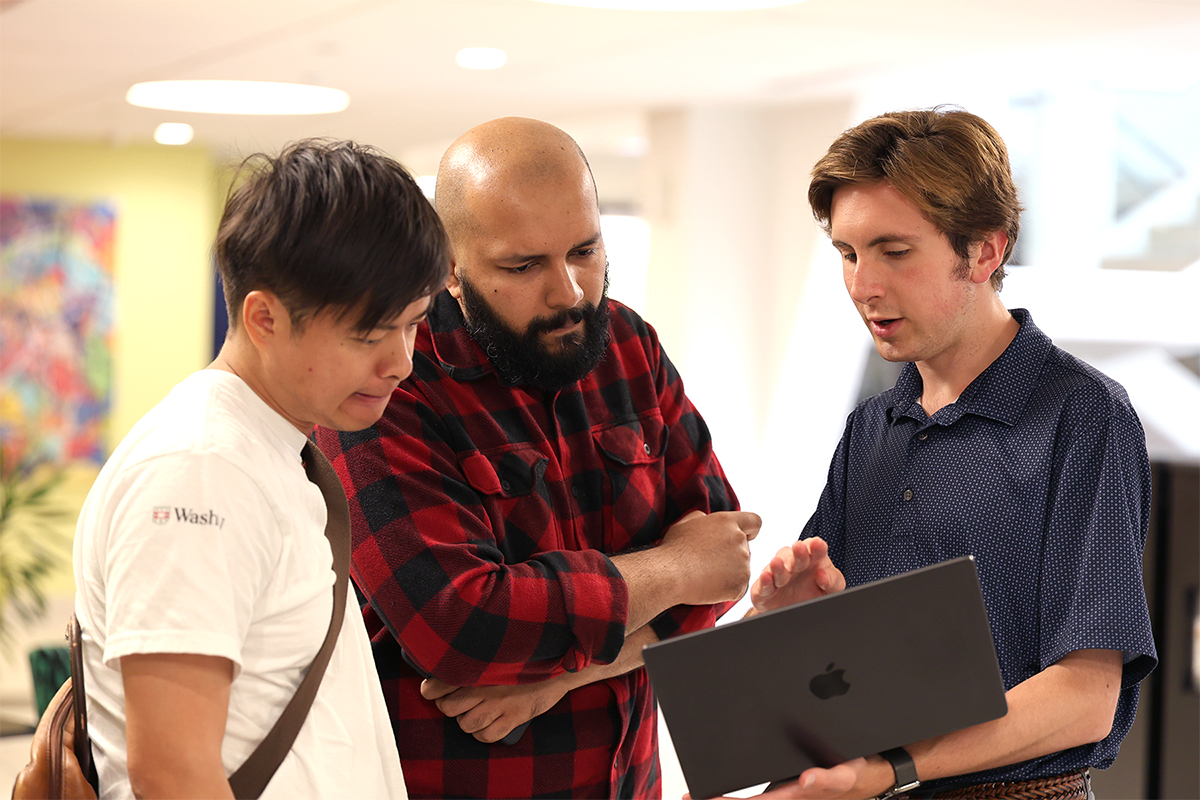
The ideas kept coming. So the team behind WashU’s AI Perspectives Week decided to add a second week of programming.
Nathan Jacobs, vice provost for artificial intelligence, was not surprised by the community’s interest.
“The proposals came from every corner of the university,” said Jacobs, a professor of computer science and engineering at WashU McKelvey Engineering. “Our faculty and students have an incredibly wide range of opinions and perspectives on AI. They are keenly aware of the profound impact this new tool is having on our society, in education, in the environment, in research, and they want to talk about it. AI Perspectives Week will give people that opportunity to navigate these incredibly challenging questions.”
AI Perspectives Week will host roughly 40 lectures, workshops, panel discussions and showcases. The series opens Thursday, Sept. 17, with the AI and Environmental Research Symposium, which will highlight faculty deploying AI in their research, and closes Sept. 30 with “AI in the Local Legal Community,” a conversation with St. Louis attorneys moderated by Stefanie Lindquist, the Nickerson Dean of WashU Law.
In the days in between, members of the WashU and St. Louis community can learn how to build an AI chatbot with the Center for Teaching and Learning, explore the ethics of AI with WashU Libraries and dive into the debates surrounding data centers and government regulation at the Gephardt Institute for Civic & Community Engagement.
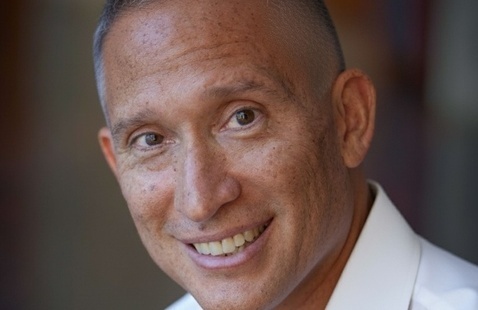
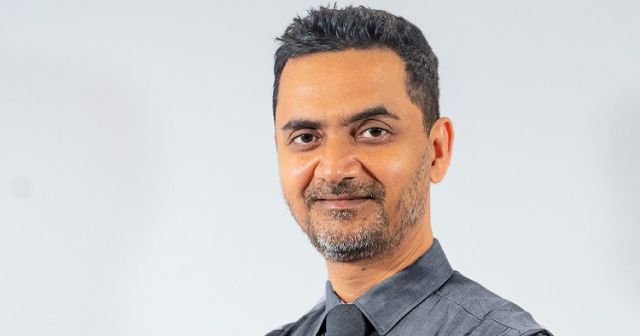
AI Perspectives Week also will showcase some of the nation’s leading thinkers in AI. The WashU Assembly Series will present Eric Horvitz, chief scientific officer at Microsoft, in conversation with Philip Payne, vice chancellor for biomedical informatics and data science at WashU Medicine and chief health AI officer for BJC Health and WashU Medicine, on Sept. 22. AI innovator and scholar José Bowen will discuss how educators can promote the intellectual friction that is essential to learning in his address, “Preserving Critical Thinking,” Sept. 24. And Abridge founder Shiv Rao will explain why continuous evaluation must be the operating system for how AI is built, deployed and improved, Sept. 29.
Jacobs is especially excited to learn how faculty are leveraging new WashU programs in their research and teaching. The Digital Transformation Research Corps Showcase Sept. 17 will spotlight the faculty-student developer collaborations that resulted in new AI-driven tools and products that advance important research. For instance, two undergraduate students built an ethical, AI-competent 3D library of human remains in collaboration with anthropology faculty. Jacobs hopes faculty attend the showcase and submit their own proposals for next summer’s program.
“We’re providing a service of recruiting and supervising these talented students to produce something that moves the needle for their project, whether that be something they can show to a potential donor or include in a proposal,” Jacobs said. “I think any faculty member who attends the showcase will be amazed by what’s possible.”
Participants in the AI Curriculum Corps (AICC) also will showcase their work Sept. 24. The summer program helped 80 faculty members create new lessons and courses that incorporate or interrogate AI.
“We all are wrestling with these questions of how do you ensure students are learning how to think critically and how do you measure and assess that,” Jacobs said. “The faculty who participated in the AICC really thought about those questions constructively. You can see the results in the classroom today.”
Jacobs stresses that AI Perspectives Week is not only for AI adopters. Skeptics are welcome.
“I’m a computer scientist, and for 20 years I’ve been thinking about AI. For most of the people who sit near me, it’s very much a great new tool,” said Jacobs who is developing a geospatial artificial intelligence capability to find early signs of instability in crop production. “But you talk to different disciplines and different faculty and students and there are very different perspectives. Our goal is not to cheerlead, but to activate the community so we can think about these issues and respond to them in a way that moves us forward.”
AI Perspectives Week is co-sponsored by the Center for Teaching and Learning, the Digital Intelligence & Innovation Accelerator, and the Office of the Provost.









Leave a Reply