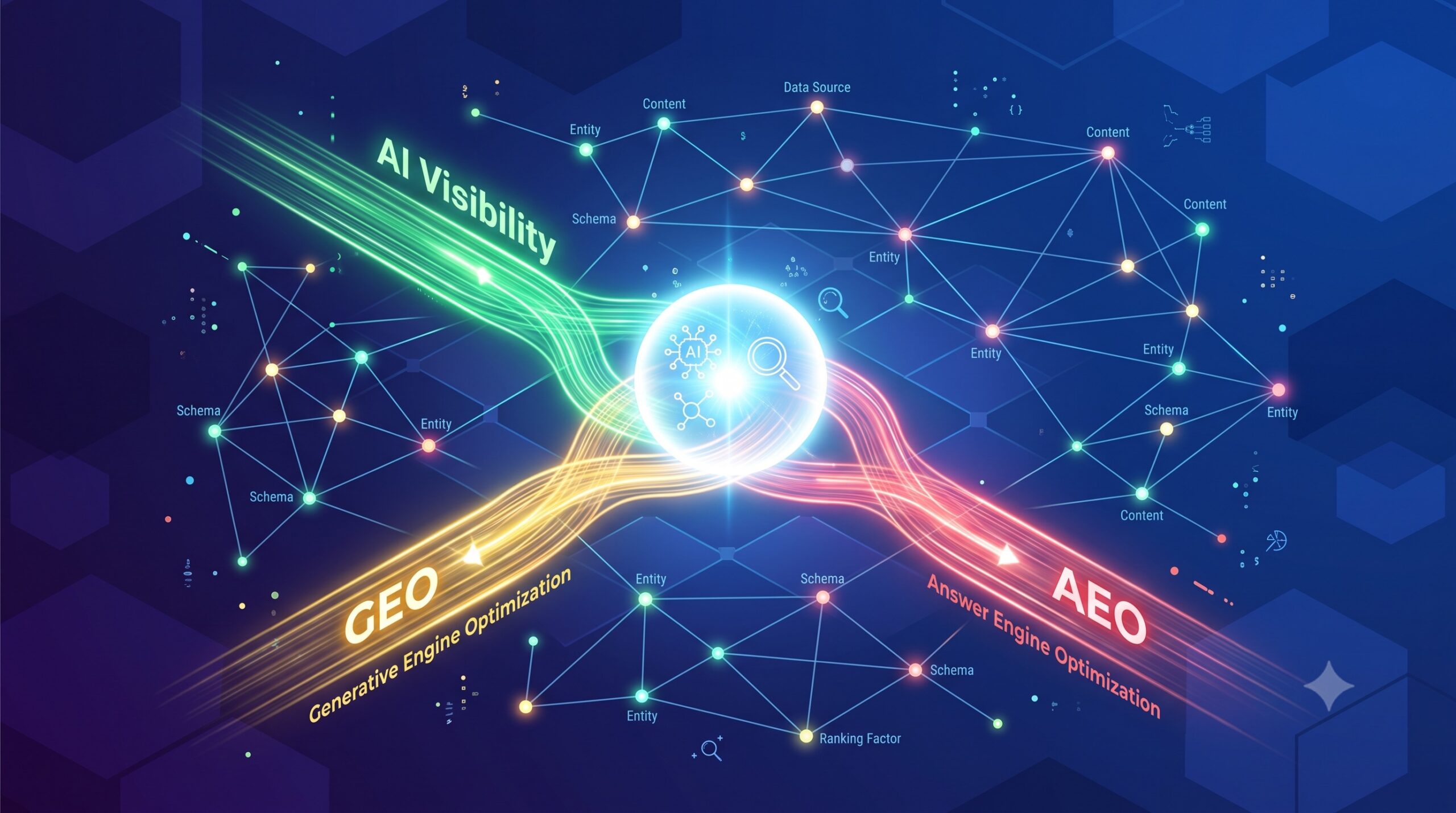
Your CMO just asked if you are “doing GEO now.” Your latest job posting lists AEO as a requirement. Your dashboard vendor calls all of it AI visibility. Three terms, one meeting, and nobody in the room is fully sure whether they are describing three different disciplines or the same idea wearing three different jackets.
This guide gives your team, and your boss, a shared vocabulary, so the next conversation starts with agreement on terms instead of a five minute detour to define them.
Why This Vocabulary Exploded Almost Overnight
A few years ago, none of these terms appeared in a typical marketing job description. Today, “AI visibility,” “GEO,” and “AEO” show up repeatedly and verbatim across G2 reviews, job titles, and job postings. That is a signal worth taking seriously: this is no longer a single vendor’s marketing language. It has become the industry’s shorthand for a real, shared problem: how do you know whether ChatGPT, Perplexity, or Google’s AI Overview are recommending your brand at all?
The trouble is that “shorthand” spreads faster than “definition.” Teams adopt the words before they agree on what the words mean, which is exactly how one person’s “AEO project” becomes another person’s “GEO audit” in the same planning document.
AI Visibility: The Umbrella Term
AI visibility is the broadest of the three. It describes whether, and how, your brand shows up when someone asks an AI system a question, whether that is a Google AI Overview, an AI Mode result, a ChatGPT response, or a Perplexity answer. Think of it as the AI-era equivalent of “search visibility”: not one tactic, but the overall outcome you are trying to measure and improve.
AI visibility depends heavily on how machine-readable your content is. Search engines and AI models increasingly parse the web through knowledge graphs, structured representations of entities and their relationships, rather than as a pile of keyword-stuffed pages. If your content is not represented clearly as connected entities, it is harder for an AI system to trust, extract, and cite it.
GEO: Getting Cited Inside the Answer
GEO (Generative Engine Optimization) is a tactic, not an outcome. It refers specifically to optimizing content so that generative engines, tools like ChatGPT, Perplexity, and Gemini, are more likely to surface and cite it directly inside a generated answer, rather than as one of ten blue links on a results page.
Where classic SEO optimizes for ranking position, GEO optimizes for something closer to trust and retrievability: is your content clear, well-sourced, and structured well enough that a language model chooses to quote or paraphrase it when constructing an answer?
This is why GEO conversations tend to focus on things like clarity of claims, citation-worthy data points, and content freshness rather than backlinks alone.
AEO: Structuring Content to Be the Answer
AEO (Answer Engine Optimization) is the closest cousin to classic technical SEO. It is about structuring content, using schema markup, FAQ formatting, and direct-answer patterns, so that both traditional answer boxes and newer AI systems can lift a precise answer straight out of your page.
We cover this in more depth in our Answer Engine Optimization (AEO) entry, but the short version is this: AEO is the discipline of making a single, extractable answer obvious to a machine, whether that machine is a featured snippet, a voice assistant, or an AI Overview.
How the Three Fit Together
Here is the alignment that saves your team the most arguing: AI visibility is the goal. GEO and AEO are two of the tactics that get you there.
- AI visibility answers the question “are we showing up?”
- GEO answers “are generative engines citing us inside their answers?”
- AEO answers “is our content structured well enough to be lifted as a direct answer?”
They are not three competing disciplines fighting for budget. They are three layers of the same stack. The confusion usually starts when two teams, say, content and technical SEO, each adopt one term as “their” project and build a separate glossary and a separate roadmap around it. That is where unified messaging matters: agree internally on which term describes the outcome and which terms describe the tactics, then use that language consistently in decks, tickets, and vendor conversations.
It does not help that the SaaS tooling landscape mixes these terms freely, sometimes for genuine technical reasons, sometimes because “AI visibility” tests better in a pricing page headline than “AEO.”
When you are evaluating vendors, ask them directly which of the three they are actually measuring or optimizing for. A tool that claims to do all three at once should be able to explain the difference in one sentence, not three paragraphs.
One Trap to Avoid
Do not treat this new vocabulary the way an old SEO habit once treated keywords: something to pile into a page until it “covers all the bases.” Keyword stuffing was a failed tactic a decade ago, and stuffing “AI visibility,” “GEO,” and “AEO” into your own content or metadata just to look current is the same instinct wearing a new outfit. The goal of this vocabulary is clarity of meaning, for your team and for the machines reading your content, not term density.
Key Takeaways
- AI visibility is the outcome: does your brand show up in AI-generated answers at all.
- GEO is the tactic for getting cited inside generative engine answers like ChatGPT and Perplexity.
- AEO is the tactic for structuring content so it can be lifted as a direct, extractable answer.
- Treat the three as layers of one stack, not competing projects, and agree on unified messaging internally before the vocabulary causes a turf war.
- Avoid keyword stuffing these terms into your own content just to appear current. Clarity beats density.
Your Next Step
Knowing the terms is step one. Knowing where your brand actually stands is step two. Start your free AI Visibility Audit → [wordlift.io/ai-visibility-audit] and see, in minutes, whether AI Overviews, ChatGPT, and Perplexity currently recognize and cite your brand.