
Seeing what others miss is a unique quality. That is what happened with Faria and Suha Zubair, who began looking for answers to their brother Zain’s strabismus. The last thing on their minds was a desire to change the way artificial intelligence was used in healthcare. They were thinking about a child, a person, a brother.
Strabismus, in which the eyes do not align properly, can go unnoticed in children. Left untreated, it can permanently affect vision and quietly erode a child’s confidence. For families far from specialists, getting the right diagnosis and treatment can be expensive and difficult.
The Zubair sisters’ answer, Strabi-Cure, was as simple as it was inventive. It uses a smartphone camera to screen for the condition, followed by gamified eye exercises and progress tracking. Even its home therapy device, made with biodegradable jute string, has been designed around affordability.
It is a small intervention aimed at a very real problem. And that is what makes it so interesting: the sisters have found a simple, practical use for AI.
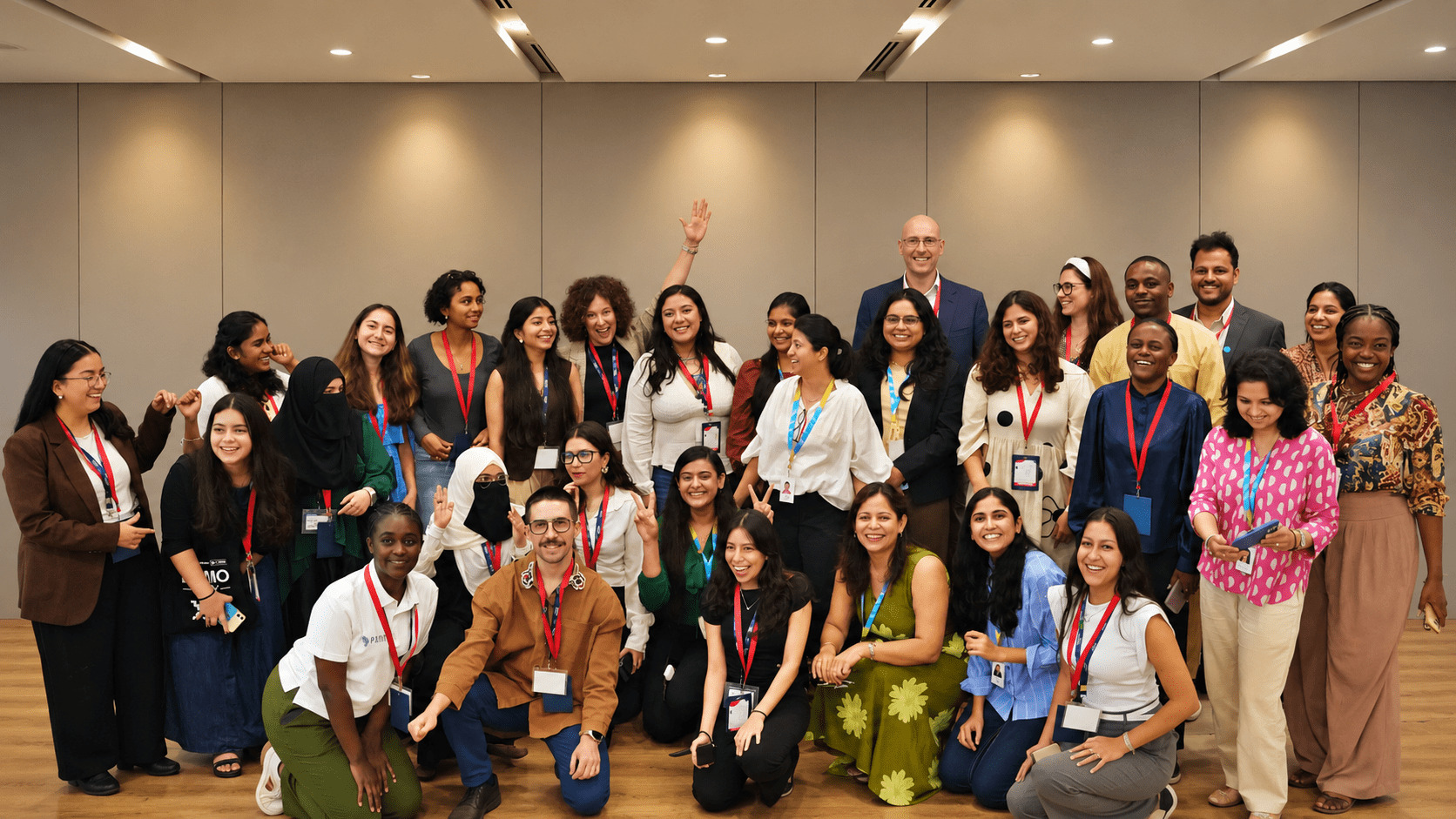
Their story is part of a much larger effort being encouraged through the AI Ventures Accelerator, supported by UNICEF Generation Unlimited and Technovation, giving young people the opportunity to look at problems around them and ask a deceptively simple question: “Can AI help?” If it can, how can we make it help? That is a different way of looking at artificial intelligence, far removed from the one that dominates the world’s AI conversation.
Making People Visible
In Rwanda, Amen Divine grew up watching her mother work as a loans officer at a local bank. She saw people with functioning businesses—tailors, market vendors and motorcycle-taxi riders—walk in looking for credit and walk out without it. The problem was not necessarily that their businesses were bad. It was just that the financial system could not see them at all. They had no conventional collateral, little or no credit history and few of the documents that formal lending systems rely on. Economically, they were active. Financially, they were invisible.
Divine’s PACIN, the Pan-African Credit Intelligence Network, is designed to change that. The system brings together everyday financial signals such as mobile-money transactions and remittances, using them to generate AI-based credit scores. The scores are designed to explain why a person has received a particular assessment.
PACIN does not lend the money. It gives lenders something they were missing: information. The team built its architecture in 60 days, interviewed over 30 small-business owners, and is working towards its first live data integrations in Kenya and Nigeria. There is something powerful about the idea: AI is not replacing the banker; it is helping him notice a customer who was already there.
Opening A Door
In Mexico, the problem looks different. Across Latin America, millions of young people struggle to find work because employers want experience they have never had the opportunity to acquire. The founders of CONCORA know that trap personally. Their answer is to change the question itself.
Instead of asking a young applicant to prove experience on a résumé, CONCORA allows companies to set real business challenges. Candidates respond with a video pitch and a demonstration of what they can do. An AI-powered skills assessment called Brújula—Spanish for compass—maps a young person’s strengths and gaps, helping create a path forward. For companies, the proposition is equally practical: rather than sort through applications for months, they receive five pre-vetted finalists in two weeks.
Launched in March 2026, CONCORA has reached 1,900-plus users in nine Latin American countries, conducted more than ten hiring challenges and closed four pilots. Most of its users are women.
Its message to applicants is mischievous in its simplicity: “By applying, you already have experience.” That kind of idea makes AI feel less like a machine from the future and more like a door that somebody has finally figured out how to open.
Thomas Michael Kaye, Senior Adviser, Global Solutions, Generation Unlimited, UNICEF, explains: “These girls have shown us creativity, persistence and the power of partnerships. Our approach was simple—seek out young girls and women who had identified local problems and wanted to bring about change. Through this programme and with AI tools, they have managed to bring about change.”
Rekindling Markets
In Africa’s informal food markets, another problem is brutally physical. Produce spoils. For small-scale vendors, many of them women, a crate of vegetables going bad is not an abstract supply-chain inefficiency. It is lost income. Sometimes, it is the difference between making the day’s money and going home with a loss.
In Kenya, KilimoChills is using AI to tackle the problem from inside a solar-powered cold-storage system designed specifically for informal markets. Its modular units have three temperature zones. Sensors monitor them, while an AI model looks for early signs that a compressor may fail—before a trader loses any stock. Another model studies local sunlight patterns and determines when the system should draw power from solar panels, batteries or the grid. The result is striking: post-harvest losses have been reduced by over 80 per cent.
There is another dimension to the project. The founders have also studied the devastating effect of fires in crowded markets, where one disaster can wipe out years of work. Protecting the livelihoods of women traders is not an incidental benefit; it is part of the reason the system exists. This is AI doing something gloriously unglamorous.
Keeping vegetables cold. Because sometimes, that is where technology matters most.
Catching the Machine
If KilimoChills makes AI practical, Glitch Detectives makes it playful. The Nigerian project turns a familiar classroom activity upside down. Instead of giving children a math problem and asking them to find the answer, it gives them an answer that contains a mistake.
An AI companion called ZED-4 presents the work. The child becomes the investigator. Find the glitch. Work out what went wrong. Repair it. Then explain the mistake in your own words. Designed for children from kindergarten through sixth grade, the platform uses interactive missions and printable activities without timers or pressure. The intention is important, more so in a world where children will increasingly encounter AI-generated answers.
The lesson is not simply mathematics. It is scepticism. A machine can be impressive and still be wrong. And for children growing up in a world filled with AI-generated answers, learning to question what a machine tells them may become as important as learning to find the answer itself. There is something deliciously appropriate about this. At a time when adults are worrying about whether humans will surrender too much to machines, these children are being taught something wonderfully simple: Don’t automatically believe the machine. Check it. Challenge it. And, when necessary, correct it.
In teaching children, the girls behind the projects have transformed their own outlook as well. Rebecca Anderson, Chief Learning and Innovation Officer at Technovation, found this the most rewarding part of the programme—“It has been so exciting to see these girls grow with their projects.” She says while some projects may have qualified for further development, every single project is unique in itself. “All 200-plus teams that completed the programme have won.”
Finding a Voice
In Kazakhstan, for instance, Diana Murzagaliyeva knows the problem her technology is trying to solve because she lived it herself. She struggled with a speech disorder. Across the country, many children with speech difficulties face long waits for therapy or have no access to it at all, particularly outside major cities where specialists are scarce.
SpeakUp is designed to put that support into an app. The system listens to unclear speech, converts it into text and gives children real-time feedback through games. A virtual character called Speechy provides another important ingredient: a space where practising does not feel like being judged. Parents and therapists can track progress through reports.
The beta version has already been tested with more than 500 children, with pilots running in schools and speech-therapy centres. Again, the technology is not the story by itself. The story is what the technology allows a child to do: Speak. Try again. Speak better. And soon, speak without being afraid.
A Different Story
Put these projects together and a different picture of artificial intelligence emerges. It is not the AI of giant laboratories. It is not measured in billions of dollars, processors deployed or models trained on massive quantities of data.
It can be a smartphone camera looking at a child’s eyes; a credit system trying to see the economic reality of a market trader; a hiring platform giving a young person a chance to demonstrate what they can do; a solar refrigerator keeping vegetables from spoiling; a cartoon AI character teaching a child to look for a mistake; or a virtual companion helping another child find the confidence to speak.
None of these projects will settle the great arguments about AI. They are not supposed to. They start with a person, a place and a problem. Perhaps that is another way to think about the AI revolution. Not every breakthrough needs to be enormous. Not every useful application needs a billion-dollar valuation. Not every piece of technology needs to change the world.
Sometimes, it is enough to change one corner of it. Then another. And another. Until, almost without noticing, the future arrives not with a bang, but as a child seeing clearly, a trader protecting her day’s income, a young woman getting a fairer shot at a job, or a child discovering that even a machine can be wrong. It may not be the world’s loudest AI story. But it may be one of its most hopeful.












Leave a Reply