

A mathematician at artificial intelligence company Anthropic says he has used the company’s Claude chatbot to prove one of the most famous unsolved problems in mathematics, potentially ending a nearly 170-year search for an answer.
Levent Alpöge announced Nov. 20 that he had developed proof of the Riemann hypothesis with help from Claude. The problem was first proposed in 1859 by German mathematician Bernhard Riemann and has challenged mathematicians for generations.
The claim received significant support Nov. 21, when the Lean Focused Research Organization and the Mathlib Initiative announced that they had independently verified Alpöge’s proof using mathematical software. The organizations said they had “full confidence” in the proof’s correctness.
However, the announcement does not mean mathematicians have finished examining or understanding the work. Some researchers might still need to assess the mathematical ideas behind the proof, and the Clay Mathematics Institute continues to list the Riemann hypothesis as unsolved.
“I believe I have, working with Claude, discovered a proof of the Riemann Hypothesis,” Alpöge wrote in a statement published on his website.

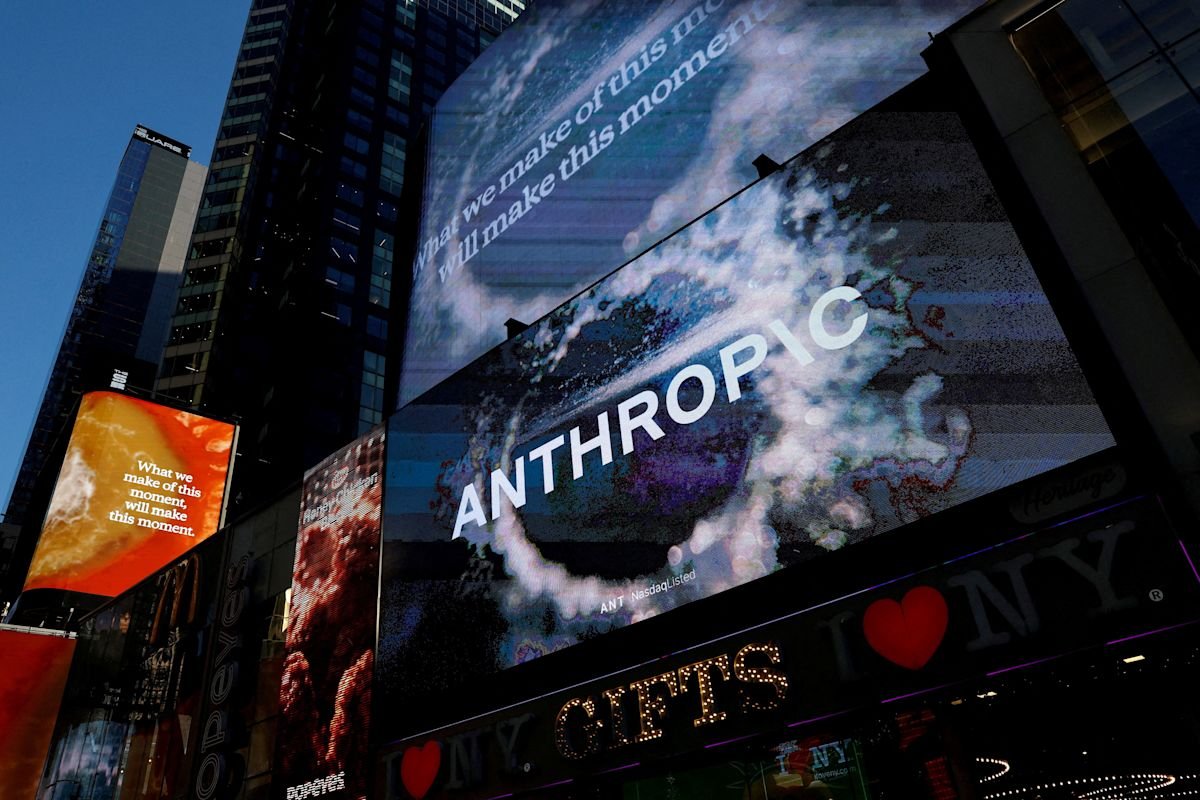
An Anthropic, PBC (ANT) sign in Times Square on the day Anthropic holds its initial public offering (IPO) at the NASDAQ Market site in New York City, US, November 19, 2026.
What is the Riemann hypothesis?
The Riemann hypothesis is a mathematical problem involving prime numbers, which are numbers greater than 1 that can only be divided evenly by themselves and 1. Examples include 2, 3, 5, 7 and 11.
Prime numbers may appear randomly along the number line, but mathematicians have long studied whether there is an underlying pattern to how frequently they appear. The Riemann hypothesis proposes a mathematical relationship that would help explain how prime numbers are distributed.
First introduced by Riemann in 1859, the problem is one of seven Millennium Prize Problems selected by the Clay Mathematics Institute. The institute offers a $1 million prize for a correct solution to each problem.
In his announcement, Alpöge said his work also establishes the Generalized Riemann Hypothesis, which extends the original problem to a broader family of mathematical functions.
How did AI help solve the problem?
Alpöge said he worked with Claude for approximately six weeks to develop the proof. He released the mathematical argument as computer code written in a programming language called Lean.
Lean allows mathematicians to check proofs by examining their individual steps and determining whether the reasoning follows established mathematical rules.
In their Nov. 21 announcement, the Lean and Mathlib communities said they checked that Alpöge’s code proved the correct mathematical statement and that multiple independent checking systems accepted the proof.
Alpöge credited Claude with making significant contributions to the work, particularly as the project approached its conclusion.
“Claude and I have had a great time together with such breadth in recent months, but this time Claude far outpaced me near the finish line,” he wrote.
What could the discovery mean for mathematics?
The potential significance of the proof extends beyond the Riemann hypothesis itself.
Mathematician Hector Pasten of the Pontifical Catholic University of Chile told Scientific American that, if the proof is correct and its ideas are understood, it could connect different areas of mathematics that researchers have only partially linked.
He compared the potential discovery to a Rosetta Stone, the ancient artifact that helped scholars decipher Egyptian hieroglyphics.
The announcement also adds to growing questions about how artificial intelligence could change mathematical research, as technology companies invest heavily in developing AI systems capable of solving increasingly difficult problems.
For Alpöge, the discovery represents both the potential end of a longstanding mathematical mystery and the beginning of something much larger.
In his statement, he acknowledged that some mathematicians might feel a sense of loss after spending years pursuing the problem. But he also expressed optimism about what AI could make possible across science.
“What I saw during the course of progress so amazed me that I believe it is one dawn across science of something far greater,” he wrote.
Reporter Anthony Thompson can be reached at ajthompson@usatodayco.com or on X @athompsonUSAT
This article originally appeared on USA TODAY: Anthropic mathematician says AI helped solve famous math problem













Leave a Reply