When Melanie Topper sent out invitations for her daughter’s bat mitzvah in December, she added a note so that guests, particularly non-Jewish ones, would know there would be a police car parked outside the synagogue and an armed guard near the entrance.
She says she did not want guests to be startled, but to know this was an act of preventive security due to the spike in violent antisemitic attacks in America – and around the world.
“People said, ‘Thanks for the heads up,’ that they had not realized that is what happens [today] at synagogues. I try to remember that people don’t know what they don’t know and it’s not out of malice,” says Ms. Topper, who lives in a Washington suburb, but grew up in Mobile, Alabama, where she was often the only Jewish person in her class.
Why We Wrote This
Many Jews report a less welcoming climate in the United States. As they deal with threats amid heightened criticism of Israel, many are also grappling with this question: “What does it mean to be an American Jew today?”
“I’ve always taken being Jewish as a serious responsibility, and try to educate as much as I can,” she says.
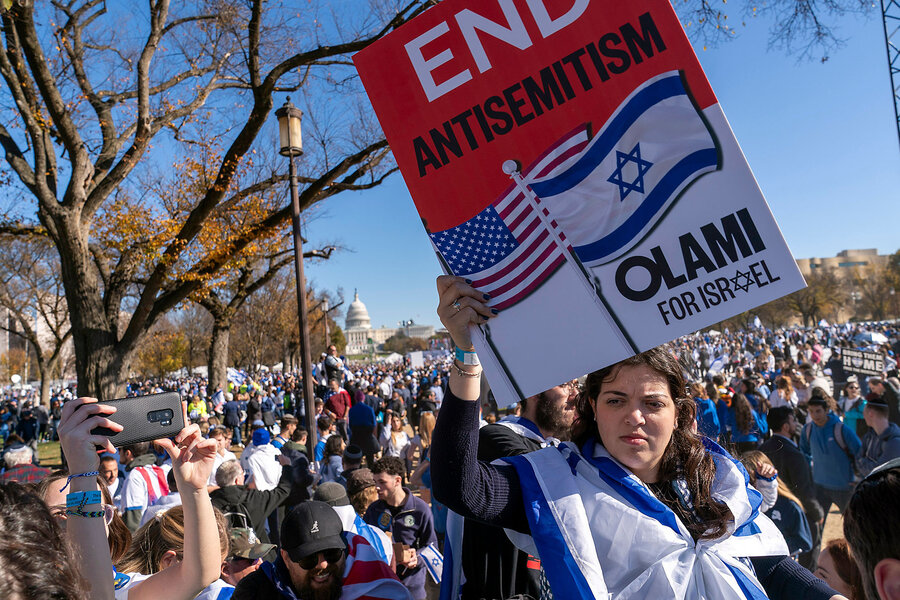
Some American Jews have been explaining to non-Jewish friends, neighbors, and colleagues the fear and apartness they have felt since Oct. 7, 2023, when Hamas breached Israel’s southern border and launched an attack that sparked the Gaza war and the anti-Israel – and in some cases antisemitic – backlash that followed.
In interviews, they describe a sense of disorientation, as if they have been jolted into an entirely new era, in which some have lost friendships and a sense of belonging. This is especially true in some progressive social circles that never condemned the Oct. 7 violence, and in some cases even within their own Jewish communities that hold differing opinions on what supporting Israel means.
Jewish writers and filmmakers report being excluded from talks and festivals and experiencing difficulties in getting new books published. American Jews are asking themselves whether the post-World War II era of acceptance and relatively low antisemitism is over and whether they are now being abandoned by people and institutions they long considered allies.
“People are asking questions about their own identity as American Jews: ‘What is my relationship to Israel? With the United States?’” says Rabbi Andy Vogel, who leads Temple Sinai, a Reform synagogue in Brookline, a Boston suburb.
Evidence of the shift shows up in public opinion polls and in statistics on violence. Nearly half (48%) of American adults say the U.S. is too supportive of Israel, a record high since pollsters at Quinnipiac University began asking the question in 2017, when that figure was at 16%. Only 7% of respondents in the most recent poll said the U.S. isn’t supportive enough.
Historian James Loeffler, in his new book, “Exceptional Hatred: Antisemitism and the Fight Over Free Speech in Modern America,” describes how the Oct. 7 attack thrust the Israeli-Palestinian conflict onto U.S. college campuses and into the national discourse. The conflict was reduced to “crude binaries of oppressor and liberator, terror supporter and anti-war protester …. No space remained to mourn all victims or hold multiple truths.”
In its original definition, the term “Zionism” meant supporting Jewish national self-determination in the biblical homeland of the Jewish people. Some say the line between anti-Zionism and antisemitism can blur when opposition to Israeli policies veers into prejudice against Jewish people, in some cases tapping age-old anti-Jewish tropes about money and power.
Incidents of violence against Jewish Americans have surged over the past decade. Although overall antisemitic incidents declined in 2025 following a record-breaking year in 2024, the number of antisemitic physical assaults has continued to rise, according to the Anti-Defamation League (ADL), which tracks anti-Jewish crimes. It also found 45% of antisemitic acts invoked Israel or Zionism. (For comparison, violence against Muslims in the U.S. has also risen, but remains rarer than anti-Jewish violence.)
In April, police foiled a car-ramming plot against a synagogue and Jewish school in Houston. The judge overseeing the case said the would-be perpetrators wanted to “kill as many Jews as possible.” Law enforcement officials said the perpetrators’ group chat contained “disturbing anti-Jewish statements.” A similar plot was carried out in a Detroit suburb in March when a man – who had lost relatives to an Israeli attack on Hezbollah in Lebanon – rammed his explosives-laden pickup truck into a synagogue attached to a Jewish nursery school.
According to a recent AP/NORC poll, 3 in 10 Jewish Americans report feeling very or somewhat unsafe in the U.S. A similar share in the poll reported that they or someone in their household has experienced violence, verbal abuse, or property damage because of their Jewish background over the past year. About 63% described anti-Jewish prejudice in the U.S. as either an “extremely” or “very” serious problem.
Jonathan Greenberg, of Highland Park, Illinois, who describes himself as a conservative who voted Republican prior to Donald Trump’s 2016 candidacy and who identifies as a Zionist on his X account, says he receives occasional death threats. Almost all of the posts left on his page are focused on Israel, he says, “but if you scratch the surface very lightly you see the Jew hatred.”
Mr. Greenberg says he has not lost any non-Jewish friends, and he attributes that to being in more Republican circles. “There is a growing problem on the right, especially the far right. But I think, for a change, the right is doing a better job of policing its crazies than the left is.”
Social worker Shara Kaufman moved to Oakland, California, to live in a progressive community, where she believed she would fit in, but now feels increasingly less at home.
“Physically, I don’t feel unsafe. But I do feel emotionally unsafe,” says Ms. Kaufman, whose friend’s son, Hersh Goldberg-Polin, was among the 251 taken hostage by Hamas, and who was later executed. When she hung a poster of him from the window, one daughter asked if they were going to be targeted.
Across the country, Allison Groff has seen an old and chilling form of antisemitism rear its head.
This school year, Dr. Groff, a physician from Frederick, Maryland, discovered both of her sons were taunted by classmates with Holocaust references. One told her 10th grader he should “get ready to be sent to a camp.” The student, later revealed to have drawn Nazi-associated insignia for a school fundraiser project, was expelled for threatening to bring a gun to school. Her son told her he had warned him he’d be his “first target.” A classmate recently gave the “Heil Hitler” salute to her younger son, a middle schooler.
“We are living in a country where our political leadership is challenging to say the least, regarding xenophobia and prejudices, so it feels harder to speak up,” Dr. Groff says.
Some individuals and groups are trying to respond. At Harvard University, which has faced criticism and a federal lawsuit over allegations that it has failed to provide a safe atmosphere for Jewish students, 170 Jewish and non-Jewish faculty members recently published an open letter calling for more action to address the issue.
Like other synagogues, Rabbi Vogel’s near Boston has seen its security budget balloon in wake of the 2018 shooting that killed 11 people at a Pittsburgh synagogue.
“We are concerned about white nationalist violent attacks, and about attacks from people on the left who associate us with Israel and engage in violence simply because we are Jewish,” he says.
Rabbi Vogel says his synagogue community has worked to delve into this charged political time both in the U.S. and Israel. “We want to wrestle with the serious issues that touch our hearts and encourage people to talk about them,” he says.
That outlook has led to working in coalition with other groups, such as those trying to protect Boston immigrant communities from enforcement actions by Immigration and Customs Enforcement. The synagogue added a prayer during the war in Gaza that called for both the release of the hostages taken from Israel and for an end to the destruction and displacement in Gaza. Since the Iran war began, it has introduced a new prayer – one for peace during a time of conflict.
Rabbi Vogel says he and his community deal with a new barrage of challenges every day, all of which lead to one underlying question: “What does it mean to be an American Jew today?”