When Donald Trump ran for president in 2024, he promised to get gas prices below $2 a gallon “within 12 months.” That sounded good to an electorate unhappy about the high cost of living; Mr. Trump secured his second term in the White House, propelled by double-digit advantages on the economy, inflation, and energy prices.
A year and a half later, with the United States at war with Iran, those onetime advantages are looking like potential liabilities, as voters express growing dissatisfaction with high prices in the run-up to the fall midterm elections.
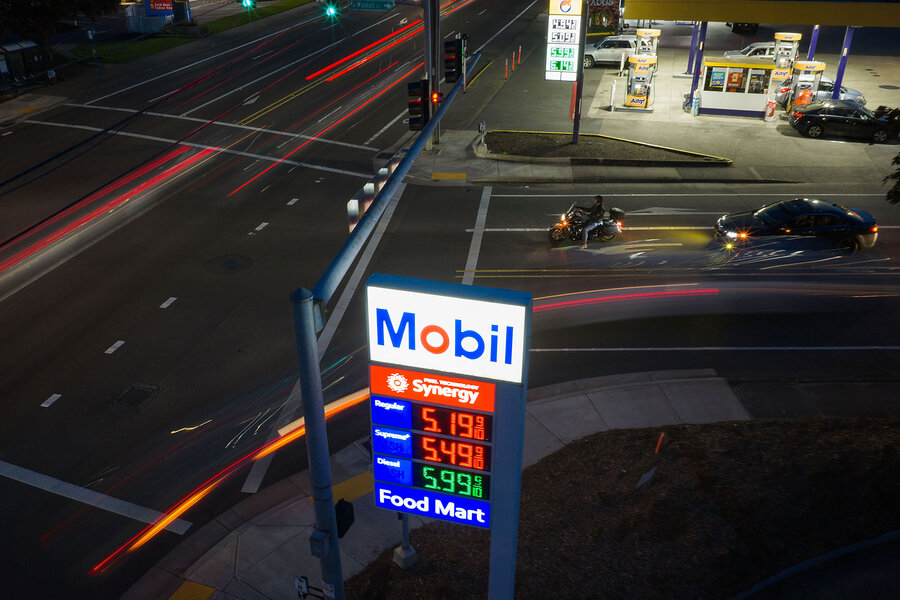
Oil and gas prices have surged to their highest levels since 2022, with the average cost of a gallon of gas reaching $4.30 on Thursday. This week alone, gas jumped by 72 cents a gallon in Michigan and 60 cents a gallon in Ohio, both states with key Senate and House races. Nationally, polls show Mr. Trump’s approval rating has sunk below 40%, with the cost of living a top concern for voters, who now say they trust Democrats more than Republicans on the economy for the first time since 2010.
Why We Wrote This
High prices at the pump pose a direct hit to many Americans’ wallets, and are a driver of other costs. Some GOP strategists worry that even if the Iran war ends soon, voters may not feel an improvement in their finances before the midterm elections.
“Based on the perception of American consumers, the economy has not gotten better, and inflation has gotten worse,” says conservative pollster Whit Ayres. “That’s a problem when you’ve run on a promise of lowering inflation and increasing the economy.”
Midterms are usually a referendum on the party in power, particularly when the president’s party holds both chambers of Congress. And gas prices – a visible, direct expense for most Americans, as well as a driver of other costs – are a “very big concern” for 78% of voters, according to a recent Reuters/Ipsos poll. That’s creating an increasingly challenging electoral landscape for Republicans, who currently hold narrow majorities in both the House and the Senate.
“At the end of the day, people really just care about what’s going on in their own pocketbook,” says Republican strategist Maura Gillespie. Even if the war were to end in the next few weeks and energy prices start to come down, she notes, it might take a while for the turnaround to be felt in household finances. “The mood may have already soured so much that they can’t necessarily recover from it in time,” she says.
Political winds and the price of gas
Presidents have long seen their political fortunes directly tied to the cost of fuel – even when it’s out of their control. At various times, some have employed short-term fixes such as releasing oil from the Strategic Petroleum Reserve to try to ameliorate price spikes. But longer-term fuel crises can be politically devastating, as Democrats saw with Jimmy Carter and the 1970s oil embargo.
While the price of oil has risen over the past two months, as Iran shut down the Strait of Hormuz and the U.S. imposed its own blockade, it has also fluctuated wildly.
“It’s so much based on people’s hopes and fears,” says Robert Kleinberg, an adjunct senior research scholar at the Columbia University Center on Global Energy Policy. “Every time a ceasefire is announced, the price of oil goes down; a ceasefire is canceled, the price of oil goes up.”
Mr. Trump’s own MAGA coalition has been unusually divided over the war, with many prominent conservative commentators sharply criticizing the president for abandoning his promise not to involve the U.S. in costly foreign entanglements.
Ms. Gillespie isn’t concerned about losing Republican voters outright, but she says that some may choose to stay home in November. And she’s worried that independent voters who supported Mr. Trump last time around, in large part because they believed he would boost the economy, could wind up turning against the GOP.
“I do think they’re going to be inspired to go vote against Republicans,” she says, “because of what they feel is a bait and switch.”
Independent voter Mark Tepper, a tech salesperson from Nashua, New Hampshire, voted for Mr. Trump in the last election and says he will likely vote Republican again in the fall. But he’s eager for the war to wrap up soon: “I do wish that President Trump finishes the job with Iran and doesn’t give them an opportunity to drag this out much longer.”
For now, he’s been adjusting his driving schedule to be more cost-efficient. When out and about, “I try to do as many chores as possible so I don’t have to go out a second and third time,” he says over text.
Democrats see an opening to paint Republicans as out of touch with the concerns of ordinary Americans. While voters are struggling to fill up their tanks and make ends meet, they say, the president is building a $400 million ballroom and catering to billionaire donors.
“There are central things all Democrats agree on, from housing to healthcare to energy, that all stem back to affordability,” says Antjuan Seawright, a Democratic strategist. “[Republicans’] crisis is our opportunity.”
At a hearing on Capitol Hill earlier this week, Democratic Rep. Maggie Goodlander of New Hampshire asked Defense Secretary Pete Hegseth directly whether he knew what the average cost of gas was on Feb. 28, the day the U.S. began bombing Iran.
“It depends on where you live,” Mr. Hegseth responded. “If you live in California, it’s eight bucks.”
“$2.83,” Ms. Goodlander responded. “Do you know what the average cost of a gallon of gas is today?”
“Much higher in California,” he said.
“$4.23,” she continued. “I gotta say, Mr. Hegseth, you said you’ve got a crack economic team that’s looking at the impacts of this war on the American taxpayer – and you can’t answer this basic question?”
Same pump, much higher prices
Some Trump voters who are frustrated with rising fuel costs say they are prepared to give the president leeway – for now.

Patrik Jonsson/The Christian Science Monitor
Eddie Perry remembers the price of gas when he first worked as a pump attendant back in 1969: 18 cents a gallon. That job later turned into a career as a gas station owner.
On Tuesday, at the very same pump that Mr. Perry, now retired, once owned on Wilmington Island, Georgia, it cost him over $100 to fill his Chevy truck.
“Well, I’m angry about that,” he says.
Still, he doesn’t blame the president. “I feel like President Trump is doing the best job he can with the situation,” Mr. Perry says. “We may end up in an extended war on account of his stubbornness. But if that’s the case, that’s the case.”
For other Trump voters, there may be a limit to their patience.
Harris, a contractor from Wilmington Island, who asks not to use his last name because he doesn’t want his business associated with politics, says he voted for Mr. Trump in the last three elections in large part because of his aversion to the Democrats’ “woke politics.”
He knows political parties use gas prices as a cudgel, recalling stickers a few years ago that showed up on gas pumps of former President Joe Biden, pointing to the price window with the caption, “I did that.”
Because he feels more culturally aligned with Republicans than Democrats, he’s prepared to ride out the current prices – but only to a point.
“Unless it gets too much more,” he says. For now, he figures he will just have to keep “rolling with it.”