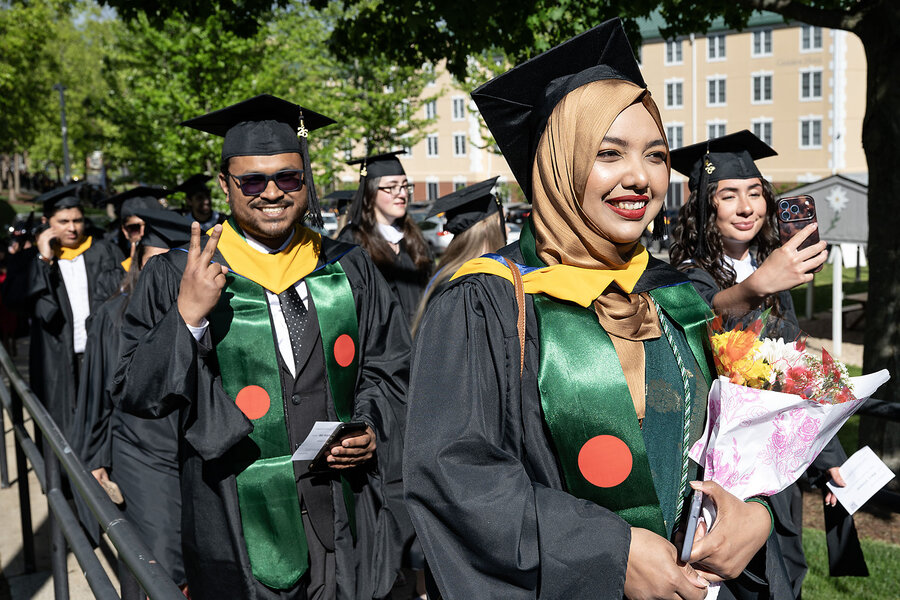
When nearly 2,000 students, many of them from abroad, received their graduate degrees on a recent sun-splashed afternoon at the University of New Haven in Connecticut, it might have been the last graduate student commencement of its size on the campus for some time.
The school, which grew its graduate student enrollment with popular programs in engineering, business, and public health, has lost some 3,000 graduate students from abroad over the past two years. When new international graduate students arrive this fall, they will number only in the dozens rather than the hundreds.
A variety of factors conspired to force this major shift in the school’s student body, but they have in common the policies of President Donald Trump. The administration’s goals of restricting legal immigration and pushing back against critics on U.S. college campuses combined to reshape who is filling college classrooms across the country, experts say.
Why We Wrote This
Enrollment of graduate students from abroad is plunging at U.S. schools, leaving them with gaping holes in their budgets. Experts blame restrictive visa and travel policies that are dampening the usually strong demand for American higher education.
DePaul University in Chicago suffered a 30% overall decline in international students, including a 62% drop in first-year international graduate school enrollment last fall. As a result, the school laid off staff and implemented salary and hiring freezes. Also facing a sharp decline in international graduate student enrollment, the loss of federal funding, and an ongoing structural deficit, the University of Southern California laid off more than 1,000 employees.
At the University of New Haven, the $35 million hole created by the enrollment drop accounted for about 17% of its budget. It led the school to stop contributing to employee retirement accounts, to cut about 10 academic programs, and to eliminate 80 jobs through attrition. Every administrative office was reduced in size.
“Anytime you have to give up that large of a portion of your revenue, you’ve got to make adjustments,” University President Jens Frederiksen says.
A policy shift
Nationwide, new international student enrollments – undergraduate and graduate – were down 17% last fall, according to the Institute of International Education and 10 partner higher education associations. The surveyed schools said that visa application concerns and travel restrictions were the leading factors.
Dr. Frederiksen went to India – his university’s largest source of international students – in 2024 because he heard applications were softening. Even then, before Mr. Trump’s election victory that November, U.S. consular officials appeared to be tightening visa availability. “This predates the current administration here in the U.S., but it was almost like the embassies were kind of hedging for a complete shift in the approach to international students,” Dr. Frederiksen says.
This year, the Trump administration expanded a ban on entry and the issuing of visas to nationals from 39 countries, including non-immigrant visas used by students. In 2025, the government revoked more than 8,000 student visas, in some cases, for students with criminal offenses and others apparently for participating in pro-Palestinian protests. Foreign visa applicants also now have to make their social media accounts public for vetting.
Additionally, last year, the Trump administration terminated or froze billions of dollars in grant funding to U.S. colleges and universities. That halted research that is often carried out by international students, leading them to look elsewhere to continue their work. And there is concern that the administration is trying to end or limit a program that allows foreign students to work in the United States for three years after graduation to gain experience and find an employer to sponsor them for a work visa.

“We will see it once these students work their way through, and we continue to have fewer and fewer new students coming into the pipeline, then that will have effects,” says Rachel Banks, senior director for legislative strategy and public policy at NAFSA: Association of International Educators, a nonprofit organization dedicated to international education and exchange.
“Historically, the administration, specifically the State Department, has sent out messages or cables to all of its consulates to say, ‘We want to make sure that students get priority in terms of appointments and processing’,” Ms. Banks says. “We didn’t see that happen last year.”
International students targeted
Zuzana Wootson, the deputy director of federal policy at the Presidents’ Alliance on Higher Education and Immigration, which advocates for immigrant students, cautions that there is a cumulative impact of having fewer international students. She says that losing those students represents not only a loss of tuition for schools, but a broader hit to the economy because of the money they generated through their work.
“We can’t know all the students who are considering applying to the United States and talk to them fully to understand why they changed their mind. However, we can make some pretty educated estimates of what is happening,” Ms. Wootson says. “The key thing is policies over the last year that have targeted international students.”

Frederick Hess, a senior fellow and director of education policy studies at the right-leaning American Enterprise Institute, says the Trump administration’s policies affecting international students are appropriate.
Many international students have been indoctrinated to hate the U.S. and develop anti-American beliefs, Mr. Hess says, signaling those who participated in protests during Israel’s war with Hamas. He says if schools dealt with antisemitism on campus better and had worked with the Trump and Biden administrations to spot bad actors during the visa process, none of this would be happening.
“In so many cases, politics is reactive, and what we’re seeing here is a reaction to the fact that these institutions didn’t do a better job taking care of it themselves,” he adds.
Anxiety on campus
Reading headlines of foreign students being arrested and deported made Kim Kanor of Ghana anxious. He received his master’s degree in computer science from the University of New Haven this spring. “I was worried, and it got progressively worse.”
He says the school supported students such as himself by inviting immigration attorneys to campus and making legal services available.
But his mother missed his graduation last week because her visa application was denied, despite Ghana not being one of the 39 listed countries. And Mr. Kanor does not plan to fly home to see his family, because he fears he might not be allowed to return to the U.S. despite having three years left on his visa.

He made good friends while at school, many of them international students. Some of them graduated with him, and others remain with limited resources after the university made cuts to the departments where he studied and worked. Now, that international diversity is thinning.
“It’s been really hard knowing that our tight-knit community here is dwindling,” Mr. Kanor says.
Others on campus said they expected the shift in the student body to become more visible in the fall when this large outgoing class of graduate students is replaced by what Dr. Frederiksen says could be just 50 to 75 international graduate students.
The impact is already being felt.
Days before graduation ceremonies, students at the University of New Haven packed up dorm rooms and snapped photos in their black caps and gowns on the school’s leafy quad.
“I noticed it because a lot of my electives were getting canceled,” said a student from Pakistan pursuing a master’s degree in public health, who agreed to speak anonymously to avoid repercussions. Whether a student’s visa could be affected appears to depend on the geopolitical situation, which can change week by week, the student said.
“I’m noticing not as many students in my field, and my peers from different degrees, they’re also having the same issues,” the student said.
A new normal
The University of New Haven is pivoting, and there is good news.

This fall, the school will welcome a record-setting first-year student class as its undergraduate student body outpaces its shrinking graduate programs. And it will open a branch campus in Saudi Arabia, a project already in the works before graduate enrollment plunged, which will now offer a new way to reach a pool of international students and open study abroad opportunities for students at the Connecticut campus.
Still, it will be a smaller school than it was just a couple of years ago. Total enrollment this fall is estimated to be 6,200 to 6,500 – down from more than 9,000 in 2024, Dr. Frederiksen says.
“That’s the new normal,” he says. “I think people have sort of braced themselves, so we’ve got to get to that point and then let’s see what kind of upside we can generate going forward.”
Staff writer Ira Porter reported from Wilmington, Delaware; staff photographer Alfredo Sosa and staff editor Chris Sherman contributed reporting from West Haven, Connecticut.