President Donald Trump has long assailed Democrats as radical leftists and Marxists. But after recent primary wins by self-described democratic socialists in New York, Washington, D.C., and Denver, the president has seized on a new label to accuse the Democratic Party of wanting to jettison capitalism for an altogether different system.
In recent speeches and social media posts, the president has repeatedly warned of “godless communists” who are “making their move” ahead of midterm elections that could flip one or both branches of Congress to Democratic control.
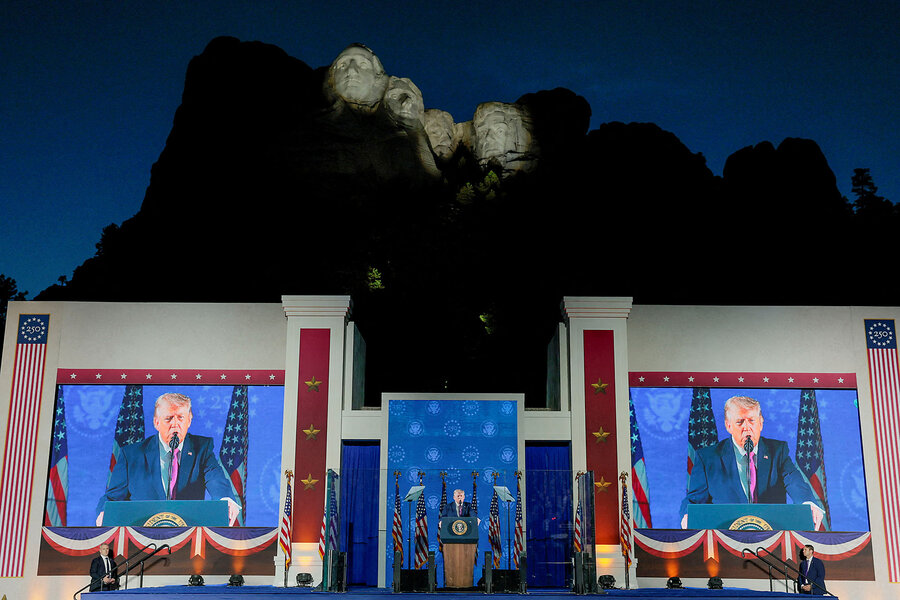
Speaking at Mount Rushmore over the July Fourth weekend, Mr. Trump said, “You can be a communist, or you can be a patriot. You cannot be both.” A June 28 Truth Social post declared that “Communism is the Greatest Threat to our Country since World War I, World War II, Pearl Harbor, or 9/11!” That same week, he told a conservative, faith-based conference in Washington that “communists” nominated by Democrats in New York City “want to completely destroy the traditional American way of life.”
Why We Wrote This
Polls show younger voters are less fearful of socialism and more likely to question the benefits of capitalism as it relates to their lives. But while anti-communist rhetoric is red meat for the Republican base, it might not persuade many other voters.
Republican House Speaker Mike Johnson used similar language at the same event, hosted by the Faith & Freedom Coalition. “They are openly running as Marxists, communists, for Congress,” he said.
The GOP rhetoric echoes the red scares of the previous century, when the Soviet Union posed a threat to the United States, and the hunt for communist sympathizers became a rallying cry for conservatives. It fits with Mr. Trump’s tendency to paint opponents as un-American or abnormal, says Robert Rowland, a professor of political rhetoric at the University of Kansas. “Trump is trying to boil down every possible sin into one word by using the word ‘communist,’” he says.
While democratic socialists favor greater government intervention in the economy and admire Scandinavian societies, it’s a far cry from Cuba’s brand of communism, in which the government directly owns businesses and restricts private enterprise. But, to many voters, those distinctions might be blurred. The Cold War ended decades ago, and many Americans have only a faint understanding of either state-backed socialism or communism.
At the same time, polls suggest that “socialism” is not the taboo it once was, which might explain Mr. Trump’s rhetorical pivot. Labeling Democrats as “communists” might resonate among older conservatives and immigrants from regions with communist or socialist dictators. But younger voters are less fearful of socialism, associating it more with European welfare states, and are more likely to question the benefits of capitalism as it relates to their lives.
In a 2025 Gallup survey, 54% of U.S. respondents held a positive view of capitalism, down from 60% in 2016 when Mr. Trump was first elected. Over the same period, the share who expressed a positive view of socialism rose from 35% to 39%. Those gains were almost entirely led by Democrats: 66% of Democrats held a favorable view of socialism, while just 42% viewed capitalism favorably.
A recent YouGov poll found 71% of Republicans viewed socialism unfavorably. Among independents, though, just 34% held unfavorable views of socialism, while 30% were favorable. Asked whether they would ever vote for a democratic socialist candidate, 24% of independents said they would, compared with 3% of Republicans and 62% of Democrats.

Anti-communist rhetoric is red meat for the Republican base, but isn’t likely to persuade many other voters, says Robert Blizzard, a GOP pollster and consultant. “It still works, but the ceiling is lower than it used to be,” he says via text message.
Still, the success of democratic socialist candidates in Democratic primaries will give Republicans a bigger target for midterm messaging, Mr. Blizzard adds. “It’s no longer purely rhetorical, we can point to real candidates [who are] actual democratic socialists, not just self-described progressives.”
Some of these democratic socialist candidates hold positions on issues such as policing and border security that are far outside the mainstream. CNN has reported that deleted social media posts by Darializa Avila Chevalier, a Democratic nominee for Congress in New York, contained positive references to Marxism and communism, mostly as concepts, while joking about anti-communism in movies and pop songs. Like other Democratic Socialists of America candidates, Ms. Chevalier, a graduate of Columbia University who helped organize pro-Palestinian rallies there, is highly critical of Israel and of pro-Israel Democrats.
Most of these activists came of age long after the Cold War that shaped Mr. Trump and his generation. Roy Cohn, who served as chief counsel to Sen. Joseph McCarthy, the iconic “red baiter” from the 1950s, was a mentor to Mr. Trump in his real estate career. Mr. Trump’s bombastic style, loose use of facts, and demonizing of opponents have drawn parallels with Senator McCarthy, who also hurled accusations without proof.
McCarthyism was effective in the 1950s because the U.S. was facing a militarized adversary whose ideology was widely seen as posing an existential threat to America and its way of life. There was a similar consensus in the 1920s over the violent threat posed by anarchists and communists in the U.S., says Edward Miller, a political historian at Northeastern University who studies conservative movements. “It was a reaction to a real-world trauma,” he says.

He’s doubtful that Mr. Trump can ignite an actual red scare in this era. “For it to work, there has to be some kind of relationship to external events,” Professor Miller says. “It’s a hard sell.”
But that doesn’t mean Mr. Trump’s attacks won’t have any impact. By embracing socialism, left-wing candidates are giving Republicans ammunition that might make it harder for moderate Democrats in swing districts to win in November. The democratic socialists recently nominated in deep-blue cities are likely to join like-minded House Democrats such as Alexandria Ocasio-Cortez and Ilhan Omar, who were both first elected in 2018.
As a political scare word, socialism no longer has much power, says Ellen Schrecker, a professor emerita at Yeshiva University and an expert on McCarthyism. Communism carries more baggage, but “nobody is a communist anymore,” she scoffs. The new generation of democratic socialists, such as New York Mayor Zohran Mamdani, speak about affordability in ways that resonate with voters who are struggling with the cost of health insurance and car payments.
Compared with the far-left activists in the 1960s, they’re not particularly radical, she argues. But importantly, “they’re not afraid of [Trump’s] red baiting. It doesn’t really work.”