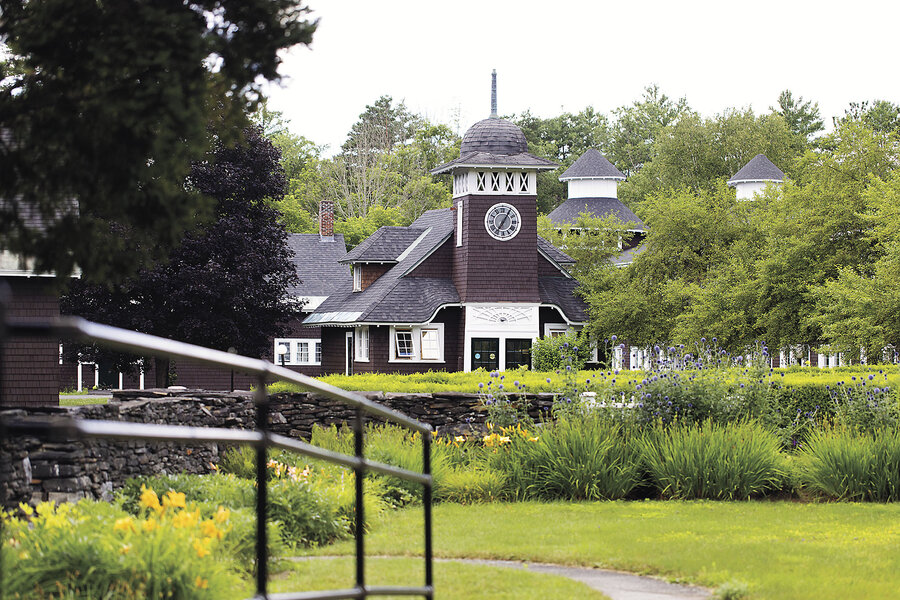
Voices bounce off century-old farmhouse walls as actors rehearse for a theater production. Amid the gardens outside, picnic tables fill with attendees of a weeklong writing retreat. And across the grounds, students at a therapeutic school rest in the shade of a tree.
This scene among the pines and mountains of a small central Vermont town reveals how Plainfield, with a population of nearly 1,000 people, is finding a way to solve a problem vexing communities across the United States.
Just two years ago, this buzzing commons was an empty college campus.
Why We Wrote This
The closures of small colleges across the U.S. affect their towns’ economic, social, and cultural well-being. In Vermont, one community turned a shuttered campus into a different type of education destination.
Goddard College is one of nearly 2,000 federally funded higher-education institutions that have closed over the past 30 years – and one of 17 four-year private nonprofit colleges to shut their doors in 2024 alone. Small, private, rural colleges are most susceptible to closures due to a combination of declining birth rates and students increasingly choosing the labor market or urban institutions, experts say.
These numbers are only expected to grow. The Western Interstate Commission for Higher Education predicts that the number of high school graduates will steadily decline until 2041, reflecting a drop in births after 2007. This will likely lead to fewer traditional college applicants and more college closures. The communities these institutions call home often bear the economic, social, and cultural effects of their closures.
Plainfield is working to restore what it lost by partnering with a private investor and the state to reinvent Goddard
College as a vibrant community hub. The Creative Campus at Goddard redefines learning as something rooted in
collaboration, creativity, and continuous growth, offering one model for other struggling college towns.
“Just the act of interacting with others on challenging topics does wonders to develop remarkable people,” says Robert Kelchen, professor and head of the Department of Educational Leadership and Policy Studies at the University of Tennessee, Knoxville.
Trying to fill a “cultural hole”
Colleges are often one of the largest employers in rural communities, Dr. Kelchen says. When they close, not only do faculty and staff lose their jobs, but the surrounding economy suffers as local businesses lose customers, which can trigger cascading job losses, prolonged economic depression, and population decline.
But college closures don’t just leave this “economic hole.” They leave “a cultural hole in the community” as well, Dr. Kelchen says.
Nathan Grawe, professor of economics at Carleton College in Minnesota, says the students, as well as the campus employees and their families, can strengthen local K-12 schools, for example.
The Creative Campus in Plainfield hopes to reimagine this cultural and intellectual life that Goddard College once brought.

Olivia Fletcher/The Christian Science Monitor
After Goddard closed its doors in spring 2024, Michael Davidson, founder of New Hampshire-based property rental company Ledgeworks Inc., bought the 131-acre campus for
$3.4 million. He worked alongside town members and the select board to understand their aspirations and needs for the space and has redeveloped it for community use. The partnership now acts as an “umbrella lessee” overlooking other nonprofits that rent campus buildings, including youth support organizations, a community radio station, and a sustainable food network. Mr. Davidson and The Creative Campus board, many of whom are former Goddard faculty members, continue to create a space for people of all ages to live, convene, and learn.
In the former Goddard mail room, where students once collected letters and packages, neighbors now gather for dinner at the new restaurant. The campus rose garden has traded silence for the sounds of weddings and concerts. Colorful buildings that once housed Goddard students are now available to Vermont youth in need. The property’s manor house, once a Goddard College library and event space, now serves as a rehearsal space for the Goddard Institute of Dramatic Arts.
Barbara Vacarr, former Goddard president and now board member of The Creative Campus, and Kris Gruen, director of The Creative Campus and Haybarn Theatre Arts, say the Creative Campus repurposing works because it breaks down the historic divide between the college and its community. Rather than “turning inward” during difficult times, the campus meets genuine needs.
But the learning continues
Favor Ellis, executive director of Elevate Youth Services, a youth well-being and development nonprofit, found “kinship” through the integrated campus community.
“Proximity matters,” Ms. Ellis says. “It tells a young person, without anyone having to say it out loud, that they belong somewhere ordinary and alive, not somewhere set apart for people who need fixing.”
As the campus fills with new people and purpose, another idea has taken shape: Education doesn’t have to end when a college closes. The Creative Campus team emphasizes lifelong learning, project-based learning, and “learning by doing.”
“The hope is that learning happens in living in the community also,” Ms. Vacarr says. “That it doesn’t necessarily have to be a course that’s being offered, but there is this kind of informal learning that happens when you live in a community.”
Actors and writers swap stories, for example. Nonprofit staff on campus share advice with other organizations.
Ms. Vacarr and Mr. Gruen emphasize that while this model of repurposing is working at Goddard, there’s no one-size-fits-all solution for towns that lose colleges. They believe successful campus repurposing requires collaboration, a coordinated system of state support and funding, and a private owner who understands regional needs.
“I think this is a moment where we all have to put our real collaboration and creativity into thinking and let go of our attachments to what has been, and really ask what can be now,” Ms. Vacarr says.