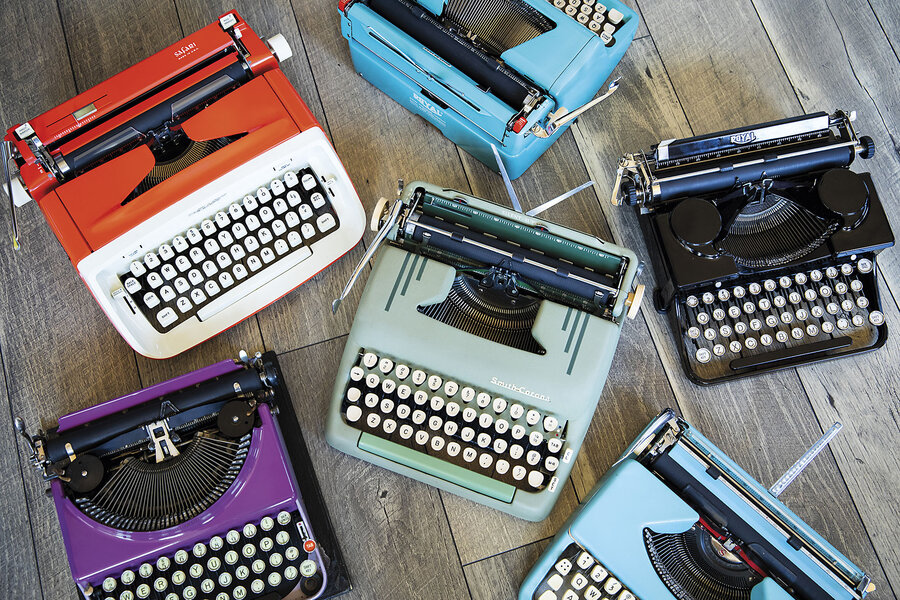
Michelle Geffken’s color-filled home, in a leafy neighborhood by the Boston area’s oldest arboretum, is a veritable museum for typewriters. The machines, of all shapes and sizes, are scattered throughout the house. There’s a transportable Corona 3 folding typewriter, and a typewriter once owned by famed Red Sox player and coach Bobby Doerr. In the dining room, Ms. Geffken displays what she lovingly calls the “Candy Shop”: three typewriters, painted in vivid hues.
Ms. Geffken authors Paper Blogging, a blog curated for writers and other creatives, where she describes herself as a “nature artist, home educator, and collector of vintage typewriters.” She has been enthralled with the machines since her teens, she says, when, inspired by Dorothea Brande’s 1934 manuscript “Becoming a Writer,” she borrowed a hand-me-down electric typewriter from her mother’s office.
It was, she says, love at first clack.
Why We Wrote This
In a world overwhelmed by cellphones, laptops, and other screens, there is a growing space for the old school and analog – from landline phones to Walkmans and typewriters.
And she is far from alone in this attraction. Since Ms. Geffken began collecting typewriters in earnest in 2017, the number of enthusiasts for the ribbon-and-ink machines has skyrocketed. For instance, when Ms. Geffken joined the Antique Typewriter Collectors group on Facebook in 2019, it had about 7,000 members. Today, it’s a digital gathering space for more than 53,000 typewriter enthusiasts who regularly share tips on repairs and typewriting projects. Other online typewriting communities on platforms such as Facebook, Instagram, Reddit, and TikTok have seen growing numbers.
Some within this typewriter community say their interest is part of a larger cultural shift away from digital devices: that in a world overwhelmed by cellphones, laptops, and other screens, there is a growing space for the old school and analog – from landline phones to Walkmans.
But typewriters, they also say, are just noisily enjoyable.
“I used to think of it like a racehorse ready to jump out of the starting gate. You turned it on, and it just kind of hummed: ‘Let’s go, let’s go,’” says Ms. Geffken. “And boy, was it so much fun.”
The original rollouts
Ms. Geffken started collecting typewriters after visiting a pop-up participatory art exhibit at Boston’s Isabella Stewart Gardner Museum that featured the machines. Called “Type Bar,” the exhibit had passersby type out letters in public; it also displayed a few old typewriters. As she listened to the familiar sound of words being slammed onto paper, she couldn’t help but think of her own past experience with typewriters – and earlier.
The first documented typewriter is from 1575 Italy, when Francesco Rampazetto, a printer and publisher, invented the scrittura tattile, a machine that left imprints of letters on paper. More than 250 years later, politician and inventor William Austin Burt patented the “typographer.” He invented the machine to help handle the amount of paperwork that his job as a surveyor entailed.
The Sholes and Glidden Typewriter went on sale July 1, 1874, at a base price of $125. And in 1878, the Remington No. 2 rolled out, with a special function for both uppercase and lowercase letters. The typewriter industry took off around the world, continuing until the 1980s, when home and office computers became more common.

Melanie Stetson Freeman/Staff
The last major manufacturer of typewriters in the world — Godrej and Boyce, located in Mumbai — closed in 2011. (In 1897, Ardeshir and Pirojsha Godrej, the company’s founders, chose Mumbai as their company’s location because it was both their hometown and the financial capital of British India.)
Today, a handful of smaller manufacturers still exist, but collectors often warn about their quality due to the use of cheaper materials such as weak plastics and thin metals. Most typewriters are now purchased secondhand.
Richard Polt, a professor of philosophy at Xavier University, says today’s resurgence of typewriters is “a break” or “a form of resistance” from technology.
“The more digital technology grows, the more a certain subpopulation is going to turn to analog technology — just to take a break [from screens] or as a form of resistance,” he says. “A good solid 1% of the American population would enjoy and benefit from using a typewriter, and that’s millions of people.”
Lucas Dul, owner of Typewriter Chicago, is one of these millions. He’s a typewriter enthusiast, purchasing and learning to repair typewriters himself over the past 12 years.
He has many ways of using typewriters, he says. He types out ideas for novels and short-form poetry on the machines. He uses them to journal his thoughts. And sometimes, Mr. Dul says, he and a friend will sit on the sidewalks of Chicago, offering to type poetry for strangers passing by.

Melanie Stetson Freeman/Staff
Free from distractions
Mr. Dul says that typewriters offer a distraction-free experience for writing that’s organic and within the user’s control.
“You’re not distracted by the machine itself. It’s not going to correct your spelling or correct your grammar. There are no emails, no pop-ups, nothing,” says Mr. Dul. “Everything that we have nowadays is disposable. It’s very complicated; it’s very connected. And people are looking for a way to get away from screens.”
The 2016 documentary “California Typewriter,” which has remained popular with the typewriter crowd, documents the growing interest in analog technology. That’s on display in Grit Matthias Phelps’ class at Cornell University.
Ms. Phelps, a senior lecturer for the Department of German Studies, instructs her students to complete at least one test or writing assignment per semester with only a typewriter. It is her way, she says, of finding an alternative to screens and sidestepping artificial intelligence.
Her students love it.
Yunxi Han, a senior studying landscape architecture, used a typewriter for the first time in Ms. Phelps’ class. Ms. Han was taken by the feel of the keyboard and the sounds the slider made when shifting to the next line of her paper. Though she found the switch from digital technology to analog technology unfamiliar, she also found it a relaxing break from screens and laptops. “It’s just interesting to be off-screen and then focusing on the thing that you can really touch,” says Ms. Han, who graduated in late May.
Many students asked for more typewriter assignments. Ms. Han began to look at websites where she can buy a secondhand typewriter of her own.