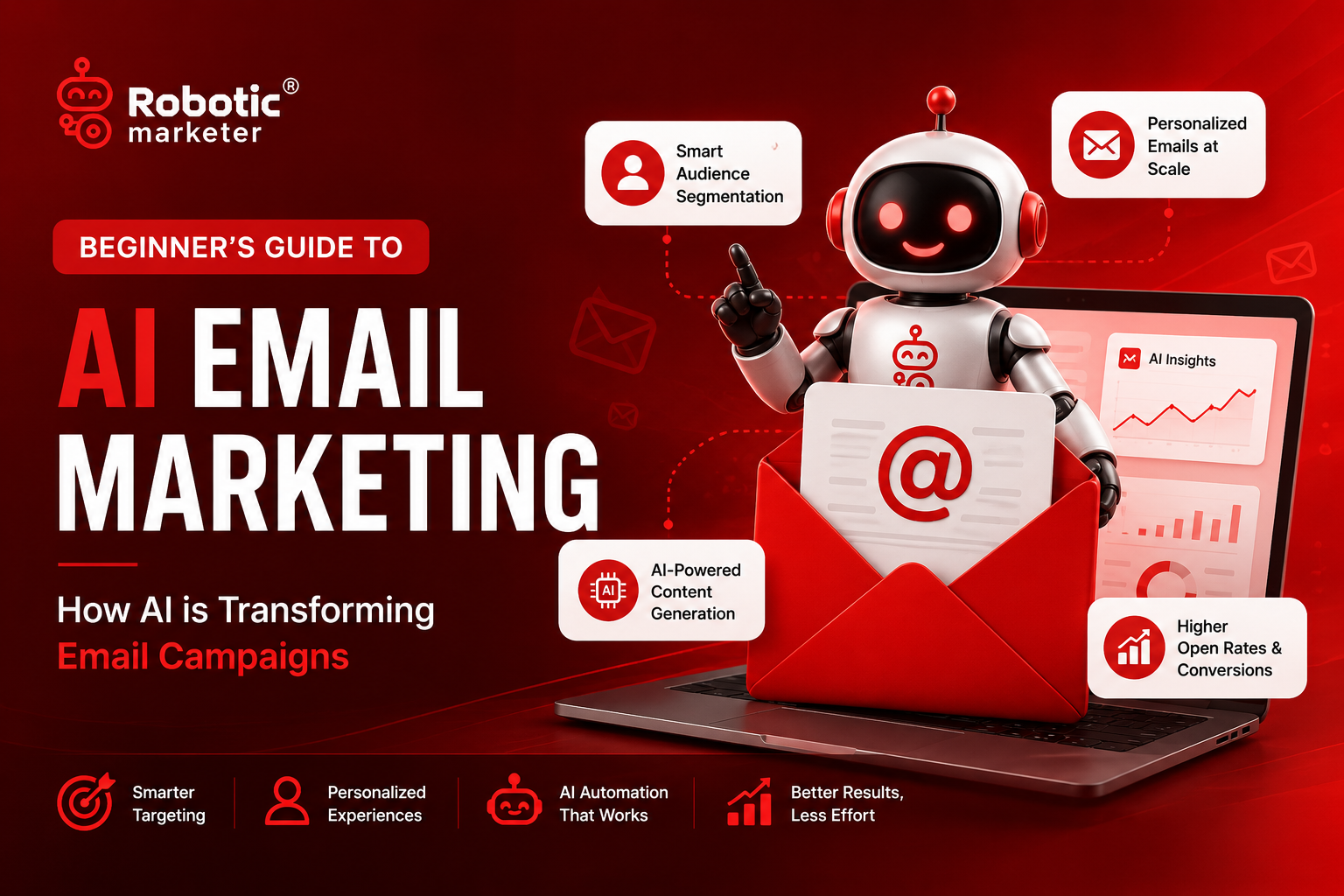
Email marketing has always been a numbers game: open rates, click-through rates, conversions. What’s changed is how those numbers get better. Artificial intelligence has moved from a buzzword to a working part of email marketing software, helping marketers send smarter campaigns without doing more manual work. This guide breaks down what AI email marketing actually is, how it changes the way campaigns are built, and what beginners should know before diving in.
What is AI email marketing?
AI email marketing refers to the use of machine learning and natural language processing to automate, personalize, and optimize email campaigns. Rather than manually segmenting lists, writing every subject line, or guessing the best send time, AI tools analyze historical data and behavioral patterns to make those decisions for you. The result is email marketing that adapts in real time to how individual subscribers actually engage, rather than relying on broad assumptions about an entire audience.
How AI changes traditional email campaigns
Traditional email campaigns follow a fairly linear process: build a list, segment it manually, design a template, write copy, schedule a send, and review results afterward. AI introduces a feedback loop into nearly every step. Instead of a single static campaign sent to everyone at the same time, AI-powered platforms can generate multiple content variations, test them automatically, and continuously refine targeting based on engagement signals. The campaign becomes a living system that improves with every send, rather than a one-off project that gets reviewed weeks later.
AI-powered personalization in email marketing
Personalization used to mean inserting a first name into a greeting. AI has expanded that significantly. Modern tools can personalize subject lines, body content, product recommendations, and even send times based on an individual’s browsing history, purchase behavior, and past email interactions. This goes beyond demographic personalization and into behavioral personalization, where two subscribers on the same list might receive entirely different versions of the same campaign depending on what’s most likely to resonate with them.
Smart audience segmentation using AI
Segmentation has traditionally relied on static categories like location, job title, or purchase history. AI-driven segmentation looks at dynamic behavioral patterns instead, such as how often someone opens emails, what content they click, and how their engagement changes over time. This allows marketers to create micro-segments that update automatically as subscriber behavior shifts, meaning a list doesn’t go stale. Someone who was highly engaged six months ago but has gone quiet can be automatically moved into a re-engagement segment without manual intervention.
AI subject line generation and optimization
Subject lines are one of the most tested elements in email marketing, and AI tools have made that testing far more efficient. AI can generate dozens of subject line variations based on tone, length, and the inclusion of elements like numbers, questions, or urgency cues. More importantly, it can predict which variations are likely to perform best for specific segments based on historical open-rate data, then test those predictions in small batches before rolling out the winning version to the full list.
Automated email workflows with AI
Workflow automation isn’t new, but AI has made workflows considerably smarter. A welcome series, abandoned cart sequence, or post-purchase follow-up can now adjust its timing, content, and frequency based on individual subscriber behavior rather than following a fixed schedule for everyone. If a subscriber engages quickly, the workflow can accelerate. If they go quiet, the workflow can pause or shift to a different message entirely. This reduces the manual mapping out of every possible scenario, since the system adapts as it goes.
Predictive analytics for email engagement
One of the most valuable applications of AI in email marketing is predictive analytics. By analyzing historical engagement data, AI models can forecast which subscribers are likely to open an email, click a link, or make a purchase, and which are at risk of unsubscribing. This allows marketers to be proactive rather than reactive. Instead of waiting for engagement to drop before acting, teams can identify at-risk subscribers early and adjust messaging or frequency before they disengage entirely.
AI tools for email marketing (examples)
Many widely used email platforms now include AI features as standard, covering content generation, send-time optimization, and predictive segmentation. Some tools focus specifically on AI-generated copywriting for subject lines and body content, while others specialize in predictive analytics that score subscribers based on likelihood to convert. There are also tools dedicated to AI-driven A/B testing, which run continuous experiments across multiple variables at once rather than testing one element at a time. The right combination depends on whether a business’s biggest challenge is content creation, audience targeting, or performance analysis.
Benefits of AI-driven email automation
The core benefit of AI-driven email automation is efficiency without sacrificing relevance. Campaigns that would take a team days to plan, segment, and test can be set up and refined in a fraction of the time. Beyond time savings, AI tends to improve key metrics like open rates and click-through rates because content and timing are matched more precisely to individual preferences. It also reduces the guesswork that often leads to “spray and pray” email strategies, where the same message goes to everyone regardless of relevance.
Common mistakes beginners should avoid
A common mistake is treating AI as a “set and forget” solution. AI tools still need quality data to work from, and campaigns should be reviewed regularly to ensure automation is producing the intended results. Another mistake is over-personalizing to the point where messaging feels intrusive rather than helpful; subscribers can tell the difference between relevant personalization and content that feels like surveillance. Beginners should also avoid relying entirely on AI-generated copy without a human review step, since brand voice and accuracy still matter, especially for regulated industries or sensitive topics. Finally, many beginners skip testing AI recommendations against a control group, which makes it difficult to know whether the AI is actually improving results.
Future of AI in email marketing
The direction of AI in email marketing points toward even tighter integration between email and other channels. Expect to see AI systems that coordinate messaging across email, SMS, and on-site experiences based on a unified view of customer behavior, rather than treating each channel separately. Generative AI will likely continue improving at producing on-brand copy with less editing required, and predictive models will become more accurate at identifying not just who is likely to engage, but when and through what type of content. For businesses, the opportunity lies in starting now with the AI features already available, building good data practices, and treating AI as a tool that augments marketing judgment rather than replaces it.
As AI email marketing matures, the businesses that benefit most will be those that combine automation with a clear strategy, using AI to handle the repetitive optimization work while marketers focus on the bigger picture of audience relationships and brand consistency.
!function(f,b,e,v,n,t,s)
{if(f.fbq)return;n=f.fbq=function(){n.callMethod?
n.callMethod.apply(n,arguments):n.queue.push(arguments)};
if(!f._fbq)f._fbq=n;n.push=n;n.loaded=!0;n.version=’2.0′;
n.queue=[];t=b.createElement(e);t.async=!0;
t.src=v;s=b.getElementsByTagName(e)[0];
s.parentNode.insertBefore(t,s)}(window, document,’script’,
‘https://connect.facebook.net/en_US/fbevents.js’);
fbq(‘init’, ‘1122401991165798’);
fbq(‘track’, ‘PageView’);