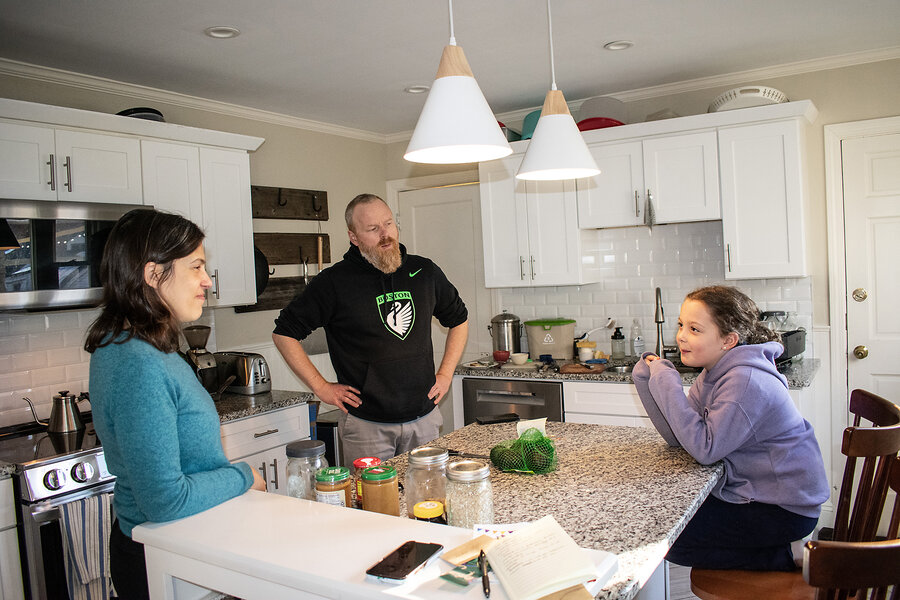
By 7:20 a.m., Andrew Iliff has already run through much of his morning routine. His daughter, Zoe, is ready for school, her tie-dye backpack nearby. Mr. Iliff spreads chili crisp and avocado on toast while Zoe’s mom sips from a white mug.
Uncertainty, though, is baked into this early morning ritual. Each day, the family wonders when – and whether – the school bus will arrive to pick up Zoe.
“No bus news,” Mr. Iliff says. The family gathers around a kitchen island as he thumbs through Zum, a GPS-enabled app that updates parents with the whereabouts of their child’s bus. “No news is good news, right?”
Why We Wrote This
School districts nationwide struggle with late buses. In Boston, parents, local officials, and the school district are pressing for accountability.
Tardy and unpredictable buses have long dogged families of Boston Public Schools (BPS), a sprawling district that transports some 19,000 students to over 200 schools a day. BPS and Transdev, the district’s bus contractor, have for years struggled to run the enormously complex operation in a city well-known for its circuitous streets and gridlocked traffic.
Parents need the bus to be reliable, say Mr. Iliff and his wife Jessica Berwick – as reliable as the morning sun rising over the eaves of the Victorian-style homes in their Jamaica Plain neighborhood. A bus that comes 15 or 30 minutes late can mean canceled appointments, skipped work and lost pay, as well as disrupted learning for children.
“Something has got to give, because right now, this is a systemic failure,” says Cheryl Buckman, a South Boston resident. Her son, Landon, takes the bus each day, and she, like parents across the city, says it’s frequently late. “You can’t let these kids down, because they’re not going to be able to learn.”
On the whole, on-time arrivals have ticked up in Boston over the years. They recently rose to 94% for morning trips in March – among the highest levels in half a decade. Yet a recent dip in performance, and a sharp increase in routes with either no drive or no bus assigned, have prompted renewed scrutiny from parents and elected officials. And even an on-time rating as high as 93% equates to some 1,330 students arriving late each day, said Boston City Council Member Erin Murphy at a March 31 hearing.
The trouble now facing the district, and parents, is how to fix it. Dan Rosengard, the district’s executive director for transportation, recognized families’ struggles at the March hearing, while highlighting the progress BPS has made and promising more improvements.
“If you are a student on one of the buses that is consistently arriving late, the system is failing you,” Mr. Rosengard said. “While we are proud of the progress we’ve made in recent years, we will not and cannot rest until every student who relies on the bus can feel confident that it’s going to get them to school safely, on time, and ready to learn.”
Because not all public school districts publish bus transportation data, it can be difficult to make comparisons across cities. Yet Boston is not alone. School districts nationwide have struggled with bus service in recent years, owing to driver shortages and shrinking budgets.
In an Associated Press-NORC poll last year, 44% of parents across the U.S. said that their children have been late to school because of transportation challenges. And about 30% of school administrators said they worried about whether their district could provide transportation for vulnerable students, such as those with disabilities or experiencing homelessness.
“We have to do this math every morning”
Around 7:30 a.m., about 30 minutes before Zoe’s bus is scheduled, Dr. Berwick leans over the kitchen counter and outlines her day. She has a meeting before heading to her job at Massachusetts General Hospital. If the bus doesn’t come, taking Zoe to school will fall to Mr. Iliff.
“We have to do this math every morning,” she says. “Every morning, it’s like we need at least one to two levels of backup plan.”
“Because the bus could say, ‘We’re 20 minutes late,’” Zoe adds.
The couple is able to adjust when the bus goes missing, owing to flexible work schedules and proximity to Zoe’s school. Usually, a delayed bus means Zoe and Mr. Iliff swaddle themselves in winter gear and bike to Rafael Hernández School, where Zoe is a third grader. Zoe’s brother, a high school junior, is old enough to carpool or take public transit, which means one less schedule to juggle.

Jurgen Schwenkenbecher/Picture-Allicance/DPA/AP/File
Yet families are not the only ones managing complicated schedules. Under Massachusetts law, BPS must provide transportation not only for public schools, but also parochial and charter schools, whose students make up 22% of bus riders. Those schools set their own distinct start times, adding wrinkles to an already complex bus schedule.
Further complicating matters is Boston’s notorious traffic – the fifth worst in the country, according to a 2025 report by INRIX, a transportation analytics company.
BPS, for its part, has worked to reform its system, launching the Zum app to provide parents more timely updates and reforming its contract with Transdev. A 2024 memo from the Department of Elementary and Secondary Education noted “some progress” in transportation, including a jump in bus on-time rates from 76.4% in September 2022 to 87.8% in March 2024. Levels have since risen to 91% on average this year. Still, the district has never achieved its benchmark of 95%.
In 2025, the district exited its Systemic Improvement Plan, which it agreed to in 2022 to avoid triggering receivership, a protocol where the state appoints an official to run the system. That followed a withering state probe that criticized BPS for “deficiencies across a broad range of district functions,” including poor bus performance.
Mr. Iliff says he recognizes the work the district has put into improving a transportation system that has long resisted even minor improvements.
“They’re working in good faith, they’re trying hard, they’re putting their best foot forward,” he says. “I wouldn’t want that job. This is a really tough ship to turn around.”
Consequences for parents – and the bus operator
About 25 minutes before Zoe’s scheduled bus, Dr. Berwick crosses her arms and shakes her head. Every morning, as she and Mr. Iliff monitor Zum, she wonders how other families with less flexible work schedules manage.
Ms. Buckman, the mother from South Boston, thinks often about the potential consequences of a late bus. Recently, she says, Landon’s father was a half hour late for work because he had to wait with their son for a tardy bus.
“We can’t keep doing this,” Ms. Buckman says. “Sooner or later, a parent’s going to lose his job if he walks in the door late because of a late bus.”
Being late to school – or late coming home – has rippling impacts on students, too, Ms. Buckman says. She says her son, who has been diagnosed with ADHD and autism, has missed medical appointments because late buses in the afternoon. Arriving late to school can cause him academic and emotional distress.
“If he’s late, it sets him up for, I want to say, maybe a 15-minute meltdown that he has in school, just to get all of his frustrations out,” she says.
Yet many parents feel that Transdev, the district’s contractor since 2013, has, unlike them, avoided consequences for its performance.
Transdev hires and trains drivers, as well as operates and maintains the 750-bus fleet. Under the most recent iteration of its contract, BPS can charge the company $500 for every bus that doesn’t show or is more than an hour late. But for most of this school year, the district has not issued those fines – a revelation that incensed some parents and local officials. Mr. Rosengard said at the March hearing that BPS would issue fines going forward. In April, Mr. Rosengard told City Council that the district had fined Transdev $105,000.
BPS told the Monitor that the contract was designed to improve performance through a “combination of incentives and accountability measures.”
“When performance declined in December 2025, particularly with increased uncovered trips, BPS took additional steps to hold the vendor accountable,” a district spokesperson said in a statement.
The number of uncovered trips, or those with no driver or no bus, leapt from 86 in September to 329 in January, according to a February letter from Mr. Rosengard to the school committee. There were more than 2,000 uncovered trips as of January, the letter said. As of March, Mr. Rosengard said at the hearing, uncovered trips have fallen to slightly below September’s levels.
In a statement to the Monitor, Transdev acknowledged that delays can “impact students’ readiness for the school day and pose significant challenges for parents.” The bus operator said that it was “deeply committed to building on our progress and delivering the reliable service that students and parents deserve.”
Rolling forward
“Two stops away,” Mr. Iliff says, checking Zum around 7:40 a.m.
The family breathes a sigh of relief this morning, now that the bus is seemingly on its way. Mr. Iliff is walking Zoe to the bus stop today. They hustle into the foyer where Zoe pulls on a pink-and-purple winter coat and shoulders her backpack.
Before she says goodbye, Dr. Berwick underscores how uncertainty adds a layer of stress to their days.
“The problem is not the walk or the drive even,” she says. “It’s the inconsistency. We could make another plan – we totally could. But I never know which morning we’re going to need that plan.”
Not this morning.
After a brief, but blustery, walk in the April cold, Mr. Iliff watches as Zoe’s bus pulls up, early, at around 7:55 a.m. The driver, Junior, who Mr. Iliff says is “always cheerful,” puts on a show, honking and flashing the vehicle’s lights.
“Good morning,” Mr. Iliff shouts to Junior, as Zoe boards the bus. Today, it seems, she’ll arrive at school on time, along with most of her BPS peers.