California’s primary was June 2, yet voters are still waiting on the official results for most races, including high-profile contests for governor and Los Angeles mayor.
That’s become typical in the Golden State, where it now often takes days or even weeks for counties to tally races. Election officials here chalk up the delay in part to the large number of ballots being cast by mail, and the extra time it takes to verify them. Some election experts say the slow count can further undermine trust in elections. And President Donald Trump is among critics who are already trying to cast doubt on California’s process.
This week, Californians may get some answers, as the last remaining ballots trickle in. As of Monday morning, about 72% of the vote in the governor’s race had been counted. Democrat Xavier Becerra is in the lead and will advance to the fall election, with Republican Steve Hilton and Democrat Tom Steyer in contention for the second slot. In Los Angeles, Mayor Karen Bass has also passed the threshold to advance. With around 83% of that vote counted, progressive Democrat Nithya Raman has taken a narrow lead over Republican candidate Spencer Pratt.
Why We Wrote This
Election officials chalk up the delay to the large number of ballots cast by mail, and the extra time it takes to verify them. But some experts say the slow count can further undermine trust in elections.
Why does it take California so long to count votes?
Many voters seem to like the convenience of mail ballots, yet they take longer to count. Prolonged tallying is a common issue in states where electorates rely more heavily on voting by mail – something California began shifting toward just before the pandemic, says Thad Kousser, co-director of the Center for Transparent and Trusted Elections at the University of California, San Diego.
Mail ballots in California are eligible to be counted as long as they are postmarked by Election Day and arrive within seven days of the election – which means counties will still be accepting ballots through June 9. Officials say those late-arriving ballots are basically a trickle, with the majority of votes cast on Election Day or before.
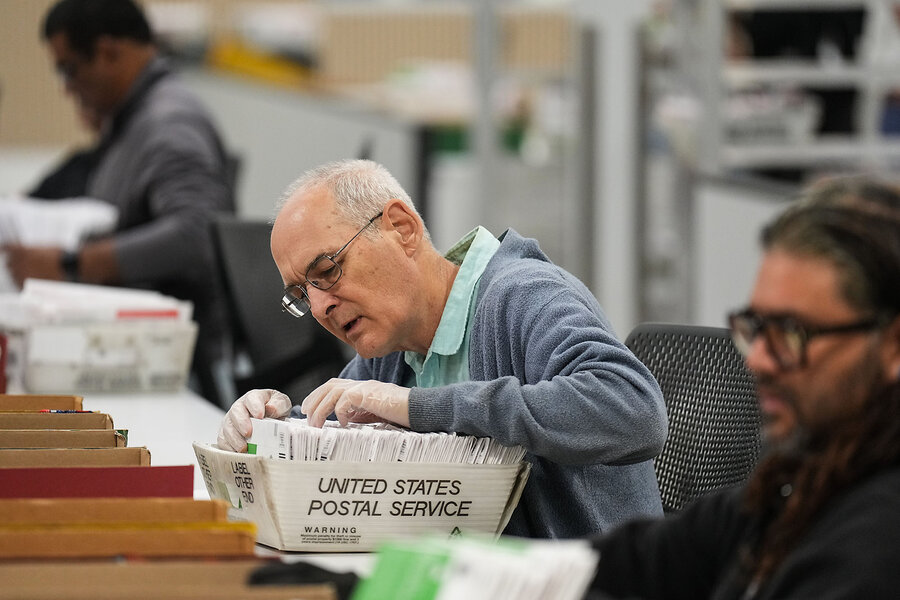
But even mail ballots that arrive well before Election Day take longer to count. When someone votes in person at a polling place, the vote can be verified then and there. Mail ballots take longer to verify, and all must go through the same process, whether they’re delivered via a drop box or the U.S. Postal Service, or dropped off at a polling place.
California is one of eight states that allow elections to be conducted entirely by mail, and every registered voter receives a mail ballot.
“That’s really the factor” behind the slow count, says Katharine Campos, a spokesperson for the Yolo County Elections Office.
“We, of course, wish that we could certify [elections] earlier,” she says. Public frustration over the delay stems from “a lack of understanding of all that goes into verifying vote-by-mail ballots,” she adds.
By June 5, Ms. Campos says, Yolo County had processed around 30,000 ballots, and still had 31,000 to go – along with any others that arrive by June 9.
To verify a mail ballot, officials must compare the voter’s signature to what the county has on file. If the signatures don’t match, or there’s no signature in their database, election officials must notify the voter, who then has an opportunity to verify their signature.
“It’s this huge crush of ballots that come in Sunday, Monday, and on Tuesday, that all need to go through this separate process to safeguard the integrity of the election,” says Professor Kousser.
Could officials speed up the count?
In May, California Gov. Gavin Newsom sent a letter to state election officials urging them to do all they can “to tabulate votes quickly and accurately,” adding, “Time is of the essence in preventing election lies from taking hold.”
In the letter, the governor pointed to 2025 state legislation aimed at allowing ballots to be processed sooner (they could already be processed as early as 29 days ahead of Election Day).
But many mail ballots don’t arrive until close to Election Day. And local election officials say their timeline is almost entirely dictated by regulations around careful processing of mail ballots, which are set by state legislators. In Butte County, which has around 127,000 registered voters, nearly all of the 41,000 votes cast in last week’s election were mail ballots.
“Everybody voted by mail except for two voters [who] cast what we would call a live ballot, which is the old-school polling place model. And then, we had about 500 vote provisionally,” says Keaton Denlay, the registrar of voters in Butte County. (Provisional ballots are used when there is a question about eligibility to be resolved, or when voters missed the registration deadline.)

Mr. Denlay says election workers often get unfairly maligned for being slow to count when really, they’re just following California law – something he wishes state officials would make clear.
“The state didn’t come out and say, ‘Here’s why we take longer; it’s on purpose to protect votes,’” he says. “It sure would be nice if the state would stand behind their policies.”
Like other election officials, Mr. Denlay does outreach in his county to try to help voters understand the process, meeting with local groups and running voter education workshops. More funding for those types of activities would be a welcome resource, he says.
Does a slow count undermine trust in the process?
The longer it takes to call a race, the further voter confidence falls and the more conspiracies grow, says Professor Kousser. So while the slowness of the count could actually reflect a careful process designed to prevent fraud, “clearly there is a cost in terms of trust.”
That’s even truer when the projected winner shifts as late votes get counted. In general, votes counted after Election Day tend to skew Democratic, partly because Democrats choose to vote by mail in higher numbers than Republicans do. In this year’s gubernatorial primary, a crowded Democratic field that for months had lacked an obvious front-runner caused many Democratic voters to hold on to their mail ballots for longer than usual before casting their votes.
Mr. Trump, a critic of mail ballots, has already cast doubt on the integrity of California’s election results, telling reporters in the Oval Office on June 4 that “they’re rigging the election.”
Separately, the U.S. Supreme Court is considering a Mississippi case that could result in barring states from accepting ballots that arrive after Election Day.
In Yolo County, Ms. Campos says election officials have tried to counter public distrust by inviting voters to visit their facilities to learn about the process and observe it firsthand. Tours like that, along with explanatory videos, have boosted trust in the process in other states as well.
Other California election officials say much of the criticism and pressure to speed things up has been coming from outside the state.
“It’s the national conversation that gets built up into this frothing mess,” says Mr. Denlay. “Talk to the average reasonable person, [and] they trust their local government for the most part.”