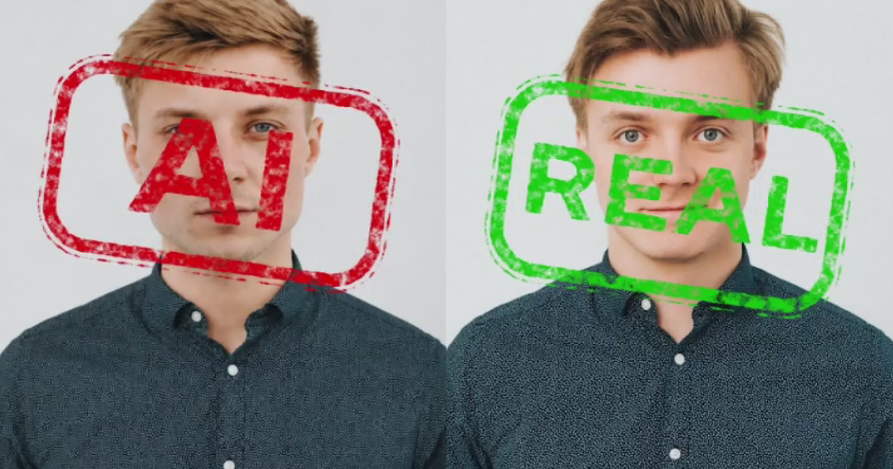
A recent survey by an identity verification company found that Americans’ ability to distinguish real images from AI-generated deepfakes was about as accurate as a coin flip.
CBS LA Consumer Investigator Kristine Lazar put that finding to the test and scored just three out of 12 on an AI detection quiz before learning what to look for.
“I’ve been a consumer investigator for nearly a decade, but I got an F when I tried to identify images and videos made with AI,” Lazar said.
Veriff, an online identity verification tool, created a quiz featuring side-by-side images and videos to test Lazar’s ability to identify authentic and AI-generated content. Although she initially felt confident in her choices, she quickly discovered many of her assumptions were wrong.
“I thought he was the fakest-looking one there,” Lazar said after learning that one of the people she believed was AI-generated was actually real.
Overall, Lazar correctly identified only three of the 12 images and videos, a 33% accuracy rate.
Raul Liive, Veriff’s product director, said those results are consistent with what the company found when testing the public.
“We are seeing that people in America especially are close to, like, it’s a coin flip essentially, that we can’t really make a difference — is it a fake photograph or a real one,” Liive said.
When asked whether people are guessing, Liive responded, “It’s kind of a guess for you and me.”
Liive said the telltale signs people once relied on, such as distorted fingers, unnatural eyes or other obvious visual flaws, have largely disappeared as AI technology has improved.
“The AI has improved over the last few years heavily,” Liive said. “It used to be pretty simple because, as you said, fingers were missing, or eyes were weird, but right now, the quality is so good.”
Instead, he recommends closely examining facial features for subtle inconsistencies, unusual texture changes and unnatural patterns. Videos can be even more difficult because of continuous motion, but viewers may notice limited blinking, inconsistent movement speeds, or clothing patterns that blend unnaturally into the background.
After receiving guidance from Liive, Lazar retook the quiz and improved her score from three correct answers to eight out of 12. Looking more carefully, she noticed subtle clues, including mismatched earrings on one subject.
“Her earring’s a little bit bigger on one side than the other side,” Lazar said. “Her earrings aren’t the same.”
Liive said even experts who work with AI every day are not able to identify every fake image correctly without additional tools.
“No, I can’t get 100% on that quiz,” he said.
The experience underscored how difficult it has become to rely on visual cues alone.
“The key takeaway for me: Seeing is no longer believing,” Lazar said.
Experts recommend using AI-powered detection tools or specialized verification apps to help determine whether an image or video is authentic rather than relying solely on what appears on screen.
Try the quiz and see how many AI images you can identify.