
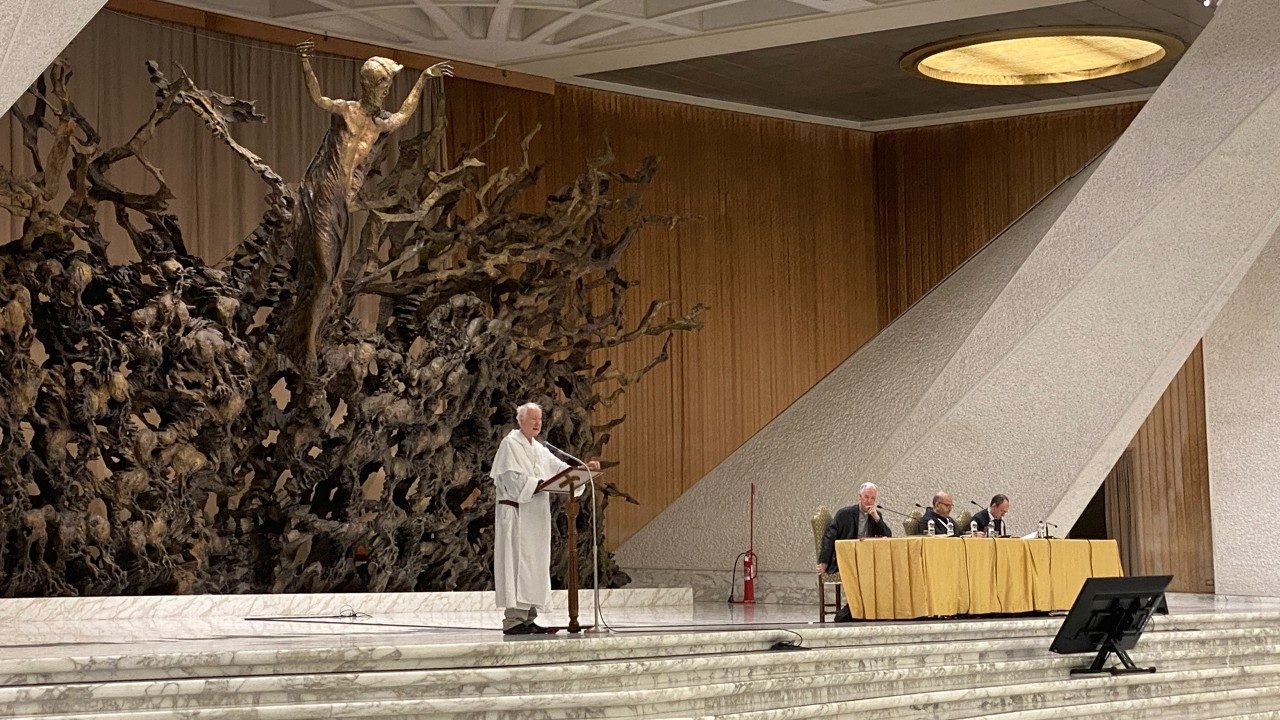
Cardinal Timothy Radcliffe speaks at the International Congress for Pastoral Care in Schools and Universities, taking place at the Vatican, and reflects on ways to inspire the imagination of young people during the digital age.
By Isabella H. de Carvalho
We can inspire the imagination of young people in the age of artificial intelligence by inviting them to ask questions, be adventurous, and pay attention to life and others, said Cardinal Timothy Radcliffe on Friday, October 23, in an address at the International Congress for Pastoral Care in Schools and Universities.
The event is taking place at the Vatican on October 22-23 and was organized by the Dicastery for Culture and Education. Cardinal Radcliffe was speaking during a session titled “Human Digital.”
Go on adventures
His speech focused on the question of engaging the imagination of young people in the digital age. He began by noting that tension is a fundamental part of life, including at the heart of Christianity, and can be lived fruitfully and joyfully.
He explained that young people, despite being an anxious generation due to coming of age in the digital era, long for both security and adventure. He noted that this “the desire for adventure” and the “risk of loving” is present in every human heart.
Cardinal Radcliffe described this tension by recalling as an example the adventure which Bilbo Baggins goes on in The Hobbit, leaving behind his safe home.
Citing St. Paul’s letter to the Romans, which stresses that nothing can separate us from the love of God, the Cardinal undelrined that we will inspire young people if we can offer them both a safe home and an invitation to lose their life.
The importance of attention
“This paradoxical love – so safe and so dangerous– is founded on acute attention to the other,” Cardinal Radcliffe emphasized, pointing out that the digital world is instead “filled with distraction.”
In this context, attention thus becomes precious. Cardinal Radcliffe cited Simone Weil who said that the “rarest and purest form of generosity” is seeing others “as they relate to themselves and not to me.”
“This invites us to be unafraid to be the object of attention ourselves. We dare to be seen,” he underlined, mentioning the story of two Dominican sisters who went viral with a clip of them laughing together some months ago.
“Sr. Gemma Simmonds explained their enormous attraction thus: ‘The discovery that you were loved before anyone swiped, checked a profile, or decided whether you were worth their time, and this fact, quietly received rather than anxiously earned, changes what freedom feels like from the inside.’”
Ask questions
Cardinal Radcliffe explained that this tension is also present in the area of Church teaching. He noted that many young people are “drawn to Catholicism because they perceive the Church as faithful to the gospels and tradition” and they “long for certainty.”
However, he highlighted that faith is also “an intellectual adventure,” as we “embrace the teachings of the Church, but we are always only at the beginning of understanding them.”
“Certainty without the quest is fundamentalism; questioning without fidelity to the tradition would easily fall into relativism. So how do we touch the imagination of the young with beauty of truths that are both given, now and forever, and yet are always to be sought?” he asked.
He reflected that the truths of our faith are more than just facts: they are to be lived. Citing Pope Leo’s Magnifica Humanitas, St. Thomas Aquinas and others, Cardinal Radcliffe stressed that asking questions, wondering and thinking are essential aspects of human life and of developing one’s understanding, and cannot be replaced by AI.
“We touch the imagination of the young by leading them into the transformative beauty of understanding which leads to wonder, astonishment, awe,” he said, noting that God’s conversations with humanity in the Bible usually revolve around questions, which “invite us to become alive more deeply.”
Presence can’t be imitated
Cardinal Radcliffe spoke about the impact AI is having on work and employment, underscoring that we urgently need “a new vision of work, which is not about survival, but about being human.”
“This demands an attention to others that no AI can give,” he explained, saying “presence can be imitated” but not replicated. He cited examples such as social workers, a teacher who stays after class with a child, or a chaplain at a bedside.
“This attention is the opening of our being to what is other than ourselves. It is a wisdom that is transformative of who we are. It releases us from the detachment of the internet into the complexity and beauty of creation.”
Cardinal Radcliffe concluded by calling to inspire the imagination of young people by “releasing them from the abstractions of the digital continent” and remembering that in any field “we need a loving attention, patiently acquired, which draws us out of narcissism into the astonishment of creation and our Creator.”












Leave a Reply