The company’s first conservation project was the Main Hall of the Hongluo Temple, a Buddhist temple in northern Beijing. Cheng was put in charge of the masonry work, and it was here that his story with ancient architecture began.
Cheng later sought guidance from Piao Xuelin, a 15th-generation descendant of the Xinglongmen masonry tradition (of the Jing generation), learning about material processing, construction methods and operational techniques for ancient building masonry. Xinglongmen was one of the workshops that helped build and repair the Forbidden City and other imperial buildings during the Ming and Qing dynasties.
Thanks to his solid foundational skills and honest character, Cheng quickly earned Piao’s recognition and became the 16th-generation inheritor of the Xinglongmen masonry tradition, receiving the master’s true teachings.
In 2004, Cheng took on his first large-scale Great Wall restoration project — the Huanghuacheng section in Huairou. His repair expertise has taken him from Huanghuacheng to other sections of the wall, including Mutianyu, Qinglong Gorge and Yaoziyu, and he finally started the restoration work in Jiankou in 2016.
The second half of the hike felt like a straight vertical climb. The path finally flattened at the bottom of a watchtower covered on one side with steel scaffolding. The three mules that had overtaken the group a mile earlier had finished resting, bags of cement removed from their backs, and were starting the climb back down.
Two Chinese hikers nimbly scaled up the scaffolding, and the NBC News team followed suit with all of its camera equipment.
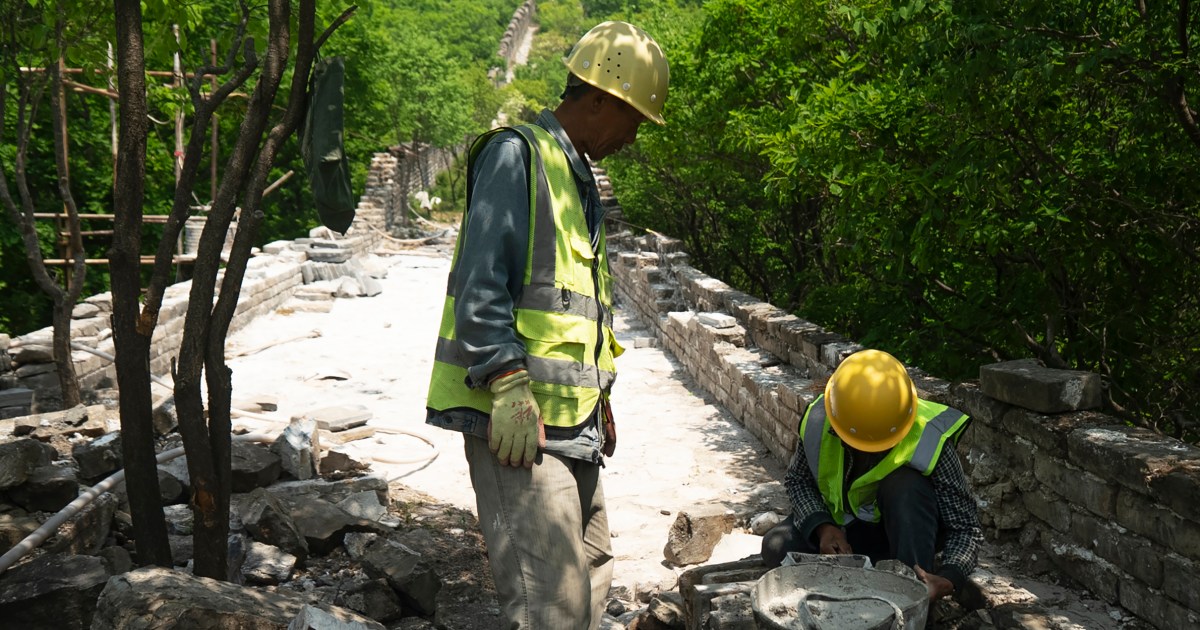
A minute later, everyone was rewarded with an impressive vista of the wall on either side of the watchtower. Bricklayers were repairing a segment of the tower and the small patch of flat ground. But they could not prevent the bursts of wild grass sprouting up between the stones.
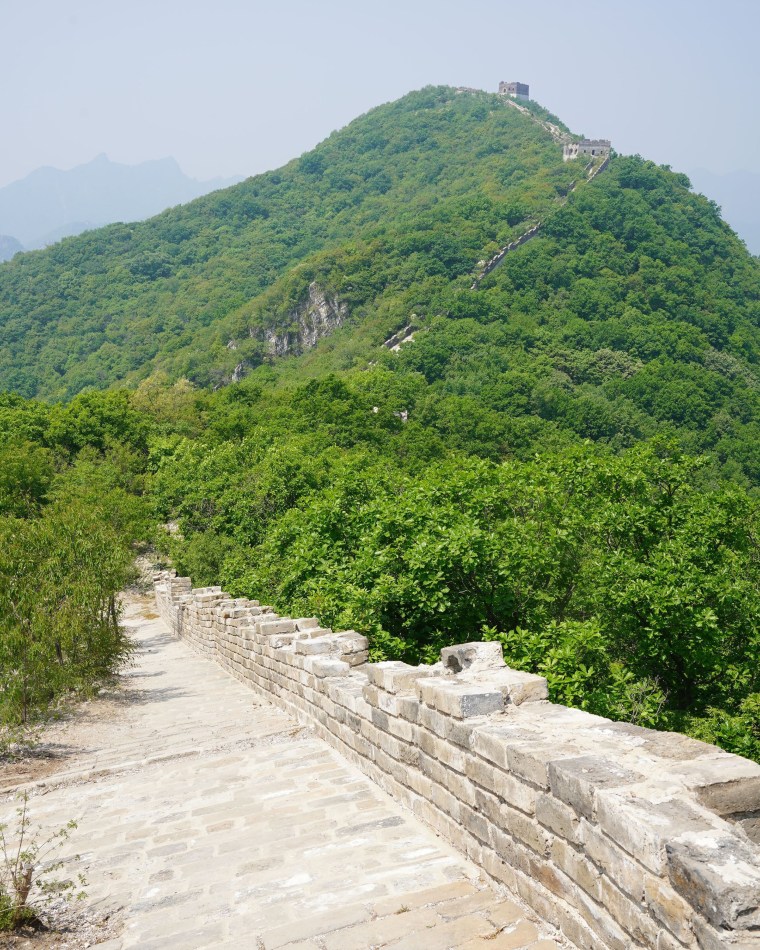
Cheng said that the Great Wall embodied the spirit of the Chinese nation and that the main principle for repairing it is “repair old to keep old.”
“Our ancestors left us this precious World Heritage site,” he said, “so we must protect it well.”