
A deeply divided electorate will choose Colombia’s next president in a runoff on Sunday that pits a progressive against a conservative outsider, with both candidates tapping into fears of a renewed internal conflict in the country as they represent “two very extreme sides,” one Colombian said.
“Right now, what worries me is the polarization that exists between us: there are two very extreme sides, and the violence is concerning,” said John Manrique, a lawyer in Colombia’s capital, Bogota. “What I hope is that people accept who won … Let’s not go out and fight.”
More than 41 million people are eligible to vote on Sunday. Voters will choose between Iván Cepeda, a far-left senator and candidate of the ruling Pacto Histórico party, who is also the heir to President Gustavo Petro’s policies, and Abelardo de la Espriella, a far-right lawyer who has modeled his rhetoric and optics after President Trump and El Salvador’s Nayib Bukele. Their race in what has been a high-stakes presidential election for Colombia headed to a runoff after Cepeda an Espriella defeated nine other contenders on May 31.
Both are pitching strategies that they say will prevent the South American country from experiencing the nonstop merciless violence, such as car bombs, kidnappings, disappearances and forced displacements that Colombians lived with in previous decades.
De la Espriella is proposing a heavy-handed approach that has earned him the endorsement of President Trump.
But Petro told CBS News earlier this month that he saw Trump’s endorsement as an act of interference, accusing Washington of abandoning its anti-drug mission cooperation for ideological reasons. He also warned that Colombia would see a wave of political violence if the right were to assume power.
The Colombian president had previously said in a social media post, in which he endorsed de la Espriella, that the results of his country’s election “are very important to the future of Colombia and its relationship to the United States.
AP Photo
Cepeda is promising to continue Petro’s efforts, including attempts at establishing dialogue with multiple illegal armed groups even though those efforts have largely failed.
The two candidates also are offering differing solutions for the country’s struggling health system, ballooning public debt and entrenched corruption.
In the first round, Cepeda earned 41% of the vote, while de la Espriella garnered 44%, according to official results. Petro, without evidence, sowed doubts in the results after Cepeda, who had consistently lead polls ahead of the May vote, did not win outright and even finished behind de la Espriella.
The election comes 10 years after Colombia signed a historic peace pact with guerrillas of the Revolutionary Armed Forces of Colombia, or FARC, that had offered hope to break the nation’s vicious cycle of fighting between rebel groups and the government.
But violence has since roared back, particularly as most rebel groups abandoned their ideologically driven fight for the financial benefits of drug trafficking.
AP Photo/Fernando Vergara 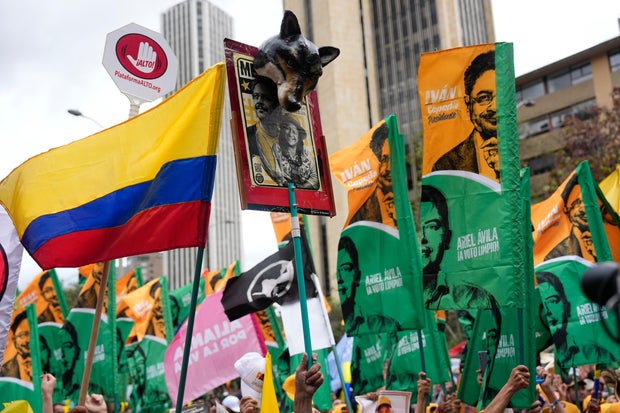
Last year, authorities recorded 14,780 homicides, the most since at least 2015 and driven by clashes among illegal armed groups. Among those killed was conservative presidential hopeful Miguel Uribe. Extortions have also soared, reaching 13,417 cases in 2025, more than double the number tallied in 2015.
De la Espriella, a political newcomer nicknamed “The Tiger,” has promised to fiercely go after criminals and build 10 mega-prisons, emulating the policies of El Salvador’s President Nayib Bukele that have lowered homicide rates but have fueled accusations of human rights abuses.
Cepeda wants to carry on Petro’s fraught signature plan to achieve “total peace” by negotiating pacts with guerrillas and criminal gangs. The heavily criticized strategy that Petro kicked off in 2022 took until Thursday to see the first armed group — one with about 100 members — give up its weapons and begin a resettlement process that will lead to their reintegration into civilian life. Colombia’s illegal groups have more than 27,000 members.
Yamile Guevara, a retired teacher in Bogota, said Petro’s plans need more time to bear results as he could not reasonably be expected to make lasting changes in a conflict that has gone on for six decades. She also criticized what she described as voters’ perennial distrust of Colombia’s left over its long-held association with rebel groups.
“The left has always been viewed negatively; it has been harsh, and many people have died,” Guevara, a Cepeda supporter, said. “So, one wonders what’s wrong with people who have forgotten history … how can they not think carefully about which candidate they are going to elect?”
The lead-up to the runoff has seen an increase in verbal attacks between the candidates as well as accusations of fraud, vote-buying and intimidation.
Cepeda filed a complaint with the Colombian Attorney General’s Office and the International Criminal Court against de la Espriella, accusing him of having ties to paramilitary groups. De la Espriella has denied the accusation.