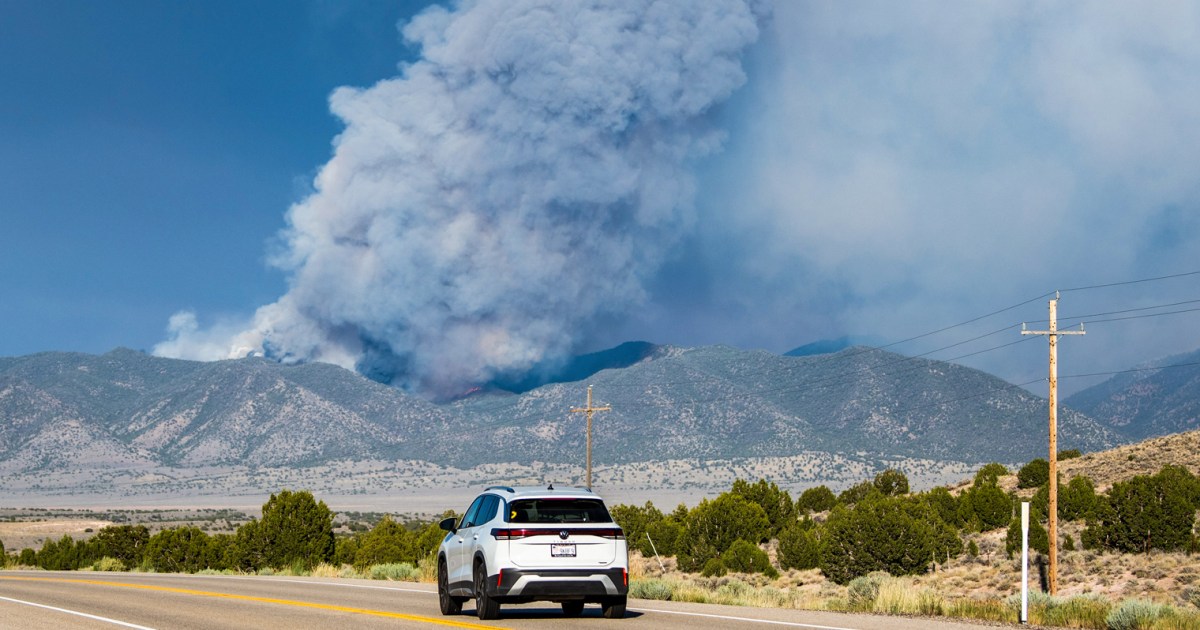
A counterintuitive recipe for wildfires is brewing across drought-stricken Western states: a cold front.
Limited time: Save 25% on NBC News subscription
Get exclusive reporting, live Q&As and ad-free reading.

Forecasters expect the large cold front to develop in the Pacific Northwest on Thursday then push southeast into the Intermountain West, creating dry lightning along the storm’s leading edge. The lightning could spark fires, and powerful winds throughout the weekend could spread any new blazes while exacerbating others already burning.
“We have high risk for lightning moving across southern and eastern areas today and tomorrow, followed by several days of strong winds,” Basil Newmerzhycky, a forecaster for the Great Basin Coordination Center, said Wednesday in an online briefing. The Salt Lake City-based center organizes firefighting resources for the Intermountain West, a region that includes parts of Arizona, Idaho, Nevada, Utah and Wyoming.
“Friday into the weekend, overall fire danger is very high to extreme. Several of our fires are already showing extreme fire behavior,” he added.
Forecasters expect a strong windstorm beginning Friday in Utah, Colorado, Arizona, Nevada and New Mexico.
“A lot of the West is going to be very flammable during this period, with very low vegetation moisture, very dry fuel, essentially, and a lot of wind,” Daniel Swain, a climate scientist at UCLA and the National Center for Atmospheric Research, said Monday in a briefing. “I am concerned.”
Swain said the windstorm could persist through Sunday in many places.
“It’s widespread, it’s going to be long in duration, and it’s going to be occurring at an unusual time of year for there to be long-duration widespread wind events, which is summer, during fire season and during a significant drought,” Swain said.
In some regions along the coast of Oregon and Washington and to the west of the Cascade mountains, the front is expected to produce significant rainfall.
But in Utah, “we should see widespread 40-50 mph gusts,” said Glen Merrill, a National Weather Service meteorologist and hydrologist based in Salt Lake City. He added that the region’s vegetation is dry and primed to burn.
“That creates hazardous fire weather conditions where fires can grow really quickly,” Merrill said.
00:21
Wildfire forces evacuations in central Utah
00:0000:00
Utah is already dealing with two large wildfires that could worsen as winds intensify. The Iron Fire, which started Friday, has burned more than 37,000 acres. It nearly destroyed the town of Eureka, which remains evacuated.
“The fire came right up to the edge of the town,” Merrill said.
The Cottonwood Fire, near the town of Beaver, started Monday and has already burned about 60,000 acres. It has doubled in size each day.
“You can see, just from the rate of growth, just how quickly these fires have grown and spread. That’s due to the dry vegetation and fuels the fire consumes and the weather conditions,” Merrill said.
Utah is mired in drought after experiencing its lowest-ever snowpack this year. A spring heat wave spiked temperatures to about 30 degrees above average in March, which started an earlier-than-usual runoff.
“Right now, we should be topping our reservoirs off, but we’ve already been drawing from our reservoirs for over a month in many areas,” Merrill said.
The area where the Cottonwood Fire is burning, he said, is above 10,000 feet — an elevation at which melting snow and moistened soil would ordinarily prevent fires so early in the year.
“Places that are burning now have typically just come out of their snowmelt,” Merrill said. “In 2023, areas burning now still had snow on the ground.”
All signs point to a long, severe fire season in Western states. According to the National Interagency Fire Center, nearly 2.8 million acres have burned already this year, which is about 800,000 acres above the 10-year average for this date.
The center produces forecast maps that predict fire potential through September. The outlook maps show large areas of above-average fire potential and no areas that are below average.