The RMP has also been understaffed, two experts said. Rick Engler, who was on the U.S. Chemical Safety and Hazard Investigation Board until he retired in 2020, said there are too few EPA staffers working on the program to effectively oversee the roughly 11,500 facilities it covers.
“There’s an entirely inadequate regulatory framework and an entirely inadequate inspection force,” he said, describing problems that have persisted through multiple presidential administrations.
The Trump administration is seeking to shut down the chemical safety board that Engler was once a part of, with a 2027 budget request that proposes zeroing out its funding.
Additionally, the administration has sought to reverse a set of updates to RMP rules, many of which are scheduled to take effect next year.
The rule changes, finalized under the Biden administration, would require companies to more thoroughly plan for chemical incidents touched off by natural hazards like hurricanes, as well as to add programs that make it easier for employees to report issues anonymously. The reforms would also require some facilities to assess the feasibility of using safer technologies or processes in their work, among other changes.
In a statement, the EPA said any facility that deals with hazardous substances already has an obligation to safely manage chemicals, identify hazards and minimize accidental releases under the Clean Air Act, even if they don’t participate in the RMP.
“Until there is an investigation report that identifies root cause of incidents, it is very difficult to say whether RMP rule compliance would have helped prevent these incidents,” an EPA spokesperson said.
The spokesperson added that the U.S. has seen decades of progress in reducing chemical accidents “without the excessive regulatory burdens imposed by the Biden EPA’s 2024 rule,” saying there’s “little research that shows a direct connection between RMP rules and reduced accidents.”
The EPA under Biden also published an online resource that allowed people to look up the location of potentially hazardous sites under the RMP program. But the Trump administration took it down.
“In 2024, for the first time, EPA created a tool the public could use to understand chemical hazards near them,” said Emma Cheuse, a senior attorney at Earthjustice, a nonprofit environmental legal advocacy group. “In early 2025, EPA took that tool offline without any public notice.”
Environmental advocates say the removal left communities in the dark about chemical risks in their backyards. The Trump administration, however, said the tool prompted national security risks.
“The Biden EPA disregarded warnings from national security experts that its 2024 rule would make chemical facilities and other sensitive sites more vulnerable to attack,” the EPA spokesperson wrote.
The EPA has proposed restoring the tool, with more limited data. For now, it remains shuttered.
Safety board investigating the Washington implosion could get defunded
The Chemical Safety and Hazard Investigation Board is on the ground investigating the paper mill implosion in Washington state, where 11 people are presumed dead. Seven others were hospitalized after a 900,000-gallon tank of white liquor used in paper production imploded.
A spokesperson for Nippon Dynawave said the company’s immediate focus was on supporting recovery efforts as it grieves the lives lost.
“We are moving quickly to support the efforts of first responders to locate our missing colleagues,” the spokesperson said. “We will continue to work closely with emergency response teams and our union and will provide more information in the coming days.”
The chemical safety board functions similarly to the National Transportation Safety Board, which investigates plane and train crashes, among other disasters. It is not a regulatory agency; rather, its purpose is to determine the facts and circumstances of accidental chemical releases.
The 2027 budget request is the Trump administration’s second attempt to cut the chemical board’s funding. The White House proposed the same thing for 2026, but Congress instead gave the Chemical Safety Board $14 million.
In its 2026 budget justification, the administration said the safety board duplicated work being done by the EPA and the Occupational Safety and Health Administration.
“CSB generates unprompted studies of the chemical industry and recommends policies that they have no authority to create or enforce,” the budget request said. “This function should reside within agencies that have authorities to issue regulations.”
The board has not announced whether it will investigate the California crisis, which was resolved without injuries or deaths. A spokesperson did not respond to questions about whether it planned to do so and about the White House’s proposal to defund the board.
As for the Trump administration’s attempts to cancel Biden-era reforms to the EPA’s Risk Management Program, officials have argued that the rollback would save industry roughly $240 million each year without substantially changing risk.
“The Trump EPA’s proposed Risk Management Program rule would preserve every core accident-prevention protection while removing duplicative, contradictory, or unproven requirements that drive up cost and create confusion without improving safety outcomes,” the EPA spokesperson said.
In a public comment, the American Petroleum Institute said the rollback would remove “burdensome” provisions that it argued would increase the costs of compliance.
The program currently requires companies to submit a plan to the EPA outlining safety precautions, hazard assessments in the case of an accidental release and emergency response steps.
The scheduled changes were designed to increase communication about chemical risks to people who live near facilities, give workers more agency in safety management programs and incentivize companies to use safer alternatives.
Stephanie Herron, an organizing director for the Environmental Justice Health Alliance for Chemical Policy Reform, described those changes as “commonsense baseline protections.”
The regulation did expand the list of chemicals that qualify for the program.
The Trump administration’s rollback is not final; public comments on the proposed rule to erase the reforms were due May 11, so the EPA still has to review the comments and respond to major concerns.
During Trump’s first term, his administration scuttled similar reform efforts that the Obama administration had initiated after a fertilizer explosion in Texas killed 15 people and injured more than 200. The chemical behind the explosion — ammonium nitrate — is not regulated under RMP.
“There has been a ping-pong match of changes,” Engler said of this back-and-forth between Republican and Democratic administrations.
A history of violations at the Southern California plant
Methyl methacrylate (MMA), the chemical that posed an explosion risk at the GKN Aerospace plant in California last week, was not as widely used as it is today when it was left off the EPA’s Risk Management Program list. The volatile organic compound can cause eye and skin irrigation as well as coughing, wheezing, headache or shortness of breath if inhaled.

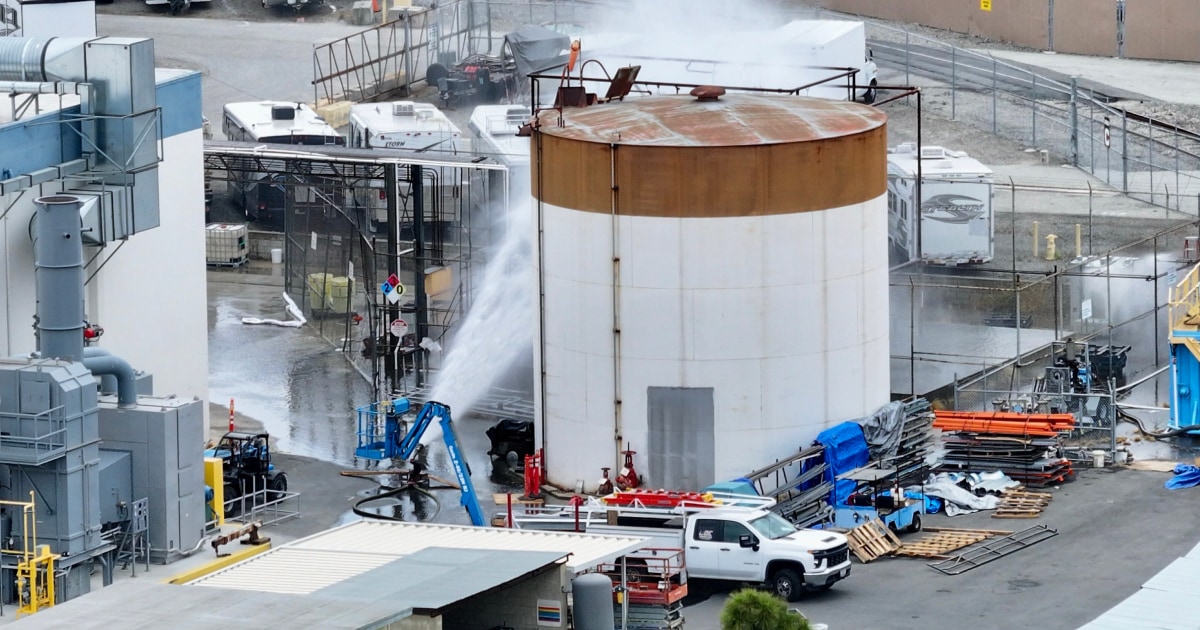
When a 7,000-gallon tank of the chemical began to overheat on May 21, officials feared it would spew into nearby neighborhoods. But with the threat neutralized, the last 16,000 residents under evacuation returned home on Tuesday.
Although the California facility is not part of the RMP, it has a history of enforcement actions by local and state regulators, including violations of state laws for aboveground storage of petroleum and violations of local water quality rules.
The company also paid about $910,000 in a settlement with the regional air quality regulator over alleged violations.