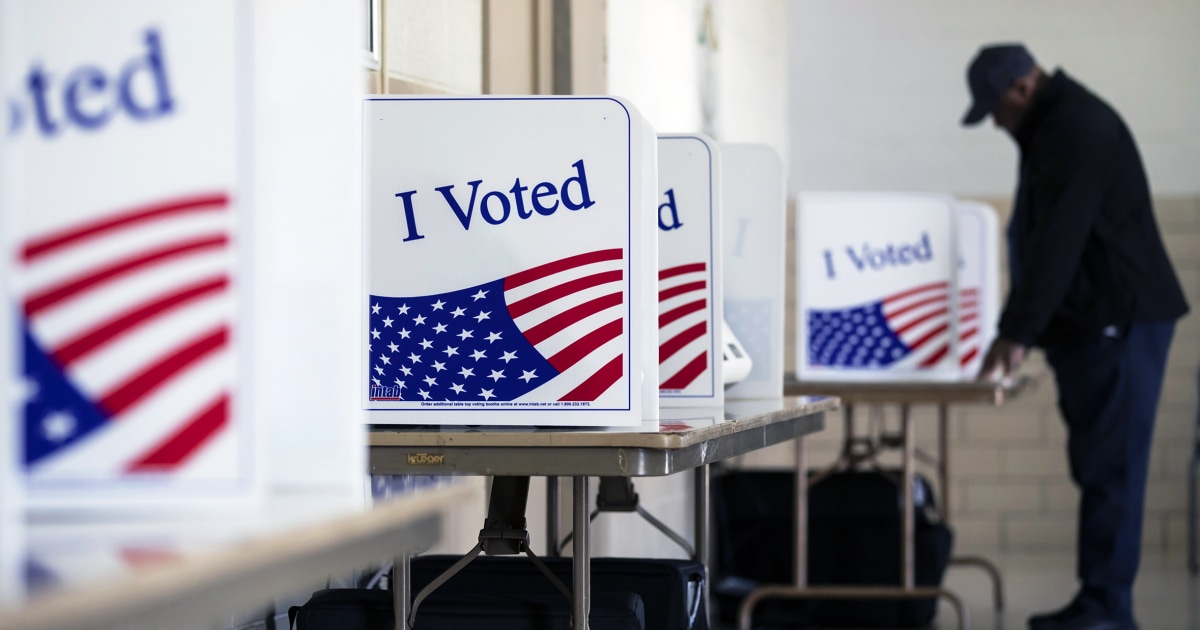
South Carolina is poised to hold the first Democratic presidential nominating contest in 2028, after the Democratic National Committee’s powerful rules committee moved to keep the state at the front of the line.
Subscribe to read this story ad-free
Get unlimited access to ad-free articles and exclusive content.

The move, set to be recommended by the rules committee Friday and presented to the full Democratic National Committee at its summer meeting next month, settles a months-long battle between a handful of states.
The end result elevates South Carolina over rivals like Nevada and New Hampshire, which will still be allowed to hold early nominating contests, and likely pushes Iowa out of the early-voting window altogether. DNC members also granted Michigan the ability to hold an early contest, and they could add two more states before the day is done.
The race to kick off the Democrats’ presidential nominating contest was hard-fought and drawn-out, with states first pitching DNC rules committee members during a January meeting in Puerto Rico and continuing to press hard in the months since.
The struggle between Nevada and South Carolina turned tense in recent weeks, particularly among some who framed the debate as one between two key pieces of the Democratic Party’s base. Latino voters make up a large portion of the Nevada electorate, and Black voters are the foundation of South Carolina’s Democratic electorate.
Key Democrats from both states leaned heavily on DNC members and sought to sway broader public opinion in the party.
“When South Carolina goes first… the Deep South goes first, Black voters go first,” South Carolina Democratic Party Chair Christale Spain said this week during an interview with Roland Martin. “Black voters are the backbone of this party, and so we should continue to elevate Black voters’ role in the process, not push it further back.”
Nevada put on the hard sell too, with a host of lawmakers, Latino groups, and influential labor leaders mounting an aggressive lobbying effort. They highlighted the importance of winning over voters in a critical battleground state, as Democrats look to rebound from the 2024 election, when President Donald Trump won Nevada.
“Democrats keep losing working-class voters because we keep skipping the states where they actually live. To win Nevada, you have to earn Latino voters, Black voters, AANHPI voters, AND white working-class voters — all at once,” Nevada Attorney General Aaron Ford, the Democratic nominee for governor, wrote on the social media platform X this week.
South Carolina Democrats’ effort got a jolt of momentum in the wake of the Supreme Court’s decision to weaken part of the Voting Rights Act, a move that prompted a number of Republican-controlled to redraw majority-minority districts represented largely by Black Democrats.
The Palmetto State’s supporters repeatedly referenced the Supreme Court decision and the struggle for Black voters in the South to gain voting rights during the Civil Rights Movement.
Donna Brazile, a rules committee member and former national party chair, emotionally evoked Barbara Jordan, a Black Democratic political icon, and criticized the Supreme Court’s ruling.
“If we believe in the future, the future that Barbara Jordan called us to build,” Brazile said, “we must begin the 2028 presidential primary season in the South.”
Rep. Debbie Dingell of Michigan, backing South Carolina, told members that “we need to send a message that we are not abandoning people that have been part of this party, and are being screwed by the Supreme Court,” even as she pushed back on the idea that the vote would elevate South Carolina over the other states in the early window.
“There are going to be six states that are first in the country to make sure that every single segment of the Democratic Party, and those we need to bring back, are going to be part of this story,” she said.
The decision marks the latest step in a significant reshuffling of past competitive Democratic presidential contests, with Iowa and New Hampshire long holding the first two contests.
But a botched 2020 Iowa caucus — in which a series of technological failures delayed the results — and a movement among some Democrats to elevate more racially diverse states prompted change in 2024.
Then-President Joe Biden pushed the DNC to reshuffle the primary calendar for his re-election year, moving South Carolina to the front of the line four years after it provided the key result for his 2020 primary campaign. The DNC also gave Georgia and Michigan the right to hold their contests during the pivotal early window. Michigan followed through, while Republican lawmakers in Georgia declined to bless the plan.
New Hampshire sought to disregard the DNC and hold its Democratic primary in January, with the party initially punishing the state but ultimately relenting, as it regularly has whenever states flout its calendar.
On top of changes to the 2028 calendar, the DNC is expected to adopt stronger punishments for states that choose to flout the party’s approved calendar.
Those new punishments would include stripping these states of all delegates, fining the state party $270,000, banning candidates from official party debates if they campaign in unsanctioned contests — and making it harder for the party to backtrack on or wipe out these penalties later.
Winning the national party’s blessing to hold a nominating contest ahead of Super Tuesday is a big prize for state Democratic Party organizations, given how these early contests have helped to shape the path of modern presidential nominations.
Biden’s 2020 campaign may not have ever taken off if not for a big win in South Carolina, where he leaned on his strong relationships with Black voters for a commanding victory after sputtering in Iowa and New Hampshire. Four years prior, Sen. Bernie Sanders’ strong showings in those first two contests sent a powerful signal to a Democratic establishment that had hoped former Secretary of State Hillary Clinton would cruise to the nomination.
While a dozen states made the pitch to DNC rules committee members over the last few months, some always faced significant practical concerns. States like North Carolina, Tennessee and Georgia pitched themselves for early contests, but Democrats would have needed Republican support in the state legislatures to change primary dates.
Meanwhile, Republicans are not expected to make substantial changes to their calendar ahead of an open 2028 presidential contest of their own.