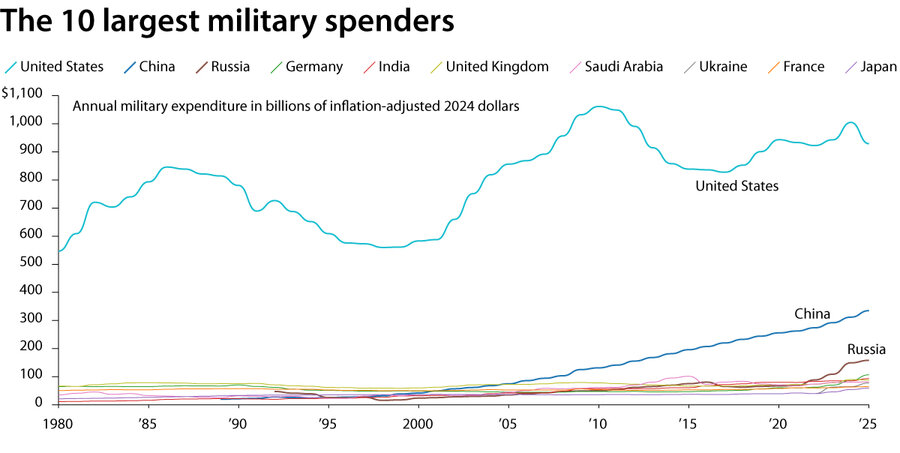
The Trump administration is hoping to spend $1.5 trillion on defense next year. That’s roughly 42% more than the United States, by far the world’s most expensive military, spends now.
That’s also getting close to 5% of U.S. gross domestic product. The last time the defense budget was significantly higher as a percentage of gross domestic product was during the Reagan administration’s Cold War military buildup in the mid-1980s, when it reached nearly 7%, or during the Vietnam War, when it was more than 9%.
While the huge budget increase plan aims to make good on President Donald Trump’s campaign pledge to rebuild America’s military, it also represents a big shift in national spending priorities. It’s a pace that potentially diverts billions of dollars from education, healthcare, and other initiatives while adding roughly $5.8 trillion to the national debt over the next decade.
Why We Wrote This
The Trump administration has proposed a massive increase in defense spending for the coming year. It’s heavy on spending for depleted munitions and plunges deep into drones, as “the future of combat.”
In the proposed U.S. military budget for the fiscal year 2027, the Army and Navy would each see their budgets grow by a quarter, while the Air Force would get a 34% boost. The Defense Department’s newest branch of service, the Space Force, stands to see its budget more than doubled to about $71 billion.
Even think tanks that describe themselves as hawkish, such as the Foundation for Defense of Democracies, called the administration’s proposed U.S. military budget for the fiscal year 2027 “extraordinary.”
With a bigger budget than the next nine countries combined, the U.S. already has the most expensive armed forces in the world. In terms of sheer active personnel numbers, America ranks third behind China and India, according to the Peterson Foundation.
It’s a “generational investment” in the country’s armed services as it approaches the 250th anniversary of its founding, the Pentagon’s acting chief financial officer, Jules Hurst III, said last Thursday.
Worth noting: The cost of the conflict with Iran is not factored into the current defense request. That will take more money – an additional $1 trillion, by some estimates.
But America’s current war is clearly influencing both public and private investments, in everything from more drones (and defenses against them) to more missiles and Navy ships. Private investment in the military and defense sectors has surged recently, namely in defense tech and startups. In the first quarter of this year, defense startups backed by venture capital raised $468 million, a 180% increase from the same period in 2025.
The new military budget request will face steep political challenges as it seeks congressional approval. To help offset the increase in military spending, the Trump administration has made deep cuts to nondefense programs across the federal government, including to affordable housing, education and job training, and medical research.
Drones
The proposed budget – which triples current spending on drones to more than $74 billion – would mark the largest investment in the technology “ever,” as those weapons reshape the modern battlefield, Mr. Hurst said last week during a Pentagon press briefing.
One of the goals of the cash infusion is to develop technology that teams up crewed and uncrewed autonomous systems. Mr. Hurst pronounced that “the future of combat.”
Collaborative Combat Aircraft, for example, would pair hundreds of uncrewed planes with advanced fighter jets.
The Defense Autonomous Warfare Group, meanwhile, whose job is to design thousands of low-cost “attritable” drones, will see its budget jump from $226 million last year to $54 billion. A jump of nearly 240 times, that’s the biggest single yearly increase of any program in the budget.
There is also a $20 billion request for countering the sort of drone-on-drone warfare that has become ubiquitous in Russia’s war against Ukraine.

Missiles
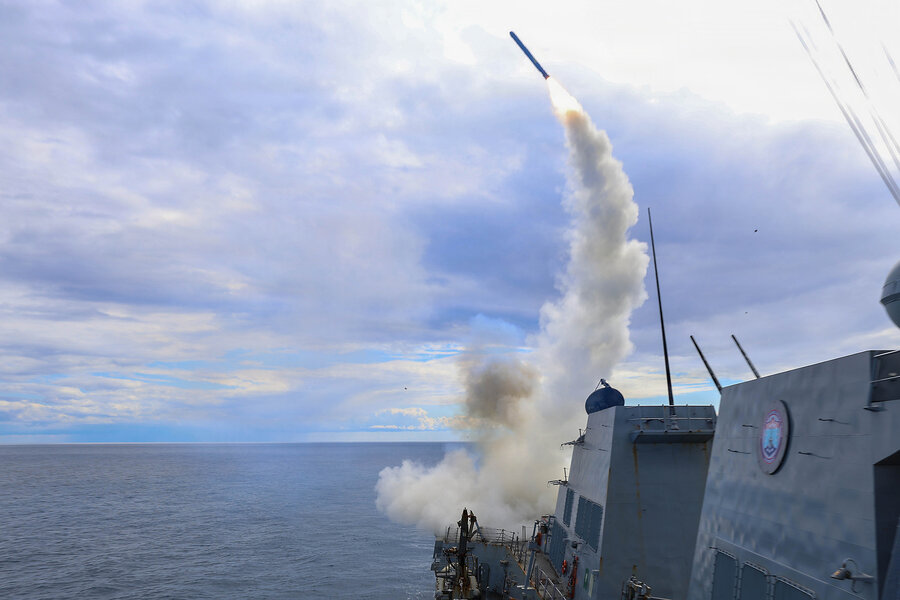
During the war in Iran, the U.S. has been firing off missiles at an “extraordinarily” fast pace, analysts say. To replenish those, the current budget requests a massive $53 billion for “critical munitions.”
Tomahawk cruise missile production alone will ramp up from 55 last year to 785 in fiscal year 2027.
At $68 billion, there is a lot more money for missile defense, too.
To shoot down Iranian missile barrages, the U.S. used more Patriot missiles in the first four days of the Iran war alone than it gave to Ukraine in four years of its war with Russia, analysts note. To provide a reset, funding for Patriot missiles is set to jump from $1.6 billion to $12 billion in fiscal year 2027.
The single-largest line item, at nearly $18 billion, is the Golden Dome missile shield, a “system of systems” Manhattan Project-scale effort that combines ground-, sea-, and space-based interceptors.
Stockholm International Peace Research Institute
|
Jacob Turcotte/Staff
Nuclear deterrence
Nuclear weapons are the “bedrock” on which U.S. national defense strategy rests, Space Force Lt. Gen. Steven Whitney, who leads budget planning for the joint military staff, said during last week’s Pentagon briefing.
The budget request seeks to modernize them and includes $16 billion for the Columbia-class submarines, a new generation of nuclear submarines designed to be quieter and harder to detect than previous subs.
They are designed to replace Ohio-class subs that have formed the backbone of the sea-based leg of the triad since the 1980s. The first Columbia-class submarine of a planned fleet of 12 is expected to be ready in the early 2030s.
The B-21 Raider is the next-generation stealth bomber, capable of delivering nuclear weapons and designed to evade modern radar and air defenses. It is slated to get about $6 billion in fiscal year 2027.
Navy ships
The proposed budget includes more than $65 billion for 18 more battleships and 16 other support ships as part of the “Golden Fleet” initiative.
That’s a nearly 140% increase over the budget last year, when the Navy was allocated $27 billion to build 17 ships.
The spending increase is a demonstration of America’s “commitment to maritime dominance,” General Whitney said.
The budget also includes some $427 million for unmanned naval vessels and testing of their weapons systems.
Troops
The budget includes a 7% pay raise for junior enlisted corps, and a 6% boost for mid-career military personnel.
The troops are “our greatest military advantage,” General Whitney said. “With this funding request, we directly invest in our people, recognizing and respecting our war fighters, their families, and the daily sacrifices they both make for our nation.”
Some of the money, $57 billion, will go toward addressing ”failing” base facilities, including family housing, and fixing barracks that have long been deemed poor or failing.
None of this includes repairs to the installations that have been struck in the Middle East during the U.S. war with Iran.
“It really depends on how we decide to rebuild those,” Mr. Hurst said. “Or if we do.”