In a prime section of downtown Chicago, sandwiched between a federal courthouse and Bank of America, pedestrians must walk under scaffolding to avoid chunks of terra cotta siding falling from a building that locals say is suffering “demolition by neglect.”
The building at 202 S. State Street was acquired by the federal government in the wake of the Sept. 11, 2001, terrorist attacks as a security buffer for the courthouse next door. But it then stood virtually vacant for two decades, with little effort to maintain or sell it after the immediate threat receded.
That building is not an isolated case. Across the country, the federal government owns roughly 10,000 underused or vacant buildings, the product of decades of neglect, delay, and dysfunctional management. Boston, Seattle, Chicago, Atlanta, Miami – nearly every major city has an aging federal courthouse, warehouse, customs facility or office building that could be redeveloped into housing, retail space, or modernized office space.
Why We Wrote This
Underuse is a chronic challenge in federal buildings. Many are outright empty – making them ripe for resale and redevelopment into housing, office, or retail space. But efforts are beset by bureaucratic hurdles.
Such repurposing isn’t easy, given the costs involved and the reality of an office-space glut in many urban centers. But the opportunity is real, and remains unrealized as bureaucratic delays, limited funding, and neglected maintenance slow or stall efforts to bring properties back into productive use.
Since 2013, some 900 mostly smaller properties worth $1.4 billion were sold by the General Services Administration (GSA), which is responsible for managing and disposing of most civilian agency buildings.
“There’s an immense amount of opportunity across the federal portfolio for redevelopment and reuse for economic development,” says Martine Combal, senior vice president for public institutions at JLL, a real estate consultancy advising the Public Buildings Reform Board (PBRB), created by Congress in 2016 to accelerate the sale of federal buildings.
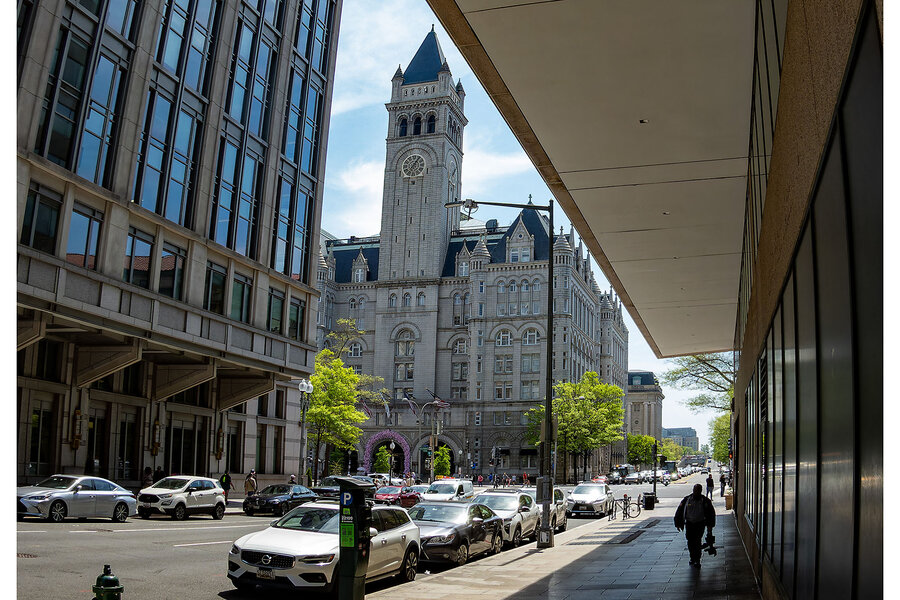
There are modest signs of progress, most evident near Washington, D.C., because the capital contains the largest concentration of federal office space in the country. The former Agriculture Department Cotton Annex has been transformed into luxury apartments. An abandoned heating plant in Georgetown is being renovated into riverfront condos. The most famous and polarizing success is the old Post Office building, five blocks from the White House. The government saved $6 million a year in operating costs by leasing it to Donald Trump in 2013, before he first became president. He poured more than $200 million into renovations that transformed it into a top hotel, later sold to the Waldorf Astoria chain. Before, it paid no city or national taxes; now, it pays $3 million in rent to the federal government and pays income, occupancy, and payroll taxes.
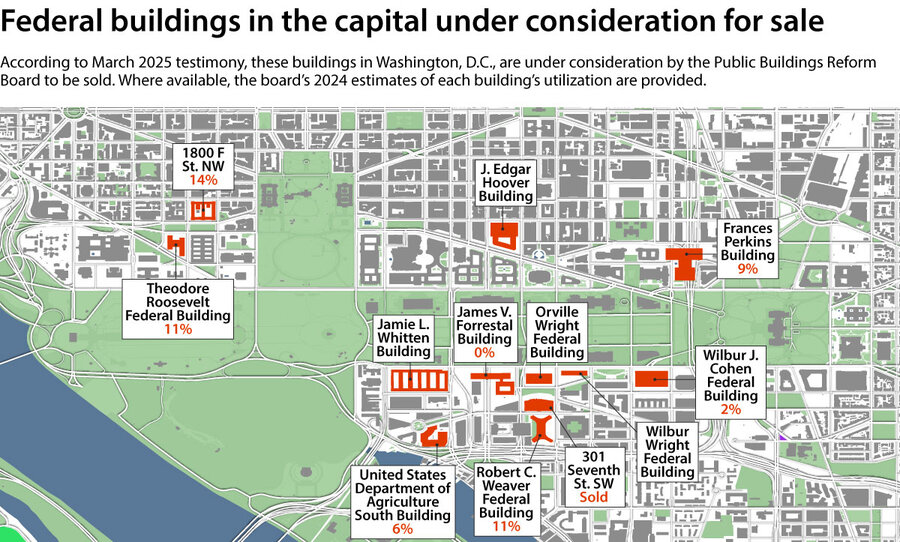
The GSA Regional Office Building, with nearly 1 million square feet of space, was recently sold and is likely to be developed into apartments. A new wave of disposals will offer for sale some of the largest office buildings in the district: the Energy Department headquarters (2.2 million square feet), the Robert F. Kennedy Department of Justice Building (1.2 million square feet), and even the FBI’s aging J. Edgar Hoover Building (2.8 million square feet).
Maintenance deferred
The projects in Washington show what is achievable. Yet each one has had to fight through a system that starves buildings of maintenance and lets them slide toward disrepair.
“Local leaders have warned that deteriorating or abandoned federal buildings are dragging down struggling downtowns, eroding property values, and stifling economic recovery,” says Talmage Hocker, a board member and the acting chairman of the PBRB.
Yet Congress chronically underfunds maintenance. Commercial real estate managers typically allocate 2% to 4% of a building’s value for maintenance each year; Congress offers 0.38%. And when agencies need to renovate a building to enable its sale, they must wait for Congress to authorize funds, which can take between 18 and 24 months. As a result, the backlog of needed repairs now exceeds $370 billion, according to the Government Accountability Office.
“The maintenance backlog is crippling agencies’ ability to deliver on their missions, endangering the federal workforce,” Mr. Hocker says.
Use it or lose it
Political pressure is growing to sell unused property and make more economical use of what remains. Indeed, President Trump launched a task force last year to identify federal property that can be used to build housing. In total, the U.S. government controls some 300 million square feet of office space nationally through ownership and leases.
For years, the government didn’t even know how much of its space was being used. That is now changing. The PBRB pushed to employ automated systems to measure how much space is used, but met resistance from federal agencies.

Annabelle Gordon/Sipa USA/Reuters/File
“We had so many objections from agencies. They didn’t want the data. Because, you know, I think anecdotally, they knew what it would show: The buildings are mostly empty,” says Dan Mathews, who was appointed to the PBRB board by President Joe Biden.
Congress in 2024 passed the USE IT Act, requiring agencies to measure how much space they use and sell or consolidate buildings if they use less than 60%. The first report under the act found that only 28% of building space was in use across 22 federal agencies from January to March this year.
At present, no government agency comes close to meeting the 60% threshold, which points to potentially big changes ahead.
“For too long, things have been allowed to wander along, and there’s been no accountability,” says Republican Rep. Scott Perry of Pennsylvania. He sits on the House Committee on Transportation and Infrastructure, which oversees questions related to federal property – and he vows to keep pressure on the GSA.
“If it looks like they’re slow-rolling it and refusing to abide by the policy and doing everything they can to resist it, I think there’s troubled waters ahead,” he says.
The long, long road to renovation
Consolidating agencies into underused space makes sense, but moving costs money that must be approved by Congress – a process that can take years.
“The primary challenge GSA and agencies face is the lack of funding necessary to vacate and dispose of these underutilized, high-cost assets,” the PBRB cautioned in a recent report.
To sell a building, agencies must navigate a multistep process: First, the building must be offered to other federal agencies, then the building must be offered as a public benefit conveyance to state and local governments or nonprofit organizations. Only then can it be offered to private buyers. Offers to state and local governments can trigger more delays as local zoning and development plans await approval.

To speed things along, Congress passed the Federal Assets Sale and Transfer Act (FASTA) of 2016, which created the PBRB. The board has six members, all of whom have significant experience in real estate. They assist in sorting through the many federal properties for those that can be readily sold.
Instead of each agency operating individually, the board proposes a list of properties for expedited sale. The details go to the Office of Management and Budget, which must approve along with Congress. The properties are then transferred to the GSA, which manages the sales.
The GSA can reduce or eliminate the federal-to-federal screening stage and the public benefit conveyance stage. But properties also must be screened by the Department of Housing and Urban Development and the Department of Health and Human Services, which are required to check whether surplus federal property can be used to assist Americans without homes.
The FASTA law was designed to expedite sales, but the most difficult steps remain: moving agencies, securing approvals, and executing complex transactions. Because federal buildings have so much deferred maintenance, finding buyers can take years. If the federal building is on a historic preservation list, that imposes higher costs on a buyer.
Originally, FASTA called for proceeds from building sales to go into a revolving fund that could be used to help agencies move into new quarters or prepare buildings for sale. However, Congress wanted to give agencies more incentive to sell, and last year changed the rules to allow agencies to retain the proceeds from building sales. That change increased incentives but shifted back to a slow process requiring congressional approval of every agency move. The PBRB has successfully shined a spotlight on buildings that can be sold, but its mandate expires at the end of 2026 unless new legislation extends it.
Another impediment to speed is the GSA itself. The agency has lost one-third of its staff in the office handling property sales and half its staff overall, according to the Government Accountability Office.
If prospective buyers seek property tax abatements or changes to infrastructure around the property, that involves more delays.
Bottom line: A potentially beneficial sell-off of federal properties is underway and could grow in scale, but looks likely to take decades to realize.