
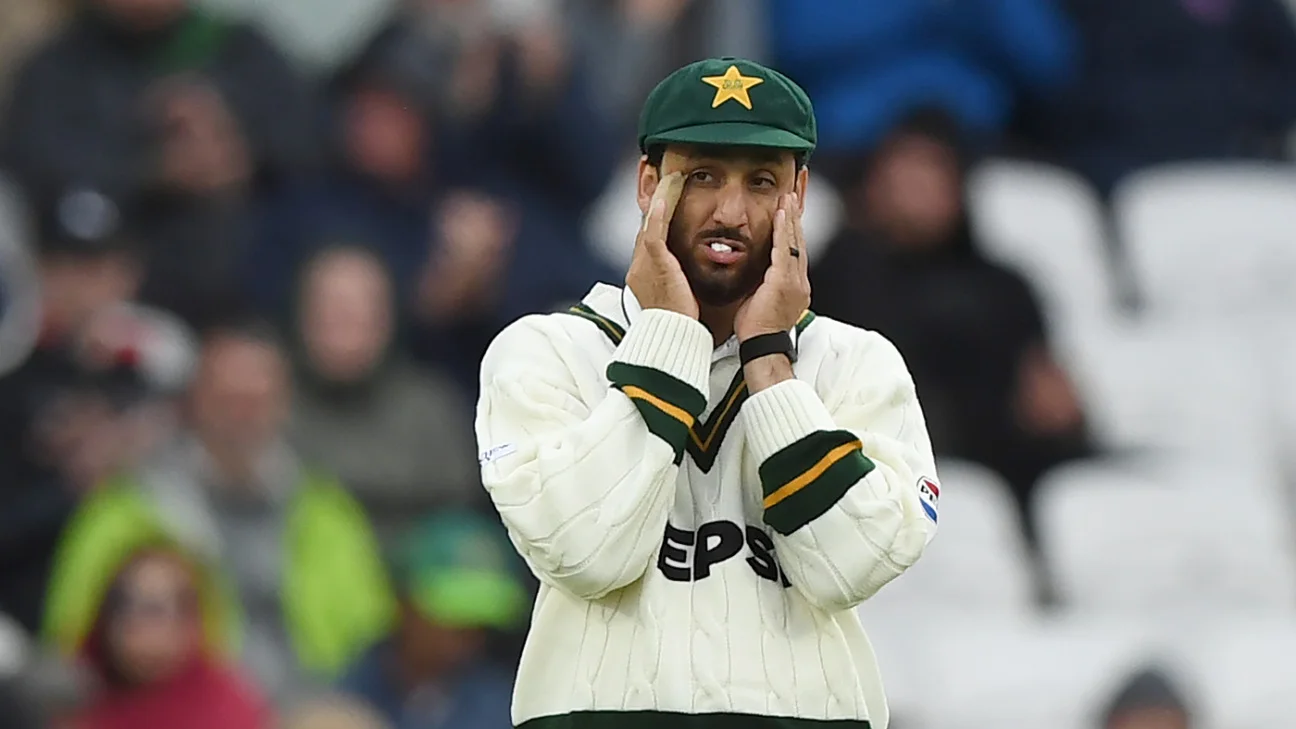
A moment later, as game-awareness made its way into the Pakistan captain’s consciousness, he aimed a panicked hurl at the stumps. He ended up whacking it straight into Mohammad Rizwan’s rear, who by now was shielding a large section of the stumps from his team-mate’s line of sight as he, too, appealed. The review failed to save their blushes; it had hit Lawrence outside the line.
It was the perfect snapshot of the attitude of this Pakistan side, and the Pakistan cricket set-up in general. Pakistan hoping for an outcome not in their power, while eschewing any effort to achieve that outcome through effort on their own part, no matter how minimal.
There might be some mitigating circumstances for Pakistan’s 36-year old bowler, well into a ten-over spell, but today, they showed these are simply the standards they set for themselves now. Across a truncated day of play, Pakistan’s fielders appeared more allergic to diving than an aquaphobe on a springboard. Mohammad Ali just about ran past one as it trickled to the boundary under his watchful eye.
At least three other fielders opted to stick a foot out rather than actually bend down, on occasion to tragicomic results. When Harry Brook cut one to deep third, Usman Ali’s left boot stopped the ball, only for his right shin to then knock it back into the boundary.
“There’s no excuse for it,” Usman admitted. “We should put in more effort. There were lapses in the field today and it cost us runs.”
It was almost as if runs weren’t especially important to Pakistan; England were by this stage exactly 100 ahead with more than half their side in reserve. But this was a day of Pakistan demonstrating their mediocrity extends well beyond the weakness of their batting, the slowness of their pace attack, or the fragility of their mentality. Those have only shielded the continuing slide in Pakistan’s fitness and fielding, matters they have full rein over, and cannot be blamed on the inequities of cricket, the vagaries of the toss, or the systemic flaws of their domestic structure.
None of that has any bearing on Ali watching Brook drive a ball three yards away from him at mid-on, and somehow contrive to slide clumsily over it. Or, when Brook had just got off the mark after Pakistan had taken two wickets in five balls, Salman shelling a regulation catch at second slip.
It is the one thing any side enjoys complete control over: the fitness standards they enforce, and the fielding that invariably stems from it. In an era where control is in abundance at the PCB, it feels pointedly like something they have done to themselves rather than something that simply happened to them. Headingley left them no hiding place, but the rot has been visible closer to home for some time.






Leave a Reply