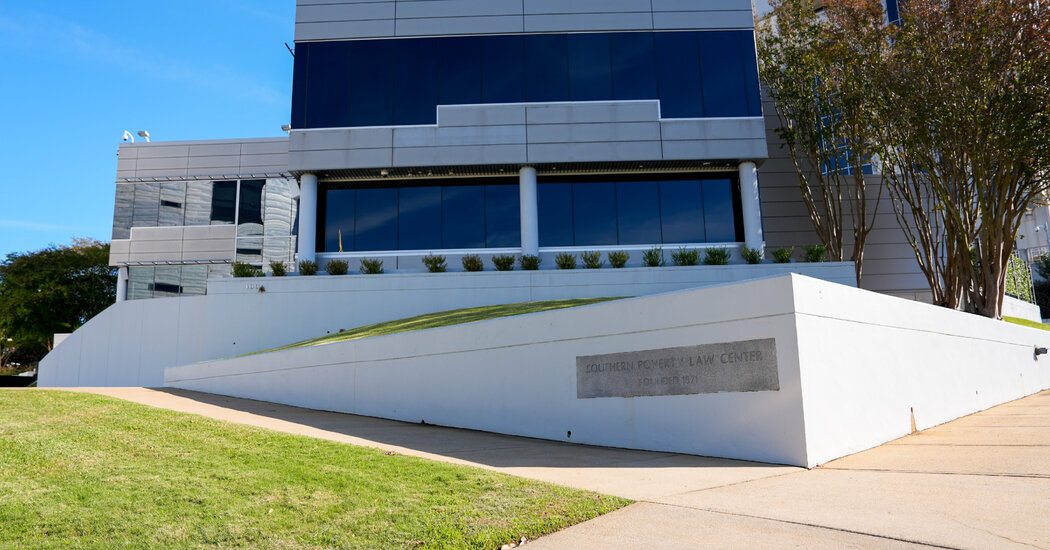
A former senior official at the Southern Poverty Law Center was charged on Wednesday with fraud and conspiracy as part of a revised indictment accusing the storied civil rights group of cheating its donors by using their money to pay informants inside right-wing extremist organizations.
The former official, Heidi Beirich, once ran the center’s informant program, which recruited what amounted to spies within far-right groups like the Ku Klux Klan. Prosecutors say that while Ms. Beirich was overseeing payments to the informants, she was in a romantic relationship with one of them and the two shared a house and bank accounts.
Most of the charges against Ms. Beirich were contained in an earlier version of the indictment, but nonetheless signaled an escalation of the Justice Department’s prosecution of the law center, which is best known for investigating white supremacist groups. It was the first time anybody connected with the law center — not just the organization — had been formally indicted.
Michael J. Proctor, Ms. Beirich’s lawyer, said in a statement that she had “dedicated her life to fighting hate groups and extremist movements.”
“Her decades-long record of success dismantling hate groups — and the resulting threats to her life — speak volumes,” the statement said. “For this, she has been indicted.”
In the previous version of the indictment, Ms. Beirich had been identified as an unnamed employee of the law center. Prosecutors said she had been in a relationship with an informant who infiltrated a neo-Nazi organization, the National Alliance, and was paid more than $1 million over two decades. Between 2015 and 2021, prosecutors said, about $140,000 of that money ended up in the joint accounts she shared with the informant, known in the indictment only as F-9.
Attorney General Todd Blanche addressed the charges against her at a news conference on Wednesday in Washington.
“I believe she was part of the effort to open bank accounts in completely fictitious companies’ names and make payments to individuals for reasons that were not accurate as described,” he said.
Abbe Lowell, who is representing the law center, assailed the new charges as the Justice Department’s most recent effort to go after his client.
“This charge reflects a desperate government confronting a weak case, scrambling to make something — anything — stick as we approach trial,” Mr. Lowell said.
The Trump administration and its allies have for years criticized the law center’s efforts to document and expose the inner workings of far-right organizations. It has said that the group often failed to draw distinctions between extremists and more traditional conservative groups, especially in one of its premier publications known as the Hate Map.
Last year, several conservative groups mentioned in the Hate Map sent a letter to Stephen Miller, one of President Trump’s top aides, asking him to urge Mr. Trump to issue an executive order removing all information from the law center from federal websites and barring the administration from using the group’s writings in any government programs.
While the president never issued the order, Kash Patel, the F.B.I. director, announced in October that the bureau was severing ties with the law center. Mr. Patel said the organization had “long ago abandoned civil rights work and turned into a partisan smear machine.” He singled out its use of the Hate Map, which, he added, unfairly targeted “mainstream Americans.”
Moreover, the letter to Mr. Miller used language about the law center that was almost identical at times to language that appeared in an F.B.I. document from October that laid out the basics of the investigation that ultimately resulted in the original indictment being filed in April.
At the heart of the government’s case is an accusation that the informant program not only tricked banks and donors to the law center, but also purposefully promoted the very type of far-right extremism that it was purporting to work against.
The claims have already gained steam among the president’s supporters. Many have shown themselves susceptible to conspiracy theories that events like the attack on the Capitol on Jan. 6, 2021, were not committed by Mr. Trump’s supporters but instead were instigated by shadowy “deep state” forces within the government.
Mr. Lowell and his partners have offered a simple argument that the law center was not promoting far-right extremism through its informant program, but rather fighting it. They have repeatedly pointed out that information gleaned from the center’s informants was shared with law enforcement agencies, including the F.B.I., resulting in arrests and prosecutions.
The law center’s lawyers said in court papers this month that the Justice Department refused to turn over records that could show even more occasions when tips and insights from its informants were shared with law enforcement. The lawyers noted that, in at least one case, an informant for the law center also worked as an informant for the F.B.I. — a development suggesting the informant was a legitimate source “used to disrupt and dismantle hate groups.”
“The S.P.L.C. did not lie to donors, did not mislead the banks it did business with and its informant program prevented violence and saved lives,” Mr. Lowell said. “This prosecution continues D.O.J.’s dangerous departure from the principles it’s required to uphold, and we will fight it aggressively in court.”