

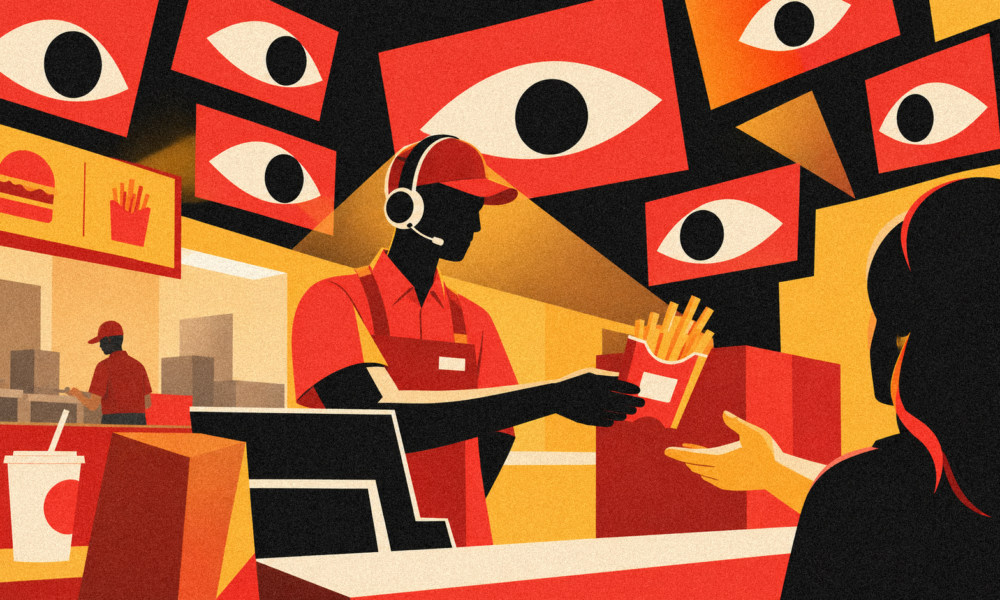
Corrin Kearney had been delivering pizzas for a Domino’s in North Texas for a few months when their store asked them to install a new app on their phone and keep it open during their shift. Soon, Kearney learned the app was tracking and scoring every delivery route they drove, with the results displayed on a leaderboard back at the store for the whole crew to see.
The app uses technology from Drivosity, a company that sells what it calls “cutting edge GPS and AI” driver-monitoring to fast-food chains, including Domino’s and Papa John’s. Each trip is scored from 0 to 100 based on factors including acceleration, braking, cornering and speed. According to Kearney, drivers at their store are expected to keep their scores above 85. Anyone below that score is written up by managers and eventually locked out of the Domino’s system. “Drivosity can effectively fire people,” Kearney said.
As a driver captain, Kearney has to write up other drivers, even though they have found the app doesn’t recognize the nuance of many real-world situations. Drivers can be penalized for sudden braking to avoid a collision or rapid acceleration to merge on a highway, forcing them to choose between risking an accident or getting points docked, according to Kearney. “It’s infuriating,” Kearney said. “The AI can tell you you haven’t driven well enough and you get fired.”
Drivosity also sells coaching and analytics features, including HustleTime®, which measures how fast employees walk from the store to their car, how long they take handing the pizza to a customer and how long they take walking back. In Drivosity’s promotional videos, franchise owners and managers at Domino’s and Papa John’s praise HustleTime®’s ability to track workers in real time down to the second. Stores can “gamify” this, according to the company website, by having workers compete for better scores.
Domino’s and Drivosity did not respond to requests for comment.
Fast-food companies are increasingly using AI-powered technology to turn worker behavior — how fast you drive, how warmly you greet a customer, how long you spend in the bathroom — into data that can score, rank, discipline and manage employees. To understand how these AI-driven tools are impacting fast-food workers, Capital & Main interviewed over a dozen workers, researchers and labor advocates, who described error-prone technologies being deployed at a rapid pace, without the consent or awareness of staff, even as their pay and promotions are increasingly shaped by AI-enabled monitoring.
“They basically use their population of workers as guinea pigs,” Alexandra Mateescu, a researcher at the nonprofit Data & Society, said of the way that fast-food companies are deploying these new tools.
* * *
In February, Burger King announced that an OpenAI-powered assistant named Patty was being rolled out at about 500 U.S. restaurants, with plans to reach all U.S. stores by the end of 2026. A few weeks later, the tool arrived at the Burger King in Niagara Falls, New York, where Dante Vasquez took drive-thru orders.
“It started with a little AI voice in our headset,” said Vasquez.
Then the monitoring features started. Each drive-thru conversation was scored on friendliness and upselling, with the numbers displayed on a screen in front of Vasquez as he worked. Anyone could click on a transaction to hear a recording and review the AI-generated transcripts. Green boxes marked what he’d done well — a “Good morning!” or “You rule!” Red boxes marked what Patty counted against him: points off for saying “please hold,” or “um,” or not speaking clearly.
Managers watched the scores closely, constantly reminding the crew to stay above the 70% friendliness target, Vasquez said. Workers who scored low were cut from the schedule, he added.
Vasquez learned to speak the way that Patty wanted. He got so good at it, that customers started asking if he was a bot. His co-workers nicknamed him “Gemini.”
“The system wants me to talk like a robot, so I’m talking like a robot,” Vasquez said. “It just gets so mentally degrading.”
Burger King has said publicly that the system was not designed to evaluate individual employees. But Capital & Main reviewed screenshots from a Burger King training module, and images of the dashboard in use, showing individual drive-thru conversations timestamped and marked for tone and upselling. Vasquez, and other Burger King employees, some of whom spoke to Capital & Main on the condition of anonymity for fear of retaliation, said it was easy to identify and discipline individual employees for low scores.
Later, Patty started scoring workers on “warmth,” a metric Vasquez couldn’t make sense of. When he asked his district manager how it was calculated, he recalled, she told him to just talk “like a warm blanket.”
According to Vasquez, Patty seemed to penalize his Black co-workers more than others for what the system flagged as “improper tone.” Mayu Tobin-Miyaji, counsel at the Electronic Privacy Information Center, said that scoring workers on warmth or friendliness is “sort of pseudoscience” and that those tools risk penalizing workers for their accents or disabilities.
Asked to respond to these concerns, Kristen Viersen, Burger King’s director of communications, emailed Capital & Main a company statement that said, “We have never before heard any example similar to the questions you raised about team members being penalized based on race, gender, ethnicity or accent.” Burger King declined to answer when asked if the company had tested these features for bias.
The new monitoring features were intended “to celebrate great examples of friendly service” and allow managers to coach their team, according to the statement, which also said that Burger King has since disabled both features “for further improvements.” Burger King would not say when the features were disabled, and workers said the monitoring was active through August of this year.
Co-workers at Vasquez’s restaurant joked that Vasquez would soon be gone, replaced by Patty entirely, a looming threat that was amplified by a sign in the store that reminded workers that Patty was being trained on every headset conversation. Eventually, the stress just wasn’t worth it.
He quit in August.
“If Patty wasn’t introduced,” Vasquez said, “I would still be working at Burger King.”
* * *
While large chains have struck high-profile deals with major AI companies — Yum Brands, which owns Taco Bell, KFC and Habit Burger & Grill, announced last year that it was deploying Nvidia-powered computer vision for “back-of-house labor management through real-time analytics and alerts” — a crowd of smaller vendors sells the same kind of AI monitoring to individual franchisees, with far less visibility.
Among the more established vendors is Solink, an Ottawa-based company backed by Goldman Sachs that describes itself as “the leader in AI-driven video intelligence.” It works with franchisees of Domino’s, Burger King, McDonald’s, Jack in the Box, Five Guys and other chains.
Solink’s product documentation describes a video-surveillance system capable of flagging workers who arrive late or leave early, take too long on their breaks, fail to wear a hairnet or the correct uniform, use their phones while on the clock or simply stand idle. The software can layer onto a restaurant’s existing security cameras, and it lets managers type in prompts to find footage of specific behaviors or set up automatic alerts.
In a statement, a Solink spokesperson, who declined to be named, said the company’s platform helps businesses “improve operations, sales, safety, and customer experience.” It also stressed that Solink “does not offer identification tools such as biometrics or facial recognition,” and that its terms require customers to comply with the law.
Data & Society’s Mateescu said these tools are rarely marketed as worker surveillance. Instead they are sold as “loss prevention” or “workflow management” tools. This language, she said, obscures what the technology actually does “both to employees and to consumers.”
* * *
While some companies use corporate euphemisms to obscure worker monitoring, others are more direct. MashMore, a new potato-themed fast-food restaurant in Albany, New York, is explicit about its AI use. Using commercially available AI models, its co-founders built an HR chatbot, named Mashy after the store’s mascot, that schedules, scores and ranks all employees.
Mashy runs on a stream of data employees generate as they work. Workers clock into routines, complete assigned “quests” and upload photos proving that tasks are completed. In exchange they earn “Mashy points,” which set their level in the restaurant’s ranking system and can determine bonuses and promotions.
When co-founder and CEO Andy Gor let Capital & Main interact with the chatbot, it didn’t hesitate about who the employee of the month should be. “Shontia Thomas, and it genuinely isn’t a contest,” the chatbot wrote on a screen that Gor shared with a reporter. Gor said the system would never be used to fire an employee, but the chatbot had created rankings for all workers, including those with the lowest scores.
Gor wants to make every routine, cleaning task and customer-service expectation tracked, scored and eventually copied from one location to another, so he can check anything from anywhere. “I’m in China right now,” he said. “I can see that during rush hour they cleaned the table nicely. Today, they pass.”
MashMore currently has just one location, but Gor wants to franchise fast. His pitch to investors is that the AI tool can manage employees across dozens of locations. Mashy, Gor said, is “our boss. Basically I’m working for him, too.”
* * *
Efforts to rein in algorithmic management have mostly stalled at the federal level. In California, Gov. Gavin Newsom signed a package of first-in-the-nation workplace-AI laws on Sept. 30. SB 947, the No Robo Bosses Act, bars employers from relying solely on AI to fire or discipline workers. AB 1883 prohibits tools that use AI to infer an employee’s emotional state or collect “neural data.” SB 951 requires employers to notify workers when AI is behind a mass layoff.
Tobin-Miyaji said in an email that the emotion-scoring ban would likely cover a tool like Patty — but that No Robo Bosses could be satisfied by “cursory” human oversight, leaving workers “constantly surveilled and quantified.”
Unions could in theory negotiate stricter protections than legislation might afford. In 2023, workers in California won the creation of a Fast Food Council, a state body empowered by law to set wages and weigh in on working conditions across the industry. But despite worker efforts to apply pressure to Gov. Newsom, the council currently lacks a chairperson and has not met for over a year. A spokesperson for the council, Charles Hamilton, told Capital & Main that “AI-powered employee monitoring and surveillance has not been presented to the council as an agenda item.”
Some workers have tried to head off the technology before it arrives. Sergio Ceja has worked in the kitchen of an Oakland Burger King for four years. He first heard about Burger King’s AI from his wife, who works at a different location. After her store brought in an AI drive-thru ordering system, she told him, several workers were laid off.
When Ceja raised his concerns about AI with his managers, he said they told him it was the owner’s call whether to bring in the new tech. Ceja and his co-workers agreed among themselves that if Patty ever came to their store, they would walk out. So far, it hasn’t. Management told them that they don’t plan to bring it in, but that in the future they may need to in order to lift sales and keep the store from closing.
Ceja’s worry wasn’t only about layoffs. It was about the kind of job that would be left if he stayed. “You’ll no longer have a co-worker,” he said through an interpreter. “You’ll have the machine.”
Copyright Capital & Main 2026
Start Selling Online with ShopOpen24
Are you a small business owner or entrepreneur? Discover seller opportunities and connect with customers through ShopOpen24.
Explore ShopOpen24 →ShopOpen24 | Local Products. Global Reach.






Leave a Reply