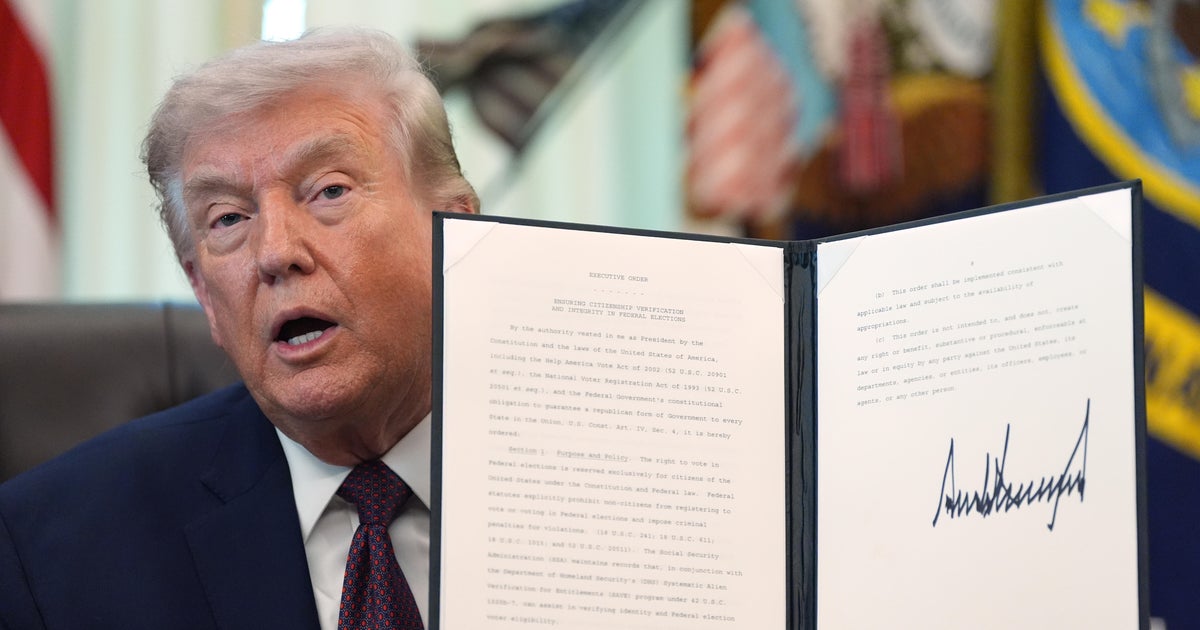
Washington — A federal judge in Boston on Thursday blocked the Trump administration from enforcing an executive order that would impose stricter mail-in voting rules and create a federal list of eligible voters in every state.
The order, signed by President Trump in March, required Homeland Security Secretary Markwayne Mullin to compile a list of U.S. citizens eligible to vote in each state using data from the Social Security Administration. It also directed the U.S. Postal Service to send absentee ballots only to people on each state’s federally prepared and approved mail-in ballot list.
U.S. District Judge Indira Talwani said the Trump administration cannot take any steps to implement those two provisions of the executive order. Talwani, an Obama nominee, said the executive and legislative branches lack authority over voter rolls.
Talwani sided with twenty-three states and the District of Columbia, which sued to block the order’s implementation.
“It is clear that the federal agencies charged with compiling Confirmed Citizen Lists lack the ability to create complete and accurate lists of the U.S. citizens residing in every state,” Talwani said in a 37-page opinion issued Thursday. “Both Congress and the president lack any role regarding voter eligibility.”
In no federal statute, Talwani said, “does Congress authorize the federal government to create their own voting database. Instead, Congress, consistent with the Constitution, has left that authority to the states alone.” The president, she continued, “lacks any authority to compile voter lists for each state.”
The executive order also directed the attorney general to “prioritize the investigation and, as appropriate, the prosecution of state and local officials” who conduct elections without using the government-approved list.
Talwani said that the list would be “used as an enforcement mechanism that has some type of legal consequence, or at minimum, as a threatened enforcement mechanism that will chill local election officials from complying with legal obligations to ensure that all eligible citizens may vote,” as part of an effort to “intimidate local election officials.”
Talwani added that “no law enacted by Congress delegates authority to control mail-in voting to the Postal Service,” adding that “the EO’s directive that USPS require all States to use a specific mail-in ballot is inconsistent with USPS rulemaking procedure.”
On Wednesday, Postmaster General David Steiner testified in a Senate Homeland Security hearing that under a newly proposed rule, the Postal Service would refuse to deliver mail-in ballots in states that do not transmit a list of approved voters to the Trump administration.
CBS News has reached out to the White House and Justice Department for a response.
Last month, U.S. District Judge Carl Nichols in Washington, D.C. denied a motion by the Democratic National Committee and affiliated groups to block the implementation of the executive order, finding that the plaintiffs in the suit did have proper standing and did not prove irreparable harm in their initial suit. Nichols, a Trump nominee, said groups can bring the challenge again when the Trump administration establishes more rules in following the order. The plaintiffs in the case have appealed that ruling.