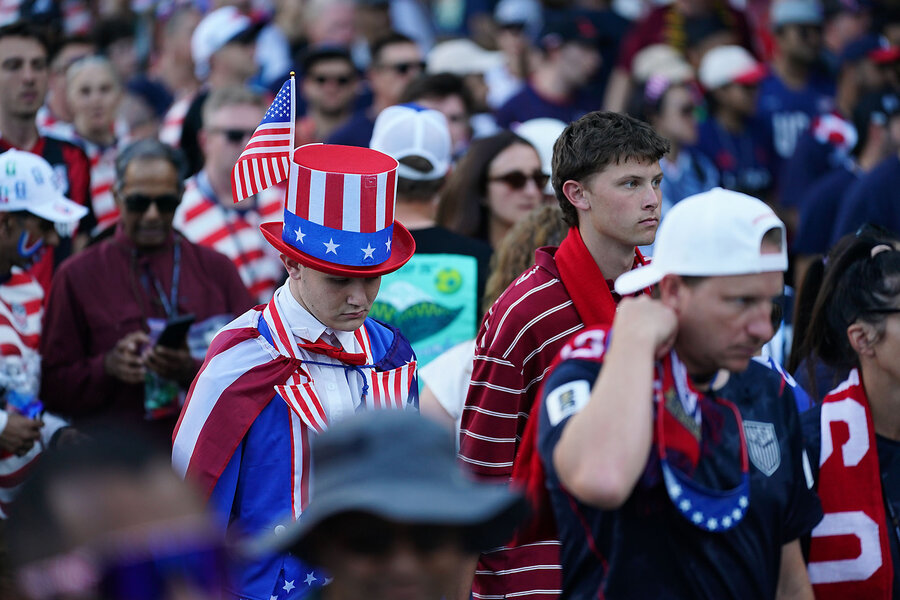
Before the first ball was kicked Monday, it was the United States against the world. After 90 minutes of some of the worst soccer played in the team’s recent history, it was clear that the members of Team USA were not remotely prepared for it.
The U.S. lost to Belgium, 4-1, ending their World Cup. But the overwhelming impression was that something more than a World Cup knockout match was happening. This was a statement about the world beyond soccer, and virtually every other nation was behind Belgium, pushing.
It would be difficult to overstate the level of outrage felt around the world at FIFA’s decision Sunday to postpone the red card suspension of American striker Folarin Balogun. FIFA President Gianni Infantino insisted the decision that allowed Mr. Balogun to play Monday after a red card in the previous round was made by an independent panel. But it was certainly not transparent, and U.S. President Donald Trump and the White House were publicly delighted with their efforts to put pressure on world soccer’s governing body.
Why We Wrote This
The U.S. World Cup team gave Americans a sense of shared possibility. But after a red card controversy and Monday’s defeat to Belgium, its star has dimmed.
To many from Brussels to Buenos Aires, the game immediately became the world today in miniature. The United States rewrites the international rules to its favor to help itself win. But tariffs or threats of invasion are one thing. For most people, everyday life rumbles on. This is football, the world’s game. And as every fan of “Ted Lasso” knows, “football is life.”
The anger over the narrative of U.S. hegemony, however, missed one key fact. In soccer, the U.S. is not a superpower.
Inspiring Americans
Before the controversy began, the U.S. had humbler goals, though still inspiring to generations of suffering American soccer fans. It hoped to write a new history for itself, celebrating a first true golden generation of stars to go deep into the World Cup. The team’s performances, so far, had more than justified those hopes. A win against Belgium seemed an achievable next step.
Now, it is almost impossible to draw any meaningful soccer conclusions from Monday’s loss, other than they almost surely would have played better had the suspension been upheld. Not that Mr. Balogun is in the least to blame for any of this – the rescinded punishment or the shocking performance. But how could they have played worse?
Belgium played through the team’s once-fierce press with absurd ease. Star player Christian Pulisic reinjured himself in the second half, though he was ineffective while playing. Captain and stalwart Tim Ream was directly responsible for the first three Belgium goals, to comic proportions on the third. The one U.S. goal was a stroke of good fortune from an inadvertent Belgian deflection. Otherwise, the U.S. offered nothing going forward. One measure of offensive threat, expected goals, suggested the U.S. created 0.42 goals worth of offense. Belgium created more than that in the first 10 minutes. Coach Rudi Garcia had cleverly filled his team with tireless workers, and they were relentless amid the American meltdown. Mere competence was more than enough.

Agustin Marcarian/Reuters
To say everything went wrong would be to undersell the scope of the calamity.
Throughout the tournament, one thing has been clear about Team USA. Its strength came from its new mentality. Coach Mauricio Pochettino is one of the best coaches in the world, but his strategic savvy, while important, is not what made the first four games of this World Cup a triumph. It was a fresh sense of positivity and resilience that made his schemes work.
Mr. Pochettino’s rallying cry of “Why not U.S.?” was a limitless mental horizon, asking the players to imagine inspiring outcomes and to inhabit them. With some amusement, many journalists have noted that Mr. Pochettino keeps a bowl of lemons around because he believes they absorb negative energy. One commenter on the sports website The Athletic quipped during Monday’s game: “That bowl of lemons in the US locker room is going to be absorbing a lot negative energy right now.”
It was a joke. But in some sense, it is the pertinent point after a performance that was not only the worst of the tournament by the U.S., but perhaps by any team. Even in its 7-1 loss to Germany, Curaçao showed some endeavor and verve. The U.S., for all intents and purposes, was not even present in Seattle Monday. From the opening kickoff, it was clear that the mentality that had brought the U.S. so much success had vanished as surely as Mr. Balogun’s suspension.
The tragedy is that none of this was the U.S. team’s fault. They had become one of the tournament’s best feel-good stories, even abroad. Mr. Balogun, in particular, had accepted his red card in the round of 32 game against Bosnia-Herzegovina with shock, but then with dignity. Like many, he did not think the call was just. But he shook the referee’s hand after the match all the same.

Agustin Marcarian/Reuters
“You can feel like something unjust has happened to you, but it’s not an excuse to be disrespectful or not do the right thing,” he said to media. “The most important thing for me is also to give the correct example to people watching.”
The suspension was an injustice, perhaps. When it was overturned, however, the United States rightly or wrongly became the evil empire to the rest of world soccer.
The coach of everyone’s favorite team to adore – rowing, grinning, flowing-haired Norway – saw this coming. “What really is bad about that situation can be that it will be [looming] over United States now, because if they beat Belgium, it will always have that extra thing about it,” said Ståle Solbakken Sunday. “It is a bad, bad, bad, bad, bad decision that will hurt the World Cup, and I feel also sorry for the United States.”
Mr. Pochettino’s American revolution was built on positive energy. When it turned dark, the whole structure collapsed.
To this point, this World Cup has been astoundingly good, frankly. The quality, the spirit, the sheer entertainment. This will likely go down as the lowest point – the blot on what has been a surprisingly bright summer. It also leaves the legacy of the U.S. team difficult to discern.
For several happy weeks, they were a shining part of that bright summer. That memory remains. But when the swirl of events beyond their control caught them into something immeasurably larger than a single game of soccer, not even the strength of their new mentality was enough to prevent them from being ruthlessly swept away.