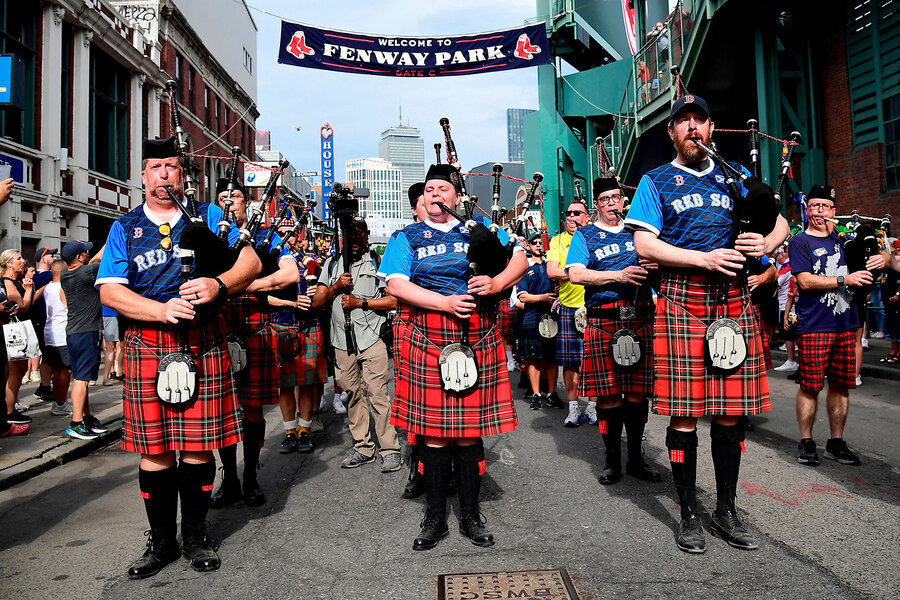
The streets of Boston rarely ring out with the mingling sounds of Scottish bagpipes and plastic buckets. But during the 2026 World Cup, the pairing hardly seemed unusual.
A Scottish bagpiper and a Boston bucket drummer recently joined forces for an impromptu jam session outside historic Faneuil Hall. One was decked out in a plaid wool kilt while the other sported a wicker hat and tank top. Down the street at City Hall, the Scottish soccer team’s fans, known as “the Tartan Army,” cheered on a local policeman as he juggled a soccer ball at a fan festival.
“We’re not so different,” says Nicholas Mylnikov of Newton, Massachusetts, who served food to fans at a World Cup fan event in Boston.
Medara Udoekong/The Christian Science Monitor
Why We Wrote This
Beyond the pitch, the World Cup offers a chance for visiting fans from dozens of nations to share their cultures, consider their own preconceptions, and explore the host countries.
Millions of international soccer fans landed in the United States, Canada, and Mexico this month as the 2026 World Cup got underway. Along with suitcases full of jerseys and fervor for their favorite teams, numerous incomers, by their own admission, say they also brought negative assumptions, about the U.S. in particular. Many local fans also held their own expectations about these visitors. Yet, the month-long tournament has connected people from dozens of cultures and countries in joyous moments that are spreading widely on social media.
“One of the things that sports can do, the World Cup can do, and travel can do, is erase those lines and instead of being separate, we’re now together,” says William Maddux, a professor of organizational behavior at the University of North Carolina.
For many international visitors, cultural exchanges have occurred simply. English fans marveled over Buc-ee’s travel plazas across the southern U.S., and Swedish fans hyper-searched “ranch dressing recipe.” A French supporter praised American air conditioning, suggesting that “The Star-Spangled Banner” should include a verse on the cooling method.
Anonymous German soccer fan “FreddyLA7” went viral on social media platform X for documenting his road trip across North America before and during the World Cup. From eating classic southern dinners at Texas Roadhouse to receiving a personal invite to a country music concert, the emerging influencer has done it all. “This is the most ‘The European mind can’t comprehend this’ moment of my life,’” he captioned one of his posts.
Besides the discovery of bottomless chips and salsa, or seeing a yellow school bus for the first time, international soccer fans have also experienced a shift in how they view the U.S. as a society.
People do not travel as a “blank slate,” says Noel Salazar, professor of social and cultural anthropology at KU Leuven in Belgium. World Cup fans who travel to the U.S., he says, arrive with “certain ideas and expectations” about what the country is like, shaped by news coverage, social media, and political events.
England fan Logan Wang, attending a watch party in Boston, said he experienced unexpected hospitality firsthand during his time in Texas a week earlier. On June 17, he traveled from Fort Worth to Arlington to watch his country beat Croatia 4-2. After the match, he was offered a ride by several Fort Worth residents, who drove him for the 37-minute journey back to his lodge.
Before traveling to the U.S., Mr. Wang said he had stereotyped Americans as loud and “a bit obnoxious.” But having spent a few weeks in the country, he says he was wrong and comments on how friendly everyone has been.
Morgan Butler, who traveled from Scotland to Boston and then Miami, shared a similar change in perspective. His experience in Boston rebutted the negative press he often heard, and Bostonians “welcomed [him] with open arms,” he says.
International fans aren’t the only ones changing their perspectives during the tournament. Many Americans are embracing exposure to visiting fans and their cultures.

Lawrence, Kansas – home of the University of Kansas and a population of less than 100,000 – serves as the base camp for the Algerian national team. About 500 Lawrence residents and KU students waited for the team upon their arrival, while green, white, and red flags filled storefronts across town. Fans dressed in Algerian merchandise, and the university’s marching band played the team’s national anthem at training sessions.
Cultural exchanges like these counter distorted media narratives, says Mimi Sheller, dean of the Global School at Worcester Polytechnic Institute in Massachusetts, who studies the movement of people around the world.
“For people to actually have an experience of hospitality with everyday Americans reinforces the idea that whatever our governments do – and lots of governments do things to each other – the people themselves are not to blame and that people still have a lot of community and hospitality,” Dr. Sheller says.
This sentiment was clear among the growing fanbase of the team from Cape Verde, an island nation off the western coast of Africa. Many of the fans who embraced Cape Verde goalie Josimar José Évora Dias, known as Vozinha, after his outstanding performance against Spain, mobilized immediately when they learned his mother did not have the visa or funding to see him play in person. With help from FIFA and from House Minority Leader Hakeem Jeffries of New York, who appealed to Secretary of State Marco Rubio, Vozinha’s fanbase helped his mother obtain a visa and flight to the goalie’s World Cup match in Miami.
Across the nation, fans have said they feel a deep sense of joy and fellowship overflow from stadiums. This cross-cultural mingling has arrived amid a period of increasing global polarization and skepticism toward newcomers, according to this year’s trust barometer released by the Edelman Trust Institute.
However, opportunities to meet people of diverse backgrounds, such as at the World Cup, help increase trust in others, Dr. Maddux says. “You start to see people as the same rather than different. … You kind of feel like we’re all on the same planet together, more than we’re on different sides of a game or a war or a dispute.”

Medara Udoekong/The Christian Science Monitor
So, whether fans are tasting their first New England lobster roll or belting the lyrics to the national anthem, many have replaced assumptions with firsthand experiences and connections.
As he danced to live Latin-Caribbean fusion music at a Boston fan zone, Deu Awouk, who moved to the city from South Sudan three years ago, captured what many see as the heart of the World Cup: “seeing all these people from different worlds – different parts of life – come together and enjoy the beautiful game together.”