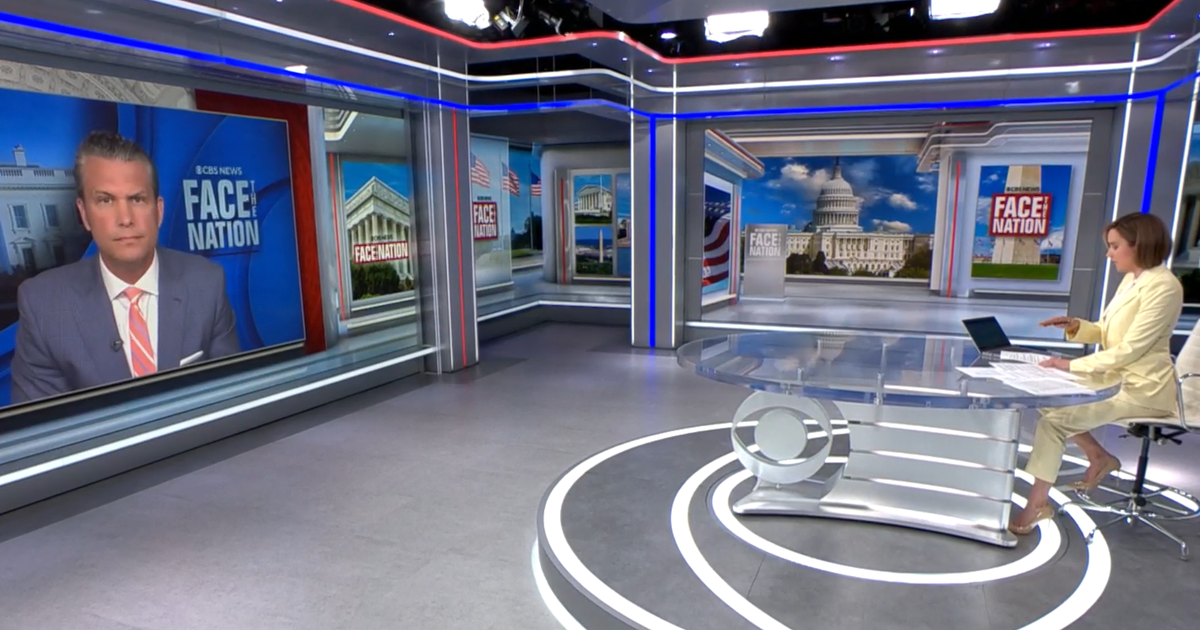
On this “Face the Nation with Margaret Brennan” broadcast, moderated by Margaret Brennan:
- Defense Secretary Pete Hegseth
- Sen. Mark Warner, Democrat of Virginia
- Sen. Mark Kelly, Democrat of Arizona
- Gary Cohn, IBM vice chairman and former National Economic Council director
Click here to browse full transcripts from 2026 of “Face the Nation with Margaret Brennan.”
MARGARET BRENNAN: I’m Margaret Brennan in Washington.
And this week on Face the Nation: the U.S. and Iran on the brink of a truce. We will get the latest in an exclusive interview with Secretary of Defense Pete Hegseth.
As the nation’s capital prepares for a UFC fight night on President Trump’s birthday, a deal that could potentially end a war in the Middle East is expected to be signed.
We will also hear from two key Democrats on committees with oversight on national security, Senators Mark Warner and Mark Kelly.
Despite a sharp jump in the inflation rate, now at its highest level in three years, President Trump is optimistic an end to fighting will stop the surge in energy prices.
(Begin VT)
DONALD TRUMP (President of the United States): No, I love it. The numbers were great. You know what I really love? I love the inflation.
(End VT)
MARGARET BRENNAN: We will get a reality check from one of President Trump’s top economic advisers from his first term, Gary Cohn.
It’s all just ahead on Face the Nation.
Good, morning, and welcome to Face the Nation.
We face a key decision point today that has implications for the global economy and potentially could stop nearly four months of conflict with Iran. As we come on the air, a preliminary memorandum of understanding between Washington and Tehran has yet to be signed.
But if and when the agreement takes effect, it would extend the cease-fire, reopen the Strait of Hormuz, and kick off 60 days of negotiations to resolve the other big issues. Yet, even as both sides signal a deal is within reach, hostilities in the region continue.
This morning, the Israeli Defense Force conducted strikes in Lebanon on Beirut’s southern suburbs to target the Iranian-backed Hezbollah leadership. The IDF called it retaliation for strikes on Israel. CBS has learned the potential U.S.-Iran truce includes a vague reference to ending the fighting in Lebanon, which may not be enough for Iran’s leaders.
And Iran’s failure to cut off support for its proxy force Hezbollah may not be enough for America’s partner Israel.
For the latest, we begin this morning with Secretary of Defense Pete Hegseth, who joins us from Tennessee.
Mr. Secretary, welcome to Face the Nation.
PETE HEGSETH (U.S. Defense Secretary): Good morning, Margaret. Thank you.
MARGARET BRENNAN: So, did the Hezbollah-Israel strikes disrupt any of the plans to have this memorandum signed today? Are we on track for a Sunday signing?
SECRETARY PETE HEGSETH: From all I know, we are on track. It’s not a matter of if. It’s a matter of when.
There’s logistics involved into how these things happen. Ultimately, obviously, we’re attuned to what’s happening with Hezbollah firing rockets into Northern Israel, which they need to stop doing, and Iran needs to encourage them to stop doing that in very adamant ways, and Israel was very measured in its response, understanding that a deal is on – is – we’re on the verge of a deal.
So, I don’t expect that to disrupt. I also accept – expect more robust talks there. The negotiations business is not really mine, but I think those talks will continue. And if Iran wants this to hold, they need to – they need to pull back Hezbollah, no doubt.
MARGARET BRENNAN: So, this memorandum would be an extension of the cease- fire, as you said, with a promise to keep talking.
Given how clear President Trump has been that he wants to end combat, will the U.S. troops come back home? Will those two aircraft carriers be pulled back?
SECRETARY PETE HEGSETH: Well, what – Margaret, what I would say the president’s been most clear about is that Iran will never have a nuclear weapon, never, full stop.
And this deal, as we talk about aspects of the deal, some of which have come up publicly, are totally wrong. It is – it’s performance-based, no money released to Iran until they perform. There’s no trust and verify. There’s no trust here, and we’re going to verify everything.
Nuclear material will be destroyed and removed. The nuclear program will be dismantled. The straits will be open, no tolling. This is – this is not a – the JCPOA was a path to a bomb. What this deal will be will be a wall to a bomb, and that was the objective from the beginning, very clear from the beginning.
So, as far as our military posture, we’ll maintain what we need to. The blockade has been a devastating success for us and impact on the Iranians.
MARGARET BRENNAN: So…
SECRETARY PETE HEGSETH: So, think of – think of this chain of events militarily just for a second.
You had 45 days of overwhelming combat, which Iran could not manage, and their navy’s gone, air force gone, air defenses, all – then it led to a blockade, which was impenetrable now…
MARGARET BRENNAN: Yes.
SECRETARY PETE HEGSETH: … for a couple of months. And then you had the underground Project Freedom, which allowed, now 125 million barrels of oil to transit the strait, showing that we control the strait.
And then we did two more days of bombing because they weren’t really…
MARGARET BRENNAN: Yes.
SECRETARY PETE HEGSETH: … coming to the table.
So, it’s been military pressure and strength from President Trump that’s compelled Iran to this deal, which will be performance-based when it’s signed shortly.
MARGARET BRENNAN: Right, but we’re not at that deal yet. We’re not even at the memorandum. That’s what we’re waiting to be – waiting on being signed today.
The U.S. and Israeli militaries, no doubt, did devastate the conventional military, as you are arguing there, but the IRGC terrorist-controlled regime, they control this country. They would be pocketing the financial benefits of being able to sell the oil if the blockade ends, as you just indicated.
They didn’t capitulate. They are negotiating. So, how do you reassure allies who are in the region and say they still feel they are at risk? Are you keeping the force posture in place through the 60 days of negotiations and beyond?
SECRETARY PETE HEGSETH: Oh, we’ll make sure the military option is there.
And that’s the – that’s the big difference between this and JCPOA and the way Obama did it. Obama, they begged Iran for a deal, and we bombed Iran, and then put in a blockade, and then ran ships through, and then have re – restarted when necessary to ensure that they come to the table for a great deal.
So our military posture will be whatever it needs to be to ensure they’re compelled over the 60 days through the memorandum of understanding that they live up to what they said they would do. The document says Iran will never have a nuclear weapon, won’t seek one, won’t buy one, won’t have one.
MARGARET BRENNAN: JCPOA said that too.
SECRETARY PETE HEGSETH: And in 60 days, they’ll be negotiations to make that final.
But they didn’t have the threat of military force the way that we do that Iran respects in a very – way that their regime is more devastated – more devastating – excuse me – more devastated than it’s ever been in its 47 years.
MARGARET BRENNAN: OK.
SECRETARY PETE HEGSETH: And that’s why they’re at the table. So the huge difference is, we did this from a position of strength. President Trump led with military might.
That military might will stay as long as necessary. You know, if the blockade comes off, then you – you pull back, and you allow shipping to flow, just like Iran needs to allow…
MARGARET BRENNAN: OK.
SECRETARY PETE HEGSETH: … shipping to go through the strait.
But we can snap that blockade back at any point, and they can’t do anything about it. And Iran knows that. And that’s why we have the leverage in these talks. And we hope they’ll go well. We really do.
MARGARET BRENNAN: OK, well, as I understand it, the first part of this deal would involve the clearing and reopening of the Strait of Hormuz. How quickly will the U.S. blockade on Iran end? How quickly will they be able to sell their oil?
SECRETARY PETE HEGSETH: Immediately is what the president has said, and that will be our expectation of the Iranians, is that it’s not us that…
MARGARET BRENNAN: So, tomorrow, you’ll end the blockade if they sign it today?
SECRETARY PETE HEGSETH: … that is the problem here.
So, when it – again, it’s performance-based, Margaret. So we’re not going to – unlike Obama, President Trump is smart about these things. He’s not going to just give it away. So, ultimately the blockade will stay as the strait opens, and then the blockade will open, and then the strait is open, and if that takes 30 days to fully mature or two weeks to fully mature, but it will start immediately…
MARGARET BRENNAN: OK.
SECRETARY PETE HEGSETH: … as the president has said.
And, by the way, I think your viewers need to remember Project Freedom never stopped, and we’ve run 125 million barrels of oil through the straits, and Iran couldn’t do anything about it. How many ships from Iran have transit our blockade? Zero. Zero. We have controlled the straits this entire time.
MARGARET BRENNAN: Right, but you’re going to negotiate with them to reopen…
SECRETARY PETE HEGSETH: This MOU will open them immediately and gradually.
MARGARET BRENNAN: … to reopen it.
So, OK, you’re saying immediately, but Secretary Rubio had said the U.S. would help to clear mines from the Strait of Hormuz. You just used 30 days as like a period of time. Can you clear the mines and remove the security threats in the strait within 30 days?
SECRETARY PETE HEGSETH: We can do any of those things within 30 days in a permissive environment.
MARGARET BRENNAN: So, we can…
SECRETARY PETE HEGSETH: So the ball is in Iran’s court at some level to agree to this deal…
MARGARET BRENNAN: So, we would get back to prewar shipping?
SECRETARY PETE HEGSETH: We are doing things I can’t – we’re already talking – we’re already doing things I can’t talk about on this program, and – and that – to ensure that safe passage happens as quickly as possible. So we’re all over this.
We know exactly what the dynamics are. Iran probably doesn’t, because they can’t see and sense their capabilities around the strait, especially these last couple nights were very devastating for them as far as their ability to understand what’s going through the strait.
MARGARET BRENNAN: Yes.
SECRETARY PETE HEGSETH: So, if they have capabilities and can do it, great. If not, if international partners who have said they want to step up, want to step up and contribute, great. But once this deal is signed, our expectation is that Iran will stop shooting, you know, drones at commercial shipping.
MARGARET BRENNAN: Yes.
SECRETARY PETE HEGSETH: It’s been them shooting at shipping the entire time.
MARGARET BRENNAN: Yes, they did that just on Friday. And, in fact, a drone collided with an Apache helicopter last week. They fired drones into Bahrain. They fired missiles at a U.S. base in Jordan just a few days ago. They still have the capacity to hurt our friends and partners.
SECRETARY PETE HEGSETH: And that’s why you have to deal with these folks with strength and not just ask them at the table. And it’s the military strength that compelled them to this point where they’re making a deal, which will be great for the security of the United States of America.
And that’s why this is such a big moment, and only President Trump’s strength and clarity of mission to say no nuclear weapon will ensure that now and, underneath the MOU, the terms are set that are performance-based for Iran to ensure that they never get a nuclear weapon. That’s what’s critical.
MARGARET BRENNAN: OK.
So once the 60 days of negotiations – and I know that could be extended – start, that’s when the nuclear program gets dealt with.
President Trump posted on social media Saturday that – quote – “At the appropriate time, when all is calm, we will go in and get the nuclear dust.” That’s how he refers to the highly enriched uranium under the bombed sites.
He said: “We’ll downblend and destroy it, whether in Iran or the U.S.”
Is the goal – is the plan to have the U.N. do all of that?
SECRETARY PETE HEGSETH: I don’t think the U.N. has been really effective in anything here. We’ll handle it as we need to.
MARGARET BRENNAN: The weapons inspectors from the IAEA?
SECRETARY PETE HEGSETH: Ultimately, that could be part of it. This is – what – the reality is, is President – President Trump has already set back Iran’s nuclear program in devastating ways, from Midnight Hammer to this – to this campaign, to ways that we know how much – how far back we’ve set them.
We’re watching that material, as we have this entire time.
MARGARET BRENNAN: Yes.
SECRETARY PETE HEGSETH: And any arrangement, as I said from the outside of the program, will be performance- and metrics-based.
You’ll have inspections. You’ll have oversight, whether they’re U.S., whether they’re international. But it will be a throttle set by the United States through our negotiators with the military and strength as the guarantor of this.
If Iran does not want to comply, then they can deal with the War Department again, which we’d rather not have to do and President Trump would rather not have to do, but we know they know the type of devastating effects that have occurred on their military and on their air defenses and on their capabilities.
MARGARET BRENNAN: Yes.
SECRETARY PETE HEGSETH: They don’t want that again.
And so, when we restruck twice, don’t – don’t discount how important it was that we were willing to show we will restart this and we will set you back even further. And that was part of the reason why Iran came to the table, and we’re going to finish this initial MOU to set the clock, so that’s the – that’s the umbrella here…
MARGARET BRENNAN: OK.
SECRETARY PETE HEGSETH: … is, we’ll work with you to remove that material, or you’ll downblend that material, but you’re not going to have any of that material, and anything you do get will be based on oversight and performance.
MARGARET BRENNAN: And…
SECRETARY PETE HEGSETH: And Iran understands that. And that’s why I think ultimately this is something that can and will succeed.
MARGARET BRENNAN: Well, those are really important details that still have to be negotiated.
When I understood what you just said there, you said the IAEA could be involved. We have reported here at CBS that American military planners had discussed contingencies with U.S. forces and the Department of Energy working together to secure their nuclear materials.
Are you saying that, at the negotiating table, the United States is going to say the U.S. military has to go in and clean up the nuclear dust?
SECRETARY PETE HEGSETH: Well, I’m – I’m not going to say on a Sunday morning television program what we will or will not do in any context.
We’ll have all options on the table, and that’s what we’ve said to President Trump and the American people and the world and the Iranians from the beginning.
The entirety of the might of the U.S. War Department is prepared to ensure Iran never has a nuclear weapon. We can do it the Midnight Hammer way. We can do it the Epic Furic way – Fury way if we need to. Ultimately, Iran will need to destroy it and remove it, downblend it, and we will be involved, whether physically or otherwise, to ensure that that happens.
Could be the U.S. military. Could be another option.
MARGARET BRENNAN: Yes.
SECRETARY PETE HEGSETH: I think our negotiators, our world-class negotiators, are going to have a lot of options. The U.S. military is good at these types of things. So is the Energy Department.
And so working with the Iranians to ensure it’s destroyed and removed and their program is dismantled will be center…
(CROSSTALK)
MARGARET BRENNAN: Right.
Well, it’s a – it’s an important point for those who are members of the U.S. military to understand whether you are saying ground troops would be involved in cleaning up nuclear dust.
SECRETARY PETE HEGSETH: That – you’re saying that. You’re trying to put words in my mouth…
MARGARET BRENNAN: No, I am asking you.
SECRETARY PETE HEGSETH: … to create a headline.
What I’m saying is, we have – we have plans. No, we have plans for everything. And should the president need, you know, a compel option, we have compel options, and many different types of compel options. But, right now, we’ve set the conditions for 60 days to ensure that that material is downblended destroyed, or removed, whatever the president decides is in the best interest of the United States of America.
MARGARET BRENNAN: Yes.
SECRETARY PETE HEGSETH: And the War Department is there to support that effort.
MARGARET BRENNAN: Let me ask you about Venezuela, because there was also big news within the past few days.
President Trump said the U.S. military killed Nino Guerrero, the leader of the Venezuelan gang Tren de Aragua, or TDA, in an airstrike earlier this week. He had been indicted in the Southern District of New York for many crimes.
I’m wondering, why go with a strike option? Why not snatch and grab him and make him face justice in a U.S. court, like you did with Nicolas Maduro?
SECRETARY PETE HEGSETH: I was going to say, we did that. We’ve shown we can do that when we did it with Nicolas Maduro.
MARGARET BRENNAN: Yes.
SECRETARY PETE HEGSETH: And because of that, it created the conditions where, in partnership with the Venezuelan government, this is a huge deal.
I mean, they invited our military in because they have a foreign terrorist organization on their soil in Tren de Aragua, the founder and leader, and we were able to identify where he was and kill him, just like we would kill al Qaeda or ISIS, and we did in the Middle East. We treat these foreign terrorist organizations the same way, just like we do with drug boats when we identify they’re run by those FTOs.
So that’s a great development. I mean, think about that. President Trump had the foresight to seize Maduro, change the relationship. We have a totally different energy dynamic around the world. By the way, the way energy flows today, the straits will be nowhere near as relevant one to two years from now, because of the foresight of President Trump.
He’s made us energy-independent at home.
MARGARET BRENNAN: Yes.
SECRETARY PETE HEGSETH: We’re export – we’re a net exporter.
Now Venezuela, through our partnerships, now we’re killing foreign terrorist leaders who have terrorized the American people. The amount of drugs and gangs that came from…
MARGARET BRENNAN: Yes, energy – energy prices are pretty high right now.
SECRETARY PETE HEGSETH: … Tren de Aragua to the United States, it’s a huge deal. It’s a huge deal.
MARGARET BRENNAN: So, I don’t know that the independence is helping people at the pump.
SECRETARY PETE HEGSETH: They are coming down. And you’ve seen it.
(LAUGHTER)
SECRETARY PETE HEGSETH: They are.
MARGARET BRENNAN: We’ll talk about that later in the program.
But I want to come back to the Venezuela point. Given that the U.S. military just carried out this operation, should Americans understand that the U.S. will remain militarily involved in Venezuela? Should they expect similar operations in places like Ecuador and Guatemala, where the U.S. is working with their government?
SECRETARY PETE HEGSETH: Yes, they should.
It’s called the Americas Counter Cartel Coalition, ACCC, and we’re forming it with partner governments all around Central and South America to go after, defeat, and destroy foreign terrorist organizations, drug cartels.
And all those countries you named are stepping up to work on partnerships with the United States, where we work with their governments and their militaries with their special capabilities and our special capabilities to hunt terrorist networks in our own hemisphere, just like we showed we were very good at with ISIS and al Qaeda in the Middle East for 20 years.
It’s an incredible reinforcement of the Monroe Doctrine, now the Donroe Doctrine. We’re taking back control of our hemisphere and ensuring the poisoning and attacks on the American people end. So, it’s – it’s a beautiful – it’s a beautiful military thing to behold…
MARGARET BRENNAN: Yes.
SECRETARY PETE HEGSETH: … other countries coming to us to work with us, and we’re going to take full advantage of it.
MARGARET BRENNAN: But let me ask you before you go about what is going on with U.S. munitions and stockpiles here.
Ukraine’s President Zelenskyy was on this program a few weeks ago. He made a plea, not just for more interceptors, but for the ability to produce them, for friendly governments to be able to produce Patriots. Some Republican lawmakers support this idea. Do you?
SECRETARY PETE HEGSETH: Nobody makes better and more munitions than the United States of America, and we are open to co-production wherever we can.
And because of this administration, we’re supercharging our arsenal of freedom, building more, building faster, opening up the Pentagon, ripping through the Pentagon bureaucracy to force industry to move faster.
MARGARET BRENNAN: But there are crisis…
SECRETARY PETE HEGSETH: So, our stockpiles are strong, and they will only get stronger in the future.
MARGARET BRENNAN: There is a crisis with those stockpiles right now There is a crisis with those stockpiles right now in private industry.
SECRETARY PETE HEGSETH: No, there’s not.
MARGARET BRENNAN: You have testified to it in front of Congress.
SECRETARY PETE HEGSETH: No, that is a – that is a manufactured story that the media wants to peddle.
And, ultimately, we are – our stockpiles are – are great. And they’ll only get stronger because of the way this president has…
MARGARET BRENNAN: You testified under oath that it would take years to rebuild those stockpiles.
SECRETARY PETE HEGSETH: And, if anything, it was the Biden administration that gave away munitions to the – you don’t have to read back to me what I – what I testified.
I speculated some munitions take more time than others. We’ve got lots of them. We’re building more than ever before. The Biden administration gave away hundreds of billions to Ukraine. And so President Trump had to refill. And he has and we have in real time.
MARGARET BRENNAN: So, the answer to Zelenskyy’s request is a no or a yes?
SECRETARY PETE HEGSETH: Ultimately, we’ve worked with them, and Ukraine is buying munitions that Europe pays for, and it’s great to see Europe finally step up and pay for those.
MARGARET BRENNAN: OK. Well, he was asking for the ability to produce.
But I will leave it there for today. Secretary Hegseth, thank you for joining us.
Face the Nation will be back in a minute. Stay with us.
(ANNOUNCEMENTS)
MARGARET BRENNAN: We’re joined now by the top Democrat on the Intelligence Committee, Virginia Senator Mark Warner.
It’s good to have you here.
SENATOR MARK WARNER (D-Virginia): Thank you, Margaret.
MARGARET BRENNAN: As you heard from the secretary, a lot of these very important details have to still be negotiated. What do you think, though, of the emerging cease-fire and agreement? Because you favored diplomacy?
SENATOR MARK WARNER: Listen, if the president can declare victory, so be it.
But you heard Pete Hegseth’s pitch. Let’s look at the real facts; 107 days into Donald Trump’s war of choice, can anyone make the case that we, or our allies are in a better spot than before this war? The regime’s leadership is more radical than ever. The ability for us to get the enriched uranium out, I believe, will require troops on the ground, which I don’t think America wants to do.
The idea that we have a 60-day additional negotiation, where does that lead? We’ll be here 60 days, still won’t have access to it. Clearly, after Hegseth had said, we’ve destroyed all their capabilities, they still have plenty of missiles and thousands of drones.
And the idea that the strait is suddenly going to be magically reopened, look at the gas prices.
MARGARET BRENNAN: Yes.
SENATOR MARK WARNER: They went from $2.80 to $4.20. And I believe they’ll go up more because the overall world reserves have all come down.
MARGARET BRENNAN: Yes.
SENATOR MARK WARNER: How is that better for America or better for our allies?
MARGARET BRENNAN: Well, it’s – there are a lot of details in here that – like I said, still have to be negotiated.
And when we look at Congress’ role in terms of peeling back some of these sanctions, this was hugely controversial during the Obama administration. Do you think ultimately that whatever is hammered out by Steve Witkoff and Jared Kushner and J.D. Vance, the vice president, will come up for approval? Do you get any say?
(CROSSTALK)
SENATOR MARK WARNER: Well, first of all, the idea that these three gentlemen that have very little background in terms of negotiations or the technical nature of nuclear negotiations going against a hardened Iranian team that’s been doing this for decades, I wish we had some of our experts at the table as well.
But I’m not sure any of this will be coming before Congress. And it should. I mean, if the president wanted to start this war, a war of choice, there was no imminent threat from Iran. Come to the Congress, come to the people, and lay out the case.
He has not, and we have not done the kind of oversight that is required.
MARGARET BRENNAN: Yes.
SENATOR MARK WARNER: We are slowly moving along and getting additional Republicans to say stop on the War Powers Act, but Congress has failed miserably.
MARGARET BRENNAN: I – before I move on to other things, I just want to put a fine point on the U.S. intelligence assessment was not that Iran was creating a nuclear weapon, but that they wanted the possibility to make one in the future.
Given what they have, the nuclear dust, the dirty bomb in the desert scenario, does that still worry you? How concerned should Americans be?
SENATOR MARK WARNER: Yes, I’m still worried.
And for all his critique of JCPOA, we had international observers. We actually had an alliance there that included the Europeans. And Russia and China were all signatories. Now it is America going alone or going with Israel only. And that does not make us safer.
And, again, I will be happy to come back on the show and eat my words if the Iranians over the next 60 days give up that enriched uranium.
MARGARET BRENNAN: Yes. Well, we’ll watch for whatever happens next.
I want to ask you about surveillance here and the lapse of a key authority. On Thursday, the president did appoint Jay Clayton, he said, who will be the next director of national intelligence, instead of Bill Pulte, to who I know you oppose. But…
SENATOR MARK WARNER: Who not only I oppose…
MARGARET BRENNAN: Yes.
SENATOR MARK WARNER: … but all of the Republican senators who will know anything about national security oppose as well.
MARGARET BRENNAN: Yes, there are some pretty colorful statements.
But Clayton is the current U.S. attorney for the Southern District of New York, a former SEC chair. How quickly can he move into the role? I mean, he doesn’t necessarily have the kind of extensive national security background that…
(CROSSTALK)
SENATOR MARK WARNER: … law enforcement. He was head of the SEC. And at Southern District of New York, that’s where we pursue a lot of our terrorists.
I know Jay. I think he’s got the right temperament. I have got a lot of questions, like who won the election in 2020, so he at least acknowledges that truthfulness. But, remember, Margaret, this was totally caused by Donald Trump.
MARGARET BRENNAN: OK. Well…
SENATOR MARK WARNER: He could have nominated Jay Clayton a week ago.
MARGARET BRENNAN: Yes.
SENATOR MARK WARNER: And we wouldn’t have gone dark.
MARGARET BRENNAN: This is an extraordinary series of events that we have to take more time to talk about on the other side of the break.
Let me take it, and we’ll finish it.
SENATOR MARK WARNER: Great.
MARGARET BRENNAN: We’ll be right back.
(ANNOUNCEMENTS)
MARGARET BRENNAN: Stay with us. We will be right back.
(ANNOUNCEMENTS)
MARGARET BRENNAN: Welcome back to Face the Nation.
We return to our conversation now with Senator Mark Warner.
Before the break, Senator, we were talking about the next director of national intelligence. The hearing for Jay Clayton is next week, this Wednesday, right?
SENATOR MARK WARNER: Yes.
MARGARET BRENNAN: How quickly can he get confirmed? And what does that do in terms of blocking Bill Pulte from ever taking the job?
SENATOR MARK WARNER: Well, I have got questions for Jay, like want to make sure that he’s going to maintain the integrity of our elections, not try to pull the things that Ms. Gabbard did, where she was interfering in domestic election activities with the seizure of the ballots in Fulton County.
My hope is, if we can get unanimous consent, we could even get him confirmed this week. I would hope that the president would then say to Tulsi Gabbard, who is going to stay until the end of the month, stay at least until Clayton is confirmed or allow the number two to stay.
MARGARET BRENNAN: That’s a shocking statement from you, because you are a huge critic of Tulsi Gabbard.
SENATOR MARK WARNER: Listen, I am a huge critic. I am a huge critic.
MARGARET BRENNAN: How much damage could Bill Pulte actually do in a matter of days?
SENATOR MARK WARNER: Well, my fear is not so much the damage he could do on Section 702, which has a full audit trail. If he misuses that, we’ll figure it out.
But having him exposed, when he doesn’t even have a security clearance, to all our nation’s classified programs, out of ignorance, he might give away information. I have had heads of our intelligence communities say to us they’re terrified of showing him information. I have had foreign governments express huge concern.
The one thing we know about Bill Pulte is, he will do whatever Donald Trump says. He was able to weaponize private mortgage insurance information. Giving him the keys to the 18 intelligence agencies would be a disaster and a national security threat.
MARGARET BRENNAN: So, I’m understanding you will withhold your vote to reauthorize FISA based on this?
SENATOR MARK WARNER: Listen, we have to get FISA reauthorized. We were on a glide path to getting this done.
MARGARET BRENNAN: This is the warrantless surveillance tool for foreigners of concern abroad.
SENATOR MARK WARNER: Well, this is a tool that foreigners – listening in on foreigners talking to foreigners abroad.
MARGARET BRENNAN: Yes.
SENATOR MARK WARNER: None of this needed to happen if Donald Trump had – he didn’t even come out in support of this tool until about six weeks ago.
If he put forward Clayton or somebody else six weeks ago, if he would have done even Jay Clayton a few days earlier. I actually think Donald Trump wants this tool to expire, because he would then try to blame Democrats if – God forbid, if anything happens.
And the remarkable thing on this is, normally, we come on here and it’s Democrats versus Republicans.
MARGARET BRENNAN: Yes.
SENATOR MARK WARNER: This one is not.
My Republican colleagues have worked hand in glove. If there is something that happens, God forbid, the responsibility lies with one man, Donald Trump.
MARGARET BRENNAN: That is a tremendous statement that you think the president actually wants this tool to not be accessible.
I mean, it’s – the congressional authorization expired on Friday. Your Republican counterpart Senator Tom Cotton described the consequences as severe, potentially fatal, considering all the mass gatherings in America right now.
How vulnerable is the U.S. right now? Have Google and Verizon and the rest said, if you come and ask me for information, I won’t hand it over?
SENATOR MARK WARNER: What has happened is, those investigations that have already started continue.
MARGARET BRENNAN: OK.
SENATOR MARK WARNER: Our ability to continue to listen to bad guys talking to bad guys abroad continues. The question is whether you can start new actions.
And we are now – and I have not gotten a report yet whether the telcos and the Googles are going to continue to adhere or whether, because they don’t have the indemnification, they’ll stop participating. We don’t have – I don’t – as of Sunday morning, I don’t have an answer on that.
I hope the Justice Department would use all the tools they can to try to encourage them to continue this program for what will be, whether we like it now or not, a short-term lapse.
MARGARET BRENNAN: But Democrats are using their leverage here with FISA to force the president to change his nominees. He did that. So why do we have a Democrat standing up and, for example, blocking unanimous consent in regard to reauthorizing even a short-term surveillance tool?
This seems to be national security risk of huge proportion.
SENATOR MARK WARNER: National security risk caused because Donald Trump did not put forward Clayton or anyone else that was legitimate until the clock had run out.
There is no question, if you got any of my Republican colleagues here, they would agree this was a White House-created problem. And, finally, somebody got to Trump and said, you got to put a rational person in, not this guy who’s not even got a national security clearance.
We will get Clayton, I hope, confirmed as quickly as possible.
MARGARET BRENNAN: Yes.
SENATOR MARK WARNER: We will then move very quickly to get FISA reauthorized. In the interim, I hope the telcos will continue to cooperate with the government.
MARGARET BRENNAN: Senator Mark Warner, thank you for your time today.
SENATOR MARK WARNER: Thank you, Margaret.
MARGARET BRENNAN: We will be right back.
(ANNOUNCEMENTS)
MARGARET BRENNAN: We turn now to Arizona Democratic Senator Mark Kelly, who joins us from Phoenix.
Welcome back to Face the Nation.
Senator, I just want to read something that the president posted on his social media account moments ago in regard to the events today in Beirut.
He said, the attack, the Israeli “attack on Beirut, should not have happened, particularly on a special day, when we are so close to a peace deal with Iran. Israel has a right to defend itself, but the attack it was responding to was very small and meaningless, and all sides should stand down.”
That’s a different response than what the secretary of defense shared with us. It seems like the president is worried this could disrupt the negotiation and the possibility of a deal being signed. Do you support the memorandum of understanding?
SENATOR MARK KELLY (D-Arizona): Well, I haven’t seen the details yet, Margaret.
And, you know, I don’t know if this is a special day and if we’re very close to a deal. I do agree with what the president said about standing down. It’s obvious that we’re negotiating with the Iranians at this point. I think it’s always important for folks to remember, how did – how did we get here?
We’re here because, in 2018, Donald Trump tore up the JCPOA and got us into an unauthorized war with the Iranians, and all this has done for the American people is driven up costs, the costs of energy, so specifically gasoline, the cost of food.
And this is at a time when the American people are having a historic time just affording their lives.
MARGARET BRENNAN: Well, you questioned Secretary Hegseth last month about what this war did to American military preparedness, specifically restocking munitions that are depleted by the Iran war.
As I questioned him about that, he said it was a media narrative, that I was making it up, but also said his testimony before your committee was speculation. What’s the reality check there? Do we have a munitions problem?
SENATOR MARK KELLY: Well, as Secretary Hegseth said in front of the Armed Services Committee, of which I’m a member, this will take years to rebuild the stockpiles of munitions.
So, of course we have a munitions issue. I mean, it just came from him. And I think it’s widely understood that, when you attack over 10,000 targets from the air with cruise missiles and ballistic missiles and bombs from airplanes, you are using a lot of munitions. And we do not have an endless supply of these things.
So, now we’re in a posture where we’ve got to be incredibly careful, and this is also at a time when Ukraine continues to need some help. The president now sells munitions to the Europeans because, I think, as everybody understands, this is always about the bottom line for him.
But Ukraine is an ally. They’ve been illegally – illegally attacked by the Russians. And they still need our assistance.
MARGARET BRENNAN: Yes.
Well, President Zelenskyy was on this program and told us he’s waiting on President Trump to say yes to a U.S.-Ukraine drone deal. Do you know what the holdup is?
SENATOR MARK KELLY: I do not at this point, and I don’t think there should be a holdup.
I also agree that we should consider some co-manufacturing. Secretary of Defense Pete Hegseth, you know, clearly indicated that he didn’t – he didn’t seem very interested in this.
MARGARET BRENNAN: Yes.
SENATOR MARK KELLY: But if Ukraine is going to win – and I got to say, right now, it seems like the momentum is on their side – they need additional help from us. So, co-production of some interceptors could be a possibility, but also help with their drone manufacturing.
And this could also help us in the future. The Ukrainians are really good at this, and we have a lot we could learn from them.
MARGARET BRENNAN: I want to come back to something we were discussing with Senator Warner. And that is the security risk that is resulting from having this warrantless surveillance program, Section 702, suspended right now.
You, earlier this month, voted against a bipartisan bill extending surveillance authority. You said any short- or long-term extension, you would not be in favor of until you solve the Bill Pulte problem.
Hasn’t that problem been solved now that Jay Clayton is the nominee?
SENATOR MARK KELLY: Not completely, because, when Tulsi Gabbard leaves, we’re not so sure if the president is going to put Bill Pulte in as the acting DNI.
But this is very easy to solve. The president could today make it very clear to the American people that Bill Pulte is going to have no role in the Office of the Director of National Intelligence. When I hear that, then we have a very straightforward path to getting FISA renewed.
MARGARET BRENNAN: That’s the price of your vote, is that statement from the president himself?
SENATOR MARK KELLY: Well, I mean, you know, I’m constantly reevaluating the situation.
I value FISA, especially 702(b), that allows surveillance of foreign nationals in other countries.
MARGARET BRENNAN: Yes.
SENATOR MARK KELLY: It is incredibly important to our national security. And when it lapses, there is some risk.
But I also think there is as much, if not more risk of putting somebody, Bill Pulte specifically, who is – who is unqualified for this job, Margaret. If you made a list of the one million most qualified Americans for this position, I am very confident that Bill Pulte would not be on that list.
There’s risk in putting him in this position. And it’s pretty straightforward right now how – how we solve this.
MARGARET BRENNAN: Well, the hearing for Jay Clayton, who would be the Senate-confirmed head of national intelligence, if he gets all these votes, is this Wednesday.
Are you pretty much a definite yes? I mean, given your opposition to Pulte, you need a solution. It sounds like this is not a question.
SENATOR MARK KELLY: Hey, I don’t know Clayton. I mean, I’m reviewing his background. He’s got a process to go through. We need to vet him.
The statute for this job says somebody will have extensive national security or intelligence experience.
MARGARET BRENNAN: Yes.
SENATOR MARK KELLY: Does he have that? I think it’s pretty clear he does not. Is he better than Bill Pulte? Yes, I think a lot better.
Does he meet some kind of maybe a minimum, barely minimum standard? Perhaps. So, I’m looking forward to Wednesday. He’s got to answer some tough, tough questions from the committee. And I will evaluate his background and whether or not I think he’s prepared to do this job.
MARGARET BRENNAN: Wow.
Meanwhile, there are so many issues of – of serious concern on the national security front, one of them artificial intelligence. The White House on Friday came out and seemed to really ramp up the dispute with Anthropic.
The White House told them to suspend access to any foreign nationals, which led the company to suspend all customers from accessing its most advanced A.I. systems. Do you know if there is an emergency? And is it, as reported by Semafor, because there was suspicion that a China-linked group had accessed it?
SENATOR MARK KELLY: Well, I haven’t officially heard that.
But Mythos and some of their other models from A.I. companies are incredibly capable. And some of the capabilities that these models have to access systems, not only federal government systems, but financial systems, is very concerning to us.
So we’ve got to take some time with these tools and do extensive evaluations as to, what is the risk to the American people when we release these? So I agree with the administration on this. We’ve got to be incredibly careful.
And the A.I. companies – and, you know, I think Anthropic is a good example – seems to be willing to work with the federal government on this to make sure that we do not make a mistake and release something that we will later regret.
MARGARET BRENNAN: Senator Mark Kelly, thank you for your time today.
We’ll be back in a moment.
(ANNOUNCEMENTS)
MARGARET BRENNAN: We’re joined now by Gary Cohn, who was the top economic adviser to President Trump in his first term. He is currently Vice Chairman at IBM.
Good to have you back here.
GARY COHN (IBM Vice Chairman, Former Director, White House National Economic Council): Thanks for having me.
MARGARET BRENNAN: So, Secretary Hegseth says didn’t give a lot of clarity on the exact time. He said both the Strait of Hormuz would be immediately open, but that it could take up to 30 days.
The bottom line for the economy here, it’s going to be impacted by what happens with oil and gas prices. Should American consumers expect that the prices they’re paying for their food and their gas and everything else is going to fall like a rock?
GARY COHN: Well, it’s not going to fall like a rock overnight.
We’re going to have to see exactly what happens in the straits. It was not clear how quickly they’ll open. But as they do open, we will start getting a change in psychology. People will start thinking that prices are going down, and they will continue to go down. When you’re in an upward price environment, people tend to fill their tanks up early because they think the price is going to be higher next week, and they tend to not let their tanks go down.
When you’re in an environment when you think the price is going to get cheaper, people tend to drive their cars till they’re almost empty, because they think, the longer I wait, the cheaper gas will be. So we’re going to be in a psychological change when the straits open and as oil starts flowing out.
We will start to see some impact. We’ve actually already seen some impact, you know, where – where gas prices are, I won’t say well, but they’re 10 percent off their recent highs.
MARGARET BRENNAN: Yes.
GARY COHN: And if we open the straits, I think we’ll continue to see these gas prices come down.
But, as you also point out, it’s not just the price of gasoline. It’s the price of groceries. The price of energy feeds through the entire economy. It feeds through manufacturing. It feeds through delivery. It feeds through everything we consume as daily consumers.
MARGARET BRENNAN: And what you’re talking about in prices, you’re talking about the price at market. But, for the price for consumers, if companies have already jacked up the price of food. Are they really going to bring it back down?
GARY COHN: Well, they will bring it back – the price of energy will come back down.
MARGARET BRENNAN: Yes.
GARY COHN: So the energy component will come back down. Whether actual food at the store will come back down, you know, it will take some time. There’s always – there’s always some pressure, and it takes a first mover to show some leadership.
We’ve seen prices go up, and then if someone wants to bring more and more retail traffic into their store, they tend to cut the price of a necessity good. And you, as a consumer, say, hey, that necessity good is cheaper at that store. I then go into that store, and the other store needs to match their price.
So the open market will drive prices down over time.
MARGARET BRENNAN: Because, as Senator Warner was talking about, those fuel inventories, commercial fuel inventories, they’re hitting some risky levels in July…
GARY COHN: Yes. Yes.
MARGARET BRENNAN: … that could cause a secondary price cycle. Goldman Sachs said, what, $10 higher per barrel than before the war, because there’s this new security premium built in here.
GARY COHN: Yes.
MARGARET BRENNAN: Given all the forces you are seeing in the economy right now, do you think the Federal Reserve can really do the kind of rate cut that President Trump very publicly says is he wants to see?
GARY COHN: Margaret, look, we have exhausted a lot of the global supply of oil. All the major economies do carry an excess reserve, and those excess reserves are at relatively low levels. So, I understand what everyone’s concerned about.
MARGARET BRENNAN: Yes.
GARY COHN: So, getting oil back online now is important.
When it comes to the Federal Reserve, look, we have a new Federal Reserve chairperson, Kevin Warsh. I think Kevin is completely acknowledging where we are in the economy. He understands that we’ve got inflation at three- year highs. He also understands that the job market is relative…
MARGARET BRENNAN: Biden levels.
GARY COHN: … relatively – yes, relatively strong. And he also understands there’s pressure on him to lower interest rates.
I think Kevin will remove himself from the political pressure, and he will do the right thing economically. Kevin is – you know, this is not his first time on the Federal Reserve. He was a Fed governor before. I think Kevin will approach this as a very traditional Fed governor. He will stay heavily involved in his lane in monetary policy.
I think he will stay outside of the secondary issues that the Fed has gotten in more recently. And I think he will also be in a position where he will move based on what he is actually seeing in the economy, not what he hopes he sees in the economy.
MARGARET BRENNAN: But he’s also made clear he thinks sort of how we judge the economy may need to change and look at data differently.
To that point, what we saw this past week with SpaceX was pretty incredible. Elon Musk is the first trillionaire, with a T. SpaceX, they make rocket ships. They want to put A.I. data centers in space. They want to mine asteroids.
I mean, it sounds like it’s straight out of the movies, but this was a huge publicly traded debut this week, the largest ever. We’re going to see more A.I. companies also go public. Where are we in the boom?
GARY COHN: So, Margaret, this is a time to celebrate.
We should celebrate America’s entrepreneurial spirit. We should celebrate America’s engineering capabilities. We should celebrate the fact that we are solving some of the biggest problems in the world. And if we in America were not solving these problems, and the Chinese were, we would, A, be way behind them or, B, paying them to solve our problems, if they were willing to sell us a solution.
So, I look at this as a massive celebration in American entrepreneurial spirit. As you said, it isn’t stopping the SpaceX. And SpaceX is now about a 25-year-old company, one where Elon Musk himself said there’s a 10 percent chance this company even survives.
We now have a handful of companies, almost of that size, that are changing the way you and I live our lives and how we’re going to change our lives going forward. And these are American-based companies, American entrepreneurs, American technology, and American engineers.
We should be lucky that we have these companies here domestically, and we’re not having to entice them into the United States.
MARGARET BRENNAN: But what – what they’re facilitating with this transformation, there’s this whole debate about whether it’s good or bad for American workers.
“The Wall Street Journal” editorial board, conservative-leaning, as you know, was extolling the benefit of SpaceX creating jobs for working-class communities…
GARY COHN: Yes.
MARGARET BRENNAN: … and said they gave stock options to their workers, so they made blue-collar workers arguably millionaires, right, by doing something like that.
Is that – I mean, this is a special case, clearly. But what is the impact on blue-collar workers?
GARY COHN: So, you’re talking about A.I. in general.
MARGARET BRENNAN: A.I. generally.
GARY COHN: So, look, there’s a large debate going on in the economy today, in business today. And the debate is, is this time different or is this time the same?
I’m in the camp that this time is the same. And what I mean by that is, if you look back at all of the major technological advancements that we have lived through and before we were alive, we read stories about how this was the end of employment.
MARGARET BRENNAN: Yes.
GARY COHN: If you go back to the cotton gin, or the internal combustion engine, or the telephone, or the cell phone or the Internet, all of these technological inventions were supposed to be the demise of human capital.
I think what we have found in the history is, they’re not the demise of human capital. What happens is, the gross domestic product, the GDP of the country grows. As it grows, we create more and more jobs. And I think that’s what’s going on here.
There’s another phenomenon that’s equally as important here. The largest companies in America historically have been asset-light companies, and they’ve been intellectual property-heavy. The largest companies in America today are becoming…
MARGARET BRENNAN: Yes.
GARY COHN: … a combination of asset-based companies and intellectual companies. The assets need to be built by people.
MARGARET BRENNAN: OK.
Gary Cohn, good to have your insights, as always.
We will be right back.
(ANNOUNCEMENTS)
MARGARET BRENNAN: Before we go today, a quick update on a story we have been tracking.
President Trump’s name was removed yesterday from the facade of the Kennedy Center here in Washington, D.C., after a court ruling last month ordered it to be taken down, declaring Congress gave the Kennedy Center its name, and only Congress can change it.
A crowd of people gathered Friday night waiting to watch its removal. In the end, the name of the 45th and 47th president adorned the building for almost six months. It was installed in December after the center’s board controlled by the president’s handpicked trustees voted to rebrand with the addition of the Trump moniker.
That’s it for us today. Thank you all for watching.
Until next week, for Face the Nation, I’m Margaret Brennan.