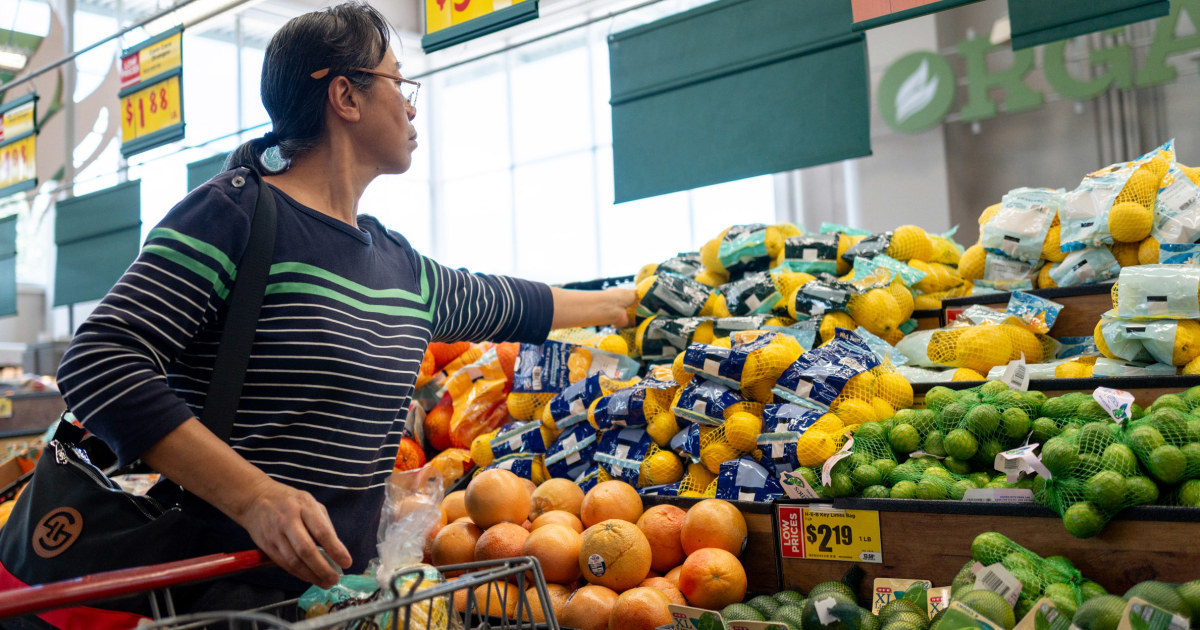
After weeks of warnings that the Iran war would drive up U.S. food prices, the numbers are finally in: According to data released Tuesday by the Bureau of Labor Statistics, the category it calls “food at home,” otherwise known as your grocery store bill, rose 0.7% in April. That increase marked the biggest one-month jump in grocery prices in nearly four years.
Subscribe to read this story ad-free
Get unlimited access to ad-free articles and exclusive content.

Overall, grocery store prices have risen 2.9% over the past year — an across-the-board jump that continues to pressure everyday Americans.
But that pressure increased significantly in recent weeks. In March, food at home prices actually fell by 0.2%, making April’s stark reversal all the more significant.
Driving that increase were substantial price hikes for things like fresh veggies. On an annualized basis, fresh vegetable prices are more than 44% higher today than they were three months ago.
Other basic necessities like bread and milk have risen by a more modest 8% and 5% over that same time period, respectively.
And then there is coffee and beef, two categories that are facing price shocks tied both to the Iran war and to factors far beyond the Middle East.
Severe weather in major coffee-producing countries like Brazil and Vietnam has created supply shortages and higher bean costs. Rising shipping costs and strong global demand have added even more upward pressure to prices.
Over the past three months, the price of coffee at the grocery store has been rising at a pace that works out to more than 22% annually.
Similarly, beef and veal prices have surged due to record-low cattle numbers, years of ranchers exiting the business after weak profits, and higher operating costs tied to fuel and energy — particularly diesel, which is essential for farmers to operate their tractors, transport cattle and feed, and operate day to day.
Will Harris, a fourth-generation cattle farmer in Bluffton, Georgia, told NBC News that the price of beef he sells directly to consumers through his farm store, on-site restaurant and online is now about 20% higher than it was just two years ago.
“It’s unprecedented for us,” he said. “This is the first time we’ve ever gone up that much, that fast.”
Harris added he’s concerned about “how much more consumers will continue to pay for beef.”
“I think that I can produce it as cheap as anybody else, but I don’t know where consumers draw their lines,” said Harris.
Encouragingly, consumer spending appears to be holding up, for now.
According to a recent Bank of America report, internal data showed that total credit and debit card spending per household rose 4.8% in April year-over-year, up from 4.3% in March.
But the data also indicated that so-called “K-shaped” economic disparity — where wealthier households play an outsized role in supporting overall spending while lower-income consumers struggle — has been deepening in recent months.
00:36
Inflation hits 3.8%, outpacing wage growth
00:0000:00
And with inflation now running at 3.8% — officially outpacing April’s 3.6% wage growth — economists warn that rising prices for consumer staples will disproportionately impact lower-income Americans.
“The ‘K’ shape in spending and wage growth persists, with higher-income households faring better than other cohorts,” Bank of America economists wrote in the report.
“And we see signs of this particularly with lower- and middle-income households easing back on discretionary spending in April, while their higher-income counterparts continued to power forward.”
Separate research from the Federal Reserve Bank of New York found that a growing K-shaped disparity was visible even within individual categories of spending, like gasoline.
According to the bank’s analysis, higher-income households largely maintained their driving habits in March despite rising fuel prices, while lower-income households cut back consumption more sharply, potentially by driving less, carpooling or using more public transit.
The gap in these consumption trends, according to the analysis, is even larger today than it was during the 2022 energy shock following Russia’s invasion of Ukraine.
Overall, wealthier Americans continue to benefit from record-high stock prices and surging home equity values that have been steadily climbing since the pandemic. But many lower-income households no longer have the post-pandemic supports, like stimulus checks, that helped cushion their budgets during the last energy crisis in 2022.
If this gap continues to widen, the Federal Reserve in Washington could also face an increasingly difficult balancing act. Surging inflation may lead to interest rates that stay higher for longer, in order to prevent the economy from overheating.
But those same elevated borrowing costs would continue to keep the pressure on businesses and consumers already struggling to keep up with rising costs.
For Harris and his cattle farm, rising prices across the supply chain could force him to keep retail prices elevated in the months ahead, in order to make ends meet.
“Things are just different now, and we don’t quite know how this is going to work out,” he said. “It’s new territory for us.”