
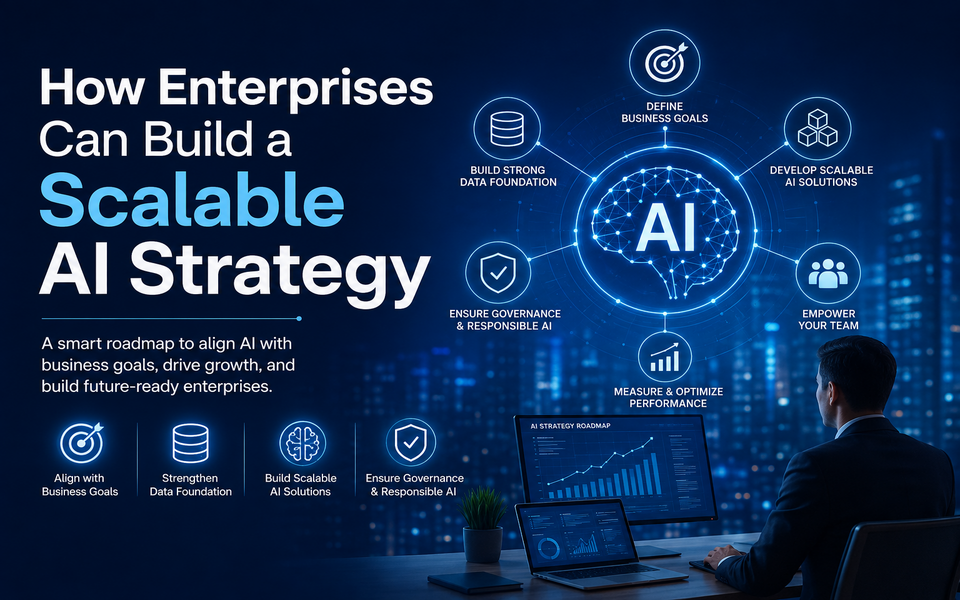
AI has evolved from a fledgling tech to a business asset. By 2026, the question is no longer “should enterprises adopt AI”, but rather “how”. By 2026, the question isn’t so much “should enterprises adopt AI”, as much as “how”. They want to know how to scale it, integrate it with current systems, risk manage it and measure business value. This is where an effective Enterprise AI Strategy is crucial.
A scalable AI strategy is more than just adopting AI tools or exploring generative AI. It demands a clear vision of business goals, data, technology infrastructure, security, employees’ competences and future governance of AI. AI can be leveraged strategically by enterprises to boost operational efficiency, streamline the decision-making process, enhance customer experiences, and uncover new growth opportunities.
What is an Enterprise AI Strategy?
An Enterprise AI Strategy is a blueprint that outlines the organization’s plans for leveraging artificial intelligence to meet its business objectives. It sets priorities for the use of AI, pinpoints beneficial applications, outlines the technology and data needs, and sets a standard for responsible implementation.
AI should not be a technology project, but part of a company’s digital transformation initiative. Whether it’s streamlining repetitive tasks, enhancing forecasting, optimizing supply chains, boosting cybersecurity or creating more personalized customer experiences, AI should help in real business results.
In 2026, the emphasis is on increasingly interconnected and scalable AI capabilities that can be applied in different departments and business functions.
Start With Business Goals, Not AI Tools
The first and foremost rule of an effective Enterprise AI Strategy is to choose a business problem, rather than an AI technology.
Businesses need to pinpoint problem-solving opportunities or quantifiable value that can be achieved by AI. For instance, a manufacturing business might employ AI for predictive maintenance and production efficiency, while a retailer could leverage it for demand forecasting and intelligent inventory management, and customer relationships.
Before deciding on a model, platform, or application, it is important to have a clear objective. There is a need for enterprises to be aware of what they want to improve, how they will know when they succeeded, and how they will benefit their business from the AI.
This will help keep companies from engaging in AI investment just because it’s a hot topic. It also simplifies the prioritization of projects based on their potential value, feasibility and strategic importance.
Identify and Prioritize the Right AI Use Cases
Not all business processes require AI. For enterprises to do so, they must be careful with their use cases and channel resources toward areas that will be able to provide sustainable value.
One of the first steps that an organization can take is to look at their workflows, customer interactions, operational processes, and data-driven decisions. AI can offer some great opportunities for implementation when it comes to high-volume repetitive tasks, complex decision making processes, forecasting tasks and when a significant amount of structured or unstructured data is involved.
Other factors to consider when implementing include ease of implementation, data availability, requirements for integration, security concerns, and ROI. Organizations can show value and instill confidence in AI before they scale up to enterprise-wide use, by starting with practical use cases.
Build a Strong Data Foundation
Reliability and accessibility of data are key to the success of AI. Without a complete, consistent, timely, and well-organized enterprise data set, even the most sophisticated AI models can fall short in providing valuable insights.
So, to create a scalable Enterprise AI Strategy, it will be crucial that organizations boost their data foundation. This involves enhancing data quality, ensuring data is shared across various business systems, defining access rules, and defining data governance.
Data from various sources in an enterprise like ERP, CRM, supply chain, finance, customer service, data from IoT etc. may need to be linked for operations. Data is easier to use for AI applications and scale across departments with a unified and well-governed data environment.
Create an AI-Ready Technology Architecture
To ensure scalability, an architecture must be designed to accommodate the growing adoption of AI applications. Before implementing extensive AI solutions, companies should assess their current platforms, business applications, APIs, data, and compute infrastructure to determine their suitability.
Cloud platforms can offer flexible compute and storage options, APIs and integration layers can facilitate the interaction between AI applications and current enterprise software. Organizations can also leverage a multi-cloud, on-premises, and hybrid approach as well as security, performance, compliance, and operational needs dictate.
The design should allow for easy integration of new AI features without the need for a complete rearchitecture of the technology infrastructure.The design should enable easy integration of new features of AI without the need for a rearchitecture of technology infrastructure. For enterprises, modularity and interoperability help spread out the use of AI over time, more efficiently.
Prepare for Generative AI and AI Agents
While generative AI is a significant piece of enterprise technology strategies, organizations must be cognizant of it and need to have clearly governed use cases for it.
Generative AI can be applied within enterprises to assist with content generation, knowledge management, document analysis, software development, customer service, support, and other business processes. AI agents can take this a step further by communicating with and interacting with enterprise systems and completing compound tasks and workflows in response to a set of given goals.
These technologies, though, need more than just integrating an AI model with a company’s data to be scaled. It is essential that enterprises have suitable access controls, monitoring, testing, human oversight and protection against incorrect or unauthorized outputs.
The aim is to develop helpful, reliable AI systems, defined within the business context.
Establish AI Governance and Security
Along the way, Governance becomes an integral part of an Enterprise AI Strategy as AI gets integrated into critical business processes.
There are policies that need to be addressed by the organizations – data usage, model selection, access permissions, privacy, security, monitoring, and accountability. Reliability, bias, security vulnerabilities, and adherence to relevant regulations should be assessed for AI systems.
Customer data, financial information, intellectual property, and operational systems are especially sensitive areas when dealing with AI applications. Companies should manage who can access AI tools and what information AI tools can access and manipulate.
Build AI Skills Across the Organization
AI transformation isn’t possible without technology. It also requires individuals who grasp the potential and ethical implications of AI use, and can apply it effectively in business.
AI engineers, data scientists, cloud experts, software developers, cybersecurity experts, data engineers, and AI product managers might be needed by organizations. In parallel, non-technical teams must have the necessary AI literacy to grasp the impact of the new tools on their work.
AI can be effectively implemented through training and collaboration, which can help alleviate change resistance among employees. The best AI strategies involve employees as change agents, not just a tool to implement new technology.
Measure AI Performance and Business Value
A scalable plan must have quantifiable results. Before investing in AI solutions, enterprises should define metrics to track and continually assess if the AI is delivering results.
Organizations can quantify the impact across a range of distinct use-cases, from processing time and operational costs to customer satisfaction, revenue, forecasting accuracy, productivity, error rates, to employee efficiency.
Post-deployment monitoring of AI performance is a must. Business dynamics, data trends and user behavior can shift, altering the effectiveness of models and AI applications. An ongoing assessment process can help companies detect issues and enhance systems as they go.
Scale AI Through a Phased Approach
Businesses should not try to do it all at once in all departments. A staged strategy can lead to a more gradual progression of enterprise-wide AI adoption.
Organizations can start the process with strategically chosen high-value use cases, establish needed data and technology foundations, quantify results, and learn from the initial project to enhance subsequent ones.
After the successful patterns have been set, AI can be applied to further departments and processes. This establishes a scalable framework for AI, instead of handling each AI project as an entirely new project.
The Future of Enterprise AI in 2026 and Beyond
The use of AI is increasingly being integrated into enterprise operations. AI-powered workflows, where smart systems can interpret data, make recommendations, make decisions, and help employees in various business processes.
Not every enterprise that integrates the maximum number of AI tools will be the best to benefit from it. They will be the ones to establish a clear plan of how to align AI with objectives, data, technology, people and governance.
As such, an effective Enterprise AI Strategy must be seen as a growing capability in the business and not just a single technology initiative. To keep up with AI advancements and enhance their use cases, enterprises must constantly assess the latest technology, fortify their systems, and improve their governance frameworks.
Conclusion
The following are the key elements of a balanced approach to achieve a scalable Enterprise AI Strategy in 2026: technology, business priorities, data, security, people, and governance. Business problems need to be meaningful, a stable data layer is essential, an AI ready architecture should be developed, appropriate skills need to be invested in and a good governance framework must be put in place from the outset.
A gradual and measurable approach allows enterprises to transition from using AI in isolated pockets of their businesses and develop comprehensive capabilities that can drive future efficiency, innovation, and growth.













Leave a Reply