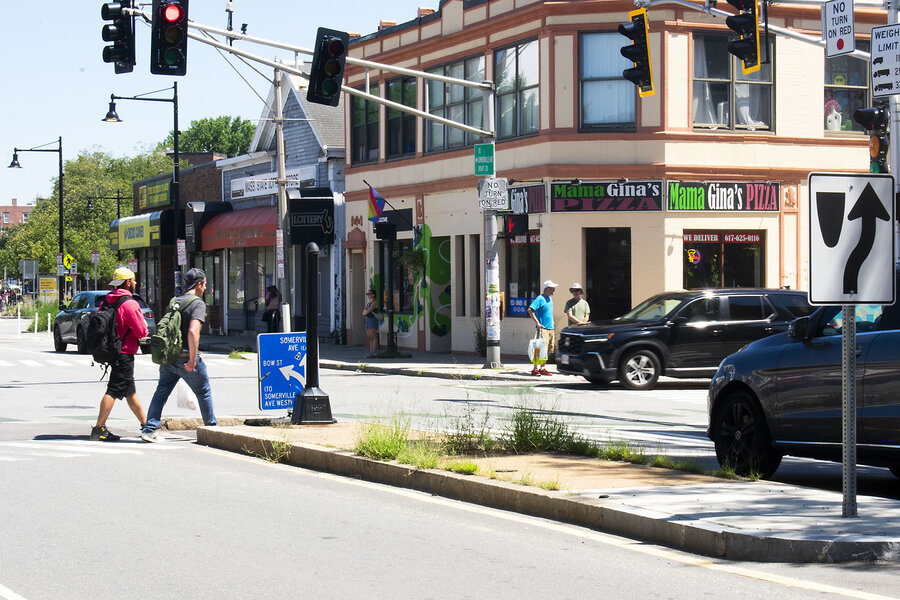
Alessandra Seiter avoids driving. She doesn’t enjoy it, and concedes to not being very good at it. Seiter rides her bike to her job as a librarian at Harvard University’s Kennedy School, and walks everywhere else.
That isn’t a risky lifestyle for Seiter to lead in Somerville. This densely populated Boston suburb has recently been on a streak: It’s gone three years without a traffic death, making it a prime example of what can go right in road safety.
“I’m not surprised to see Somerville really stand out as a traffic safety leader,” says Leah Shahum, founder and executive director of the Vision Zero Network, a national nonprofit that works to eliminate traffic deaths. “They’ve had really consistent and strong leadership in terms of really prioritizing safety over speed.”
Why We Wrote This
The United States struggles with traffic safety in comparison with the track records of other developed nations. There are some bright spots, such as the city of Somerville, Massachusetts, where use of road safety tools and community engagement has brought success.
Although traffic deaths in the United States have declined after surging during the pandemic, American streets remain hazardous. Some 36,640 people died on the road in 2025, according to government data. That’s about 100 people per day, and 12% higher than the country’s best year, 2014. The U.S. performs poorly compared with other developed nations, recording 12.2 deaths per 100,000 people in 2023. Only two other surveyed countries fared worse that year, according to the International Transport Forum.
Few places have had more success bucking those trends than Somerville. For roughly a decade, officials in this city of 81,000 people have focused on reducing car speeds, both by lowering limits and improving infrastructure. And it’s done so, proponents say, with a commitment to community engagement and working with volunteer residents to flag safety problems.
The city’s solutions are neither groundbreaking nor flashy. But they’ve worked. Last year, Somerville reported a 50% decline in car crashes causing serious injury, and crashes overall have decreased every year since 2022. Everything the city has done, transit activists say, can be replicated elsewhere.
“They are not using some magic toolbox in Somerville,” Ms. Shahum says. “They are really leaning into and committing to road safety tools that work best, and so many places could be doing that.”
Setting a vision and sticking with it
In 2017, Somerville – following in the footsteps of neighboring Boston and Cambridge – committed to “Vision Zero,” an international road safety initiative holding that smartly designed infrastructure can prevent all traffic deaths. The idea started in Sweden in 1997 and has since spread around the world. More than 70 other U.S. cities, including Savannah, Georgia; New York; and Portland, Oregon, have made a Vision Zero commitment, according to Vision Zero Network.
“We as humans do not have to accept the status quo that people lose their lives on the street,” says Brad Rawson, who has worked as Somerville’s chief transportation official for more than a decade.

Cameron Pugh /The Christian Science Monitor
Yet the city was eyeing safer streets even before Vision Zero. In 2006, a Massachusetts Highway Department report found the city had the most accident-prone intersection in the state. In 2016, Somerville lowered speed limits on most roads from 30 mph to 25 mph, taking advantage of a recently passed state law allowing lower speed limits in certain areas. Since then, the city has created more than 500 “safety zones” where the speed limit is 20 mph, according to a report by LiveableStreets.
Vision Zero, though, is about more than legal limits. Road infrastructure, proponents say, must encourage lower speeds – and accommodate human error. To that end, Somerville has made hundreds of changes to create what Mr. Rawson calls “physical traffic calming.” In 2025, Somerville installed more than 70 such upgrades.
Of those features, the speed hump has reigned supreme. Since 2019, the city has installed 139 of them. (Drivers can comfortably ride over these gradual mounds of raised road at about 15 mph – faster than they can traverse the steeper and taller speed bumps, which slow vehicles to a near halt and tend to be better suited for parking lots than roadways.)
“Speed humps work. They really work,” says Peter Furth, a professor of civil and environmental engineering at Northeastern University.

Cameron Pugh /The Christian Science Monitor
Data backs that up. On Laurel Street, a short residential thoroughfare, speeds fell from between 25 to 30 mph to less than 20 mph after speed humps were added. The number of vehicles hitting pedestrians has dropped citywide for years: Somerville reported 26 such collisions in 2025, compared to 40 in 2013. Fewer cyclists are being hit, too: falling from more than 60 in 2013 to 36 last year.
Other traffic-calming features included raised crosswalks, which can lower vehicle speeds and reduce the risk of someone getting hit by 45%, according to the Federal Highway Administration. Curb extensions – where curbs at intersections protrude into the street to shorten crosswalks – have also proven popular in Somerville.
Other cities have seen success using similar tools. Hoboken, New Jersey, just over the river from New York City, has gone nine years without a traffic fatality.
To Seiter, the librarian, what sets Somerville apart is its commitment to meeting residents where they are. As chair of the Pedestrian and Transit Advisory Committee, Seiter hosts community walks around areas slated for new infrastructure so that residents can ask questions and make recommendations.
“What I see Somerville doing differently is recognizing that infrastructure is not going to be successful unless it is really meeting the needs of community members on the ground,” Seiter says.