
Today, the discovery paradigm is undergoing a fundamental shift as consumers increasingly turn to conversational AI platforms like ChatGPT, Gemini, and Perplexity for instant, synthesised recommendations. This transition has given rise to an entirely new visibility layer, one where brand presence is defined not by keywords and backlinks, but by how AI engines evaluate, cite, and recommend companies in real-time responses.
At the forefront of this shift is OptimizeGEO.AI, an early pioneer in Generative Engine Optimization (GEO), the company builds tools to help brands understand, track, and optimize their presence across the emerging answer economy.
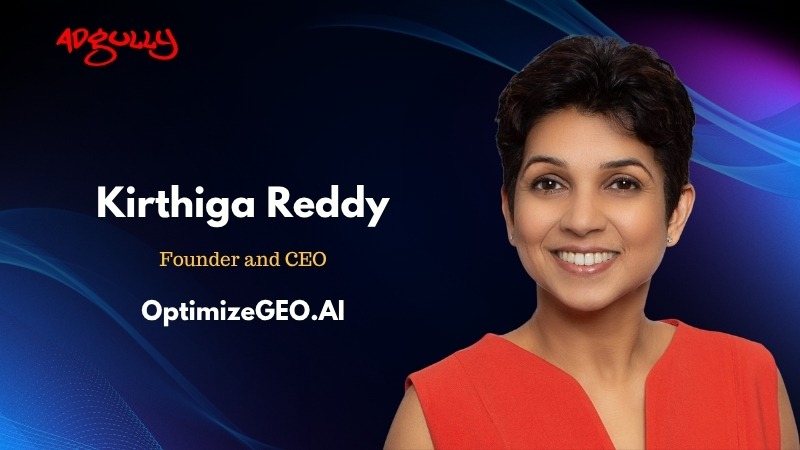
In conversation with Adgully, Kirthiga Reddy, Founder and CEO, OptimizeGEO, outlines how companies must re-architect their content strategies, why trust and community discussions dictate AI citations, how marketing teams can quantify their AI Share of Voice in an AI-first world and much more.
Edited excerpts…

As discovery transitions from traditional search engine results to AI-generated answers, how must brands fundamentally re-architect their content strategies to ensure they are cited by AI models?
Content remains a central pillar for visibility in AI answers. Web pages must be structured with clean, machine-readable, factual content rather than dense prose. For example, clients set up autonomous growth loops using our platform to understand user search intent and auto-generate content. We integrate a human-in-the-loop workflow alongside governance and brand tone frameworks, ensuring output remains uniquely customised for each brand before passing through an approval process. Once published to the content management system (CMS), this forms an autonomous growth loop like analysing user queries, developing structured content, integrating it with the CMS, and ensuring those answers get picked up in AI search.
Additionally, companies must invest heavily in both owned media and community efforts. On average, Large Language Models (LLMs) extract only 5% to 10% of their answers directly from a brand’s website. They also factor in user forum discussions, creator conversations, PR strategies, and broader media coverage. Maintaining a deliberate, consistent content strategy across the entire marketing mix is essential in this evolving landscape.
As AI developers like Anthropic and OpenAI implement digital watermarking and provenance tracking to identify AI-generated content, how will these technical standards influence SEO/GEO rankings and brand credibility?
These standards are crucial for helping users identify whether content is human-generated or AI-generated, as well as the extent of AI involvement. However, these mechanisms function separately from what influences AI search results. Platforms like Google have specifically stated that watermarking is not taken into account when evaluating available web content to answer a user query, whether it concerns skincare, logistics providers, or insurance products. While this may evolve, digital watermarking and search indexing currently remain distinct efforts.
With AI-generated filler content flooding the web, how are search platforms and AI models adjusting their algorithms to reward original reporting and expertise over low-quality, automated text?
LLMs heavily reward consistency and clarity when determining which brand, product, or service gets cited. Models prioritise content that directly addresses a precise user prompt, such as identifying the best CRM system for a mid-sized fintech company. Search has become pluralized: an answer no longer stems from a single set of Google search results, but rather from an amalgamation of owned content, creative strategy, user forums, and paid media.

How can consumer-facing brands leverage digital watermarking, human-curated content, and verified brand assets to signal authenticity and stand out in an ecosystem increasingly saturated with synthetic media?
This principle applies to both B2C and B2B segments. A recent CIO study indicated that 80% of B2B purchase decisions are now informed by AI search. Building user trust through authentic content is key to distinguishing real content from synthetic media. While authentic content does not have a direct, mathematical correlation with AI search rankings, it acts as a derivative driver: it shapes user trust, opinions, and conversations across platforms like Instagram, TikTok, and user forums, which AI models subsequently process to determine search visibility.
As Generative Engine Optimization matures, what measures will prevent AI answer engines from prioritizing paid brand integrations or biased recommendation loops over objective, accurate search answers?
AI platforms maintain that paid media will not dictate organic results. This creates a significant opportunity for challenger brands to leverage Generative Engine Optimization (GEO) strategies to outpace industry incumbents. Simultaneously, incumbent brands must adopt a challenger mindset to defend their market position in this new paradigm.
With industry bodies like the MMA collaborating on events around GEO, what standardization framework should Indian media and advertising ecosystems adopt to quantify AI search share-of-voice?
Brands must expand beyond traditional metrics and adopt AI Share of Voice to track their position relative to competitors in AI search results, taking several deep dives into the data. Visibility scores vary across platforms like ChatGPT, Gemini, and Claude, requiring brands to track performance where their target audience is most active. With the search funnel compressing single-interaction queries into purchase decisions, brands with high awareness scores often experience sharp drop-offs when moving into evaluation and decision phases.
Tracking at the query level uncovers hidden gaps. For instance, a leading baby skincare brand with high overall AI visibility discovered its presence on safety-related queries was exceptionally low, signaling a need to adjust its creative, media, and PR strategy. Citation frequency acts as a primary leading indicator that precedes broader growth in AI visibility and share-of-voice scores.
In our study around the Indian Premier League (IPL), we found that spending heavily on media without a parallel AI visibility strategy is far less effective than executing both in tandem. Paid media buys reach and attention, but it does not guarantee a presence in AI-generated answers.

How do you see the future of Generative Engine Optimization?
Generative Engine Optimization initially highlights current metrics, performance gaps, and necessary adjustments. The next wave of innovation centers on developing execution platforms and AI agents that act as extensions of lean marketing and agency teams to implement these recommendations rapidly.
For example, one of our clients transformed its workflows from static reporting into an active execution pipeline running its content operations. Similarly, with e-commerce brands, we help decode search queries to deploy content rapidly. As adoption cycles compress from quarters to weeks and days, execution agents bridge the gap between awareness and action with necessary urgency.




Leave a Reply