In the 1830s, a group of white settlers stood chatting by a well here when a stranger approached. The group offered the man a drink. Grateful, he noted: “This is quite a social circle.”
Now, this community of just more than 5,000 outside Atlanta, appropriately named Social Circle, is seeing its tradition of hospitality challenged once again. Up to 10,000 immigrant detainees, seized by the Department of Homeland Security, are expected to be housed in an industrial building here. It was recently bought by the federal government for $129 million as part of the Trump administration’s immigration enforcement campaign.
Since January 2025, Immigration and Customs Enforcement says it has arrested almost 400,000 people. As of early April, the agency says it is holding more than 60,000 people in detention, more than 70% of whom have no criminal convictions. By late 2025, the administration was using some 100 additional detention facilities across 50 states and territories to house the thousands of people it had rounded up. Those include local jails where ICE rents beds for detainee use.
Why We Wrote This
Democrat-led cities protested ICE arrests. Now, conservative towns sited for massive immigration detention centers are also pushing back, pointing out infrastructure and budget strains and exposing a rift between federal enforcement and local concerns.
Though more than three-quarters of Georgia voters who said immigration was their top issue voted for Donald Trump in 2024, many residents are not welcoming the detention centers or the complications surrounding them. Pushback against the potential for such a center in Social Circle has been swift and overwhelming, say local officials.
The outcry here reflects growing opposition to the siting of some 20 new such detention facilities in rural or suburban areas already stressed by local utilities’ ability to take on additional service.
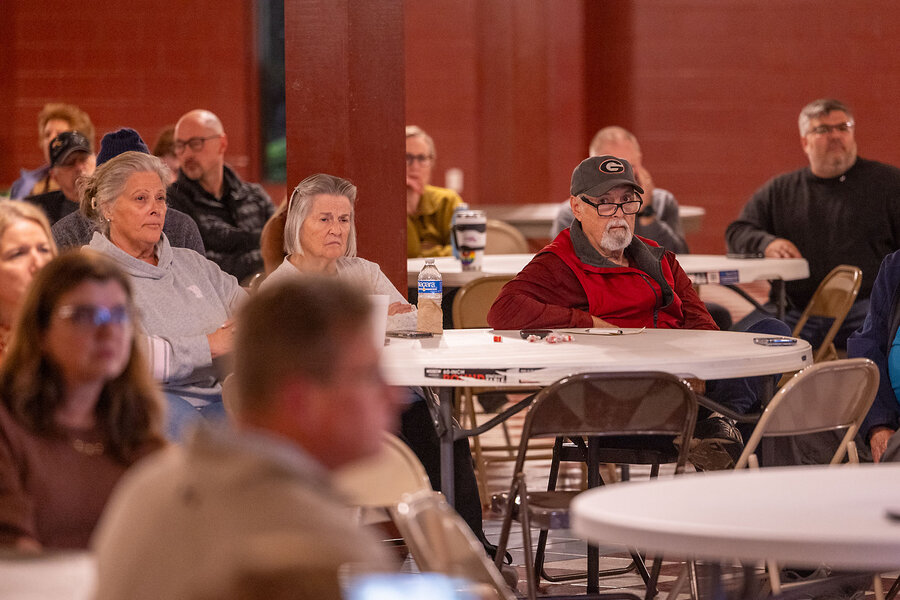
In town, opposition has taken the form of prayer vigils and heated town-hall meetings. Local leaders, who argue that the communities don’t have the infrastructure to support the detention centers, say they have tried to get answers from the Trump administration but have received none.
“People who came out have told me, ‘I don’t want to go to protests, but I do want to pray,’” says the Rev. Dallas Anne Thompson, a Presbyterian minister who led prayer vigils outside a planned facility in Oakwood, just north of Social Circle.
Deportation opposition tactics seen in Democratic-controlled cities such as Chicago and Minneapolis are now being mirrored in conservative ones, from small towns like Merrimack, New Hampshire, to the industrial outskirts of places like Salt Lake City or Phoenix. Many of these protests are happening in the South, where a large percentage of the arrests are occurring, and where the mega-jails will be located.
The opposition often focuses on infrastructure limitations. Here in Social Circle, for example, a historic railroad town, the town manager clicked a padlock on the water meter until DHS explained in detail where its project’s water demand would be sourced.
But as the vigil campaign led by Ms. Thompson points out, many residents have deeper concerns about facility conditions, quality-of-life impacts, and even reputational and moral costs of being associated with a mass deportation enterprise.
“They’re saying, ‘I want our community to be safe, but this is not the way to do it,’” the minister says.
Short end of the stick
The promise of new jobs to support the detention facilities, or more customers for local businesses, is not enough to prevent pushback. Residents argue that immigrant detention is a big business that often benefits outsiders – private equity firms and corporations – not local schools or community centers.
Several deportation center efforts have been scrapped after public outcries. Republican Sen. Roger Wicker fought behind the scenes to nix plans for a facility in rural Byhalia, Mississippi. Another one in New Hampshire was abandoned after Gov. Kelly Ayotte, also a Republican, intervened. GOP city leaders in Roxbury Township, New Jersey, have joined state officials in a suit against DHS over a planned detention center there.
Where to put the detention centers has become a quandary for the federal government.
These immigration policies “have to play out somewhere,” says Andrea Pitzer, the author of “One Long Night,” about the global history of civilian detention camps. “What is happening now is that people are having to decide not only who they want for president or senator, but what kind of community they want to live in?”
Why the push for detention centers?
While getting the detention centers sorted out is proving messy, the Trump administration’s deportation campaign is proceeding.
The number of detained immigrants has risen from 37,000 at the end of fiscal year 2024 to more than 60,000 as of early April, as street arrests of people suspected of immigration violations have surged. Deportations rose fivefold during the current Trump administration’s first year, in part because of expanded arrests, increased detention capacity, and fewer releases. It also got harder for detainees to get released on bond before their hearings, according to a study this month by the Deportation Data Project.
To manage more interior enforcement, the United States has invested $45 billion in a flexible “hub-and-spoke” detention network. Several warehouses have already been bought, including those here in Georgia. ICE says it’s renovating the warehouses to meet detention standards.

“These detention centers are pivotal to the federal government’s immigration law enforcement efforts,’’ says César García Hernández, the author of “Migrating to Prison” and a law professor at Ohio State University. “Whoever they arrest has to go somewhere.’’
He adds: “Without [the centers], the work of arresting folks runs into a brick wall.”
Towns say a lack of communication from the federal government has been part of the problem. Social Circle officials said that they invited federal officials to a hearing on the project, but none showed up.
Just north of Social Circle, the town of Oakwood was blindsided earlier this year when a local reporter asked the town manager about plans for a new detention center to house 1,500 people. Officials said they knew nothing about it until that point.
A spokesperson for U.S. Rep. Andrew Clyde, whose district includes Oakwood, did not directly respond to the Monitor’s questions about local complaints but pointed to a statement in which Mr. Clyde said that ICE found “no detrimental effect” of putting a facility in Hall County.
“I fully support President Trump in protecting American citizens by detaining and deporting criminal illegals from our communities,” Mr. Clyde said. “The new Oakwood ICE facility will play an important role in this fight … [and] the forthcoming facility will also bring a major economic investment to the city of Oakwood and … surrounding communities. I am confident that the Oakwood ICE … facility will be a safe and prosperous addition to the Ninth District.”
A help, or a hit, to town coffers?
The government, through DHS, bought the Oakwood facility in February from real estate investors for $68 million, at least 13% above market value.
Because the Constitution bars communities from taxing federal agencies, that property will now be removed from the town’s tax rolls. Given its assessed value, it would have generated at least $300,000 in annual property taxes, used to help pay for police and fire protection, road repairs, and public schools and parks.
The town says its frustration is not just about lost tax revenue. If the detention center opens, Oakwood will also have to pay $12 million in fees to expand the facility’s access to a local wastewater treatment plant. The town’s entire annual budget is $10 million.
B.R. White, Oakwood’s city manager, describes the Trump administration’s promises that the detention centers will yield economic benefits as “voodoo economics.” Despite Republican lawmakers’ assurances that plans would involve local input, “it’s been a one-way street so far,” he says. “They shoved it down our throats, basically.”
The detention center site here is ringed on three sides by residential neighborhoods, which Mr. White says likely means those property values will depreciate and homeowners will have a “diminished quality of life.” Moreover, 30% of Oakwood’s residents are Hispanic, and many work in the region’s sprawling poultry plants. “These are our friends, our neighbors, our co-workers, and they are scared, absolutely scared,” says Mr. White.
“What people here have said is, ‘We don’t have a problem with securing the border, but it’s the means by which people are being rounded up and branded criminals … for minor offenses,’” that is troubling, he adds. “The question now is, do the means justify the ends?”
Pushback
In Democratic-led states, state attorneys general have joined the fight against the facilities.
But in Trump-friendly Georgia, towns such as Social Circle and Oakwood are largely left to defend themselves, says Rusi Patel, general counsel for the Georgia Municipal Association in Atlanta. That leaves town leaders to walk a tightrope: They have to object by focusing on tax impacts and infrastructure limitations, not the deportation campaign’s merits.
So far, new DHS Secretary Markwayne Mullin has paused 11 projects, reportedly to address local backlash. Work on the warehouses in Social Circle and Oakwood appears to have slowed, local officials say. During his confirmation hearing, Mr. Mullin said he would be more attuned to local concerns as he reviews policies under former DHS chief Kristi Noem, whose firing was made public by Mr. Trump on March 5.

Patrik Jonsson/The Christian Science Monitor
The pause shows that “a lot of people who want a secure border and less illegal immigration are uncomfortable with heavy-handedness,” says Joshua Kennedy, a political scientist at Georgia Southern University in Statesboro. “There are plenty of people who voted for Trump who are saying, ‘Well, this is a little much. There’s got to be a better way to handle this.’”
Ms. Thompson, the Presbyterian minister, grew up in Hall County, outside Oakwood. She says that immigration policy had never been on her radar. Her independent research into the current deportation moves revealed what she calls “inhumane conditions” for detainees, especially those without criminal records.
”In the South, we have what I call the radical welcome of, ‘You’re new here, glad you’re here, let me show you a good seat up front,’” she says. “So, when we see policies that roll out that actively hurt people, it starts to change how you feel about those policies.”
Gregg Poole, a Republican Hall County commissioner running against Mr. Clyde in Georgia’s 9th Congressional District, says on his website that, if elected, he would “stand with President Trump to secure the border.”
But not necessarily on where to put detainees. In an interview, he notes there is a women’s prison closing in a nearby county that could be another option for where to put people detained by immigration enforcement, reflecting the broader sense that the projects present far more problems than benefits for local communities.
“They have not finished mission one, which is to get rid of criminal aspects, gang bangers, child sex traffickers. … So, why go to mission two when mission one is not complete?” says Mr. Poole, a Baptist preacher. “For them to impose this on me without knowing the economic impact is insane. I voted for Trump three times, but when you get my yes vote, you also get my criticism.”